

Best for flexible treatment adjustments: testosterone injections. Best for avoiding needles: topical testosterone gel. Best for avoiding daily administration: testosterone pellets. With TRT delivery methods compared, the right choice depends on your diagnosis, fertility plans, safety risks and ability to follow the treatment routine—not a universal winner.
- Testosterone injections suit men comfortable with needles who want a treatment their prescriber can adjust.
- Topical testosterone gel avoids needles but requires daily use and precautions against skin transfer.
- Testosterone pellets reduce daily administration but require a procedure and are harder to adjust.
- Bainshealth offers personalized TRT consultations; prescribing decisions depend on symptoms, laboratory results and individual risks.
Why this matters
Testosterone replacement therapy, or TRT, treats appropriately diagnosed testosterone deficiency. It is not a general treatment for fatigue, weight gain or getting older. Those symptoms have other causes, including sleep disorders, medication effects and thyroid disease.
In 2026, choosing a delivery method still comes after confirming that treatment is appropriate. Clinical guidelines recommend compatible symptoms and consistently low testosterone, generally confirmed with 2 separate morning blood tests. Your clinician also evaluates why testosterone is low.
Bainshealth is best for men seeking personalized TRT care with continuity from the same provider. You can discuss your symptoms, treatment preferences and follow-up needs through Bainshealth. Prospective patients in California and Oregon should confirm appointment and prescribing arrangements for their location.
What makes the best TRT delivery method?
The best testosterone delivery method is the one you can use correctly while your clinician monitors its effectiveness and safety. Rank the options against these criteria:
- Adjustability: How easily can your prescriber change or stop treatment if symptoms, laboratory results or side effects require it?
- Routine fit: Can you reliably manage injections, daily application, repeated nasal administration or procedure appointments?
- Exposure precautions: Does your household include children or others who could contact testosterone applied to your skin?
- Procedure burden: Are you comfortable with needles, an insertion procedure or a recurring medication routine?
- Medical suitability: Do your fertility plans, blood count, blood pressure, sleep history or other conditions affect the choice?
- Total treatment commitment: What monitoring, appointments, supplies and medication expenses will you pay directly?
No route eliminates the need for follow-up. Convenience matters, but it does not replace a confirmed diagnosis or ongoing clinical assessment.
TRT delivery methods at a glance in 2026
This ranking separates practical use cases rather than claiming that one route produces better results for every man. Each option has limitations that belong in the decision.
| Delivery method | Best for | Standout feature | Key limitation |
|---|---|---|---|
| Testosterone injections | Men comfortable with needles who prioritize adjustability | Prescriber can change subsequent treatment | Needle use and possible testosterone fluctuations |
| Topical testosterone gel | Men who want needle-free daily treatment | Application without an injection or insertion procedure | Skin-transfer precautions and daily adherence |
| Testosterone pellets | Men who want fewer administration tasks | Medication releases from pellets placed under the skin | Procedure required; changes are less straightforward |
| Oral testosterone undecanoate | Men who prefer swallowing medication | Avoids skin application and needles | Product-specific instructions and blood-pressure monitoring |
| Intranasal testosterone gel | Men who prefer a nasal route | Avoids application to exposed body skin | Repeated daily administration and nasal irritation |
These are general treatment categories, not a list of treatments offered by Bainshealth. Your consultation determines which formulation, if any, fits your medical needs.
1. Testosterone injections: best TRT for treatment adjustability
Testosterone injections deliver medication into muscle or under the skin, depending on the prescribed formulation. Your clinician determines the appropriate product, route and administration plan. Do not assume that different injectable products are interchangeable.
Injections are a practical starting point for discussion when you are comfortable with needles and want treatment that can be adjusted through subsequent prescriptions. Blood-test timing matters because testosterone levels can change between injections.
Testosterone injection pros:
- Subsequent treatment can be adjusted without removing an implanted medication.
- No testosterone is left on exposed skin for another person to touch.
- Administration does not depend on remembering a daily skin application.
- Some prescribed products support self-administration after appropriate training.
Testosterone injection cons:
- Needles, injection discomfort and correct technique are part of treatment.
- Certain formulations produce peaks and troughs that complicate symptom assessment.
- Testosterone therapy can raise hematocrit, making blood-count monitoring essential.
Best for: Men comfortable with needle use who want flexibility in their prescribed treatment.
Verdict: Hold until your prescriber confirms the formulation, route and training. Choose injections for routine fit and adjustability, not because a larger amount of testosterone promises a better result.
2. Topical testosterone gel: best TRT for avoiding needles
Topical testosterone gel delivers testosterone through the skin. Application sites and handling instructions depend on the specific product. You need to follow that product's instructions rather than treating all gels as equivalent.
The main practical trade-off is household exposure. Testosterone can transfer from an application site to another person, so handwashing, covering the site and following contact precautions are part of treatment—not optional extras.
Topical testosterone gel pros:
- Avoids needles and an implantation procedure.
- Fits a consistent daily routine.
- Treatment changes do not require a pellet-removal procedure.
Topical testosterone gel cons:
- Skin-transfer risk requires precautions around partners and children.
- Absorption varies, so laboratory monitoring remains necessary.
- Skin irritation and daily application can make adherence difficult.
Best for: Men who prefer needle-free treatment and can reliably follow application and transfer precautions.
Verdict: Hold until you understand the product's contact precautions. Gel is a sensible discussion option when avoiding needles matters more than avoiding a daily task.
3. Testosterone pellets: best TRT for fewer daily tasks
Testosterone pellets are placed under the skin during a clinical procedure. They release testosterone over an extended period, reducing the need for daily application or repeated self-administered injections.
That convenience comes with less immediate flexibility. Once pellets are inserted, changing exposure is not as straightforward as changing the next application or injection. Discuss this trade-off before committing to a procedure.
Testosterone pellet pros:
- No daily medication-application task.
- No testosterone on exposed skin requiring transfer precautions.
- Administration happens through a clinician-performed procedure.
Testosterone pellet cons:
- Insertion carries risks including bleeding, infection and pellet extrusion.
- Treatment changes are less straightforward after insertion.
- Continuing treatment requires further procedure appointments.
Best for: Men who prioritize fewer administration tasks and accept the procedural commitment.
Verdict: Hold until the insertion risks and adjustment limits are clear. Pellets belong on your shortlist when convenience outweighs the need for easy treatment changes.
4. Oral testosterone undecanoate: best TRT for a pill-based routine
Oral testosterone undecanoate is a prescription testosterone formulation taken by mouth. It is not the same as a supplement marketed as a testosterone booster. Product-specific instructions determine how it must be taken.
Avoid assuming that oral treatment is simpler medically because it resembles other pills. Your prescriber still needs to assess testosterone levels, blood count, blood pressure and treatment response.
Oral testosterone undecanoate pros:
- Avoids injections and pellet insertion.
- Does not create a testosterone skin-transfer risk.
- Fits a medication-taking routine for men who prefer oral treatment.
Oral testosterone undecanoate cons:
- Food instructions and absorption considerations differ between products.
- Blood pressure can increase and requires monitoring.
- Consistent adherence remains necessary despite the familiar delivery route.
Best for: Men who prefer swallowing medication and can follow the prescribed product's requirements.
Verdict: Hold until your clinician reviews blood pressure and product instructions. A pill-based route is a preference, not proof of lower risk.
5. Intranasal testosterone gel: best TRT for a nasal route
Intranasal testosterone gel delivers medication through the lining inside the nose. It avoids applying testosterone to exposed body skin and does not require an injection or insertion procedure.
Its main practical limitation is repeated administration during the day. Nasal symptoms and conditions also matter, so discuss congestion, irritation and other nasal treatments with your prescriber.
Intranasal testosterone gel pros:
- Avoids needles and an implantation procedure.
- Avoids application to exposed skin that others could touch.
- Offers a distinct route for men who dislike body-skin application.
Intranasal testosterone gel cons:
- Repeated daily administration adds an adherence burden.
- Nasal irritation or symptoms can interfere with use.
- Nasal conditions and other nasal medicines require review.
Best for: Men who prefer nasal administration and can maintain the prescribed daily routine.
Verdict: Hold until your clinician reviews nasal suitability and adherence. Choose this route only if the practical routine works for you.
How these TRT methods were ranked
Injections lead this practical ranking for adjustability; gel leads for needle avoidance; pellets lead for reducing daily administration tasks. Oral and nasal formulations address distinct preferences but introduce their own adherence and monitoring requirements.
The ranking does not establish clinical superiority or replace prescribing decisions. In 2026, the appropriate route still depends on your diagnosis, health history, treatment response and the instructions for the specific medication.
What to check before choosing TRT
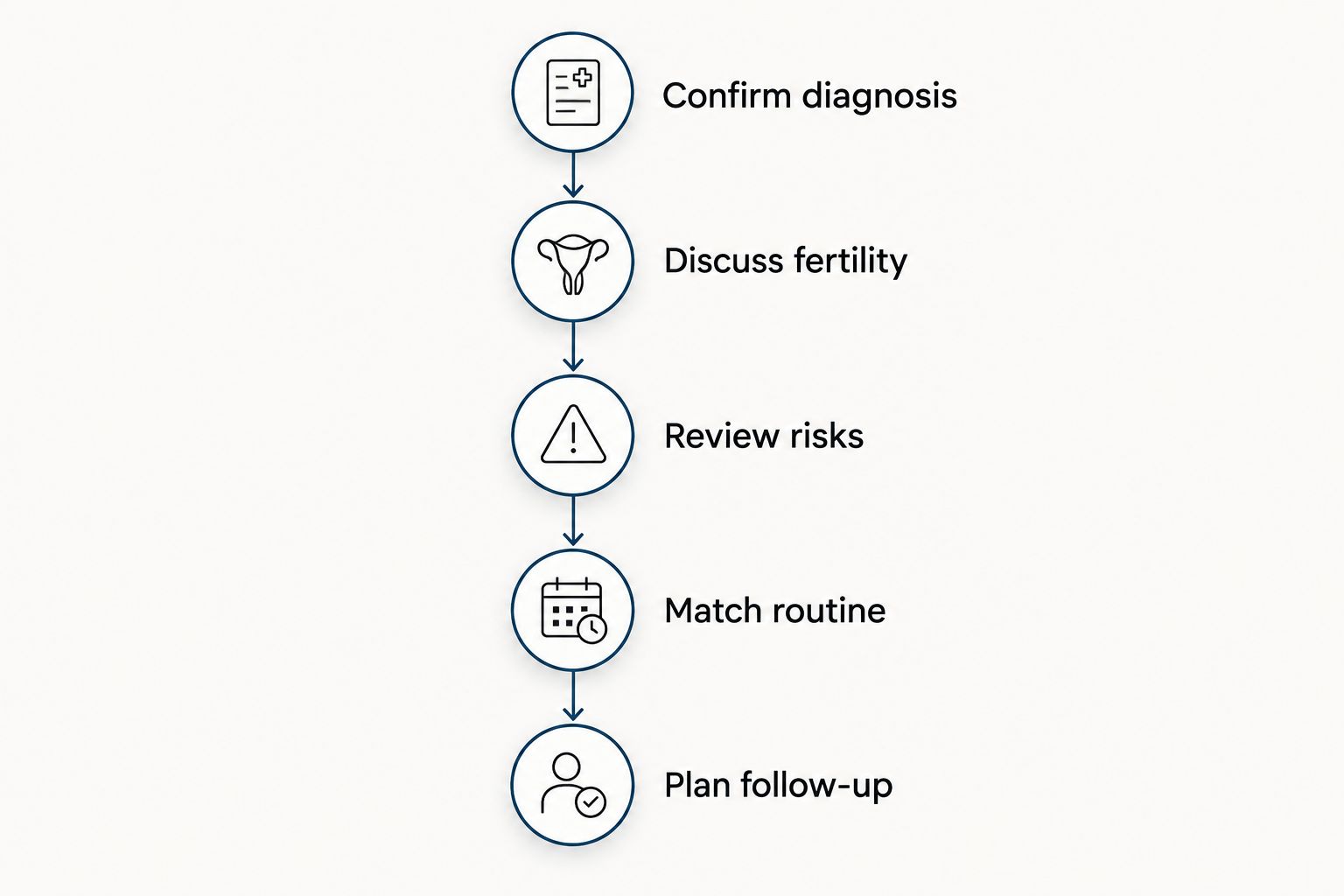
Use this consultation sequence to move from a preferred delivery method to an informed treatment decision:
- Confirm diagnosis: Review symptoms, appropriately timed testosterone testing and potential causes of low levels.
- Discuss fertility: Tell your clinician whether you want children now or in the future. Testosterone treatment can suppress sperm production.
- Review risks: Discuss blood count, blood pressure, sleep apnea, prostate-related concerns and relevant cardiovascular history.
- Match routine: Explain needle preferences, household contact, travel and your ability to follow daily tasks.
- Plan follow-up: Confirm testing, symptom reviews, provider access and directly payable treatment expenses.
TRT is not a fertility treatment. If preserving fertility is a priority, raise it before starting medication rather than waiting for a follow-up visit.
Monitoring belongs in the treatment plan
Clinical guidance commonly includes reassessing testosterone and hematocrit after 3–6 months, with subsequent monitoring based on the treatment and clinical situation. Hematocrit measures how much of your blood consists of red blood cells; an excessive rise requires clinical review.
For stable treatment, hematocrit monitoring generally continues at 12-month intervals. Your clinician can require earlier testing, and testosterone blood draws must be timed for the formulation. These intervals describe general guidance, not a personalized appointment schedule.
In 2026, ask how results will reach your provider and what happens if symptoms persist or side effects develop. New severe symptoms require appropriate medical assessment rather than waiting for a routine TRT appointment.
Self-pay treatment and continuity of care
Bainshealth operates as a self-pay, cash-pay practice. Patients pay the practice directly; do not plan around the practice billing or accepting insurance. Cash-pay describes the billing model, not a requirement to use physical cash.
Ask for a clear explanation of consultation, follow-up, laboratory and medication charges, including which expenses are separate. Transparent pricing means understanding the complete plan before agreeing to treatment, not assuming that a quoted service includes everything.
Bainshealth emphasizes personalized care, continuity with the same provider, direct provider access and convenient appointments. Established patients may see their own provider for minor ailments or work-note requests up to twice a year, when clinically appropriate. This is not unlimited primary care, urgent care or a guarantee of a work note.
Discuss your TRT options
Review symptoms, delivery preferences, monitoring and self-pay treatment expectations.
Which TRT delivery method should you choose?
Start by discussing injections if adjustability is your priority and needles are acceptable. Discuss topical gel if needle avoidance matters most, provided you can follow skin-transfer precautions. Consider pellets when fewer daily tasks outweigh the procedural commitment.
Oral testosterone undecanoate and intranasal testosterone gel fit more specific preferences. Neither removes the need for diagnosis, monitoring or reliable adherence. The best route is the one your clinician considers appropriate and you can consistently use as prescribed.
FAQ
What's the best TRT delivery method for men?
There is no single best TRT delivery method for every man. Injections fit men who prioritize adjustability, gel fits needle avoidance, and pellets fit fewer daily administration tasks. Your diagnosis and safety assessment determine the appropriate option.
Are testosterone injections better than gel?
Testosterone injections are not universally better than gel. Injections involve needles and possible level fluctuations; gel requires daily application and precautions against transferring testosterone to another person.
Are testosterone pellets easier than injections?
Testosterone pellets reduce daily administration tasks but require an insertion procedure. They are less straightforward to adjust after insertion, so convenience must be weighed against procedural risks and treatment flexibility.
Can I take TRT as a pill instead of an injection?
Prescription oral testosterone undecanoate is a pill-based TRT option. Suitability depends on your medical history and the specific product, including its administration instructions and blood-pressure monitoring requirements.
Can I use TRT if I want to have children?
Tell your clinician about fertility plans before starting TRT because testosterone treatment can suppress sperm production. A fertility-focused assessment can change the treatment discussion.
How often do I need blood tests during TRT?
TRT monitoring depends on the formulation and your clinical situation. General guidance includes testosterone and hematocrit reassessment after 3–6 months, with ongoing monitoring and earlier testing when clinically necessary.
Does Bainshealth accept insurance for TRT in 2026?
Bainshealth currently operates as a self-pay, cash-pay practice and does not bill or accept insurance. Ask which consultation, medication, laboratory and follow-up expenses you will pay directly before agreeing to treatment.
Can an online TRT consultation determine my delivery method?
An online TRT consultation can support evaluation and discussion of delivery preferences. Prescribing depends on the clinical assessment, required testing and applicable requirements; pellet insertion requires an in-person procedure.
One last thing
Write down the time of your last testosterone administration before a blood draw. A testosterone result means more when your clinician knows where it falls in the treatment cycle. In 2026, that small preparation step remains more useful than choosing a route based on convenience alone.