

Best for infusion-based delivery: NAD+ IV; best for avoiding an infusion session: clinician-directed NAD+ injections. Best overall: neither route has established superiority for general wellness outcomes, so this guide compares administration, risks, appointment demands and consultation questions—not promised results.
- NAD IV vs NAD injections compared: neither route has established superiority for general wellness outcomes.
- NAD+ IV uses a vein and an infusion setup; injections deliver NAD+ into muscle or under the skin.
- Bainshealth offers personalized NAD+ care for patients seeking a clinician-led consultation, not a guaranteed wellness result.
- Compare the complete self-pay treatment plan, monitoring and follow-up before choosing an administration route.
NAD+ is nicotinamide adenine dinucleotide, a molecule involved in cellular energy metabolism. Its biological role does not establish that administering additional NAD+ improves fatigue, cognition, athletic recovery or aging-related concerns. Bainshealth is best suited to patients seeking personalized NAD+ care with continuity from their provider. You can explore its personalized health services before discussing whether treatment fits your medical history.
Why this matters
Choosing a delivery method is not the same as establishing a reason for treatment. In 2026, the central question remains whether NAD+ administration offers a meaningful benefit for your specific concern—not whether an IV sounds more intensive than an injection.
Fatigue, reduced concentration and changes in exercise tolerance have many possible causes. A consultation should examine those symptoms rather than automatically attribute them to low NAD+. An administration route does not replace an evaluation.
This comparison covers 2 administration routes: IV infusion and injection. It provides general education, not a prescribing recommendation or instructions for administering either treatment.
What makes the best NAD+ administration method?
A useful comparison starts with clinical suitability, not treatment intensity. Use these criteria to judge either route:
- Clinical purpose: Identify the symptom or goal and ask what evidence supports NAD+ administration for it.
- Route suitability: Review your medical history, medications and previous reactions before discussing IV, intramuscular or subcutaneous administration.
- Safety and monitoring: Establish who administers treatment, how symptoms are monitored and what happens if you have a reaction.
- Appointment demands: Compare the setup, supervision and follow-up required—not just the time spent receiving the treatment.
- Complete self-pay cost: Request an itemized explanation of the proposed plan before agreeing to treatment.
- Continuity: Know which provider reviews your progress and decides whether treatment should continue.
These criteria prevent a common mistake: treating convenience or direct bloodstream delivery as proof of a better health outcome. Neither establishes that NAD+ treatment is appropriate for you.
NAD+ administration methods at a glance in 2026
| Method | Best for | Standout feature | Practical advantage | Key limitation |
|---|---|---|---|---|
| NAD+ IV infusion | Patients whose clinician selects an infusion-based approach | Delivers NAD+ directly into a vein | Supports observation during an infusion session | Requires venous access and infusion equipment; wellness superiority is not established |
| NAD+ injections | Patients whose clinician selects a non-infusion approach | Delivers NAD+ into muscle or under the skin, depending on the prescribed route | Avoids an IV infusion setup | Injection-site risks remain; greater convenience does not establish effectiveness |
Neither option earns a “best budget” label here. A lower administration charge is not necessarily a lower total treatment cost, and a meaningful comparison requires the complete proposed plan.
1. NAD+ IV: best for clinician-selected infusion delivery
NAD+ IV infusion delivers the substance directly into a vein through an IV line. A clinician determines the treatment plan and monitors tolerability during administration. Direct delivery describes the route; it does not prove that the treatment improves a particular symptom.
An IV approach involves venous access, equipment and time in an infusion setting. That makes the appointment structure different from a discrete injection, even before you consider follow-up.
NAD+ IV pros
- Direct venous administration avoids the absorption step required after an intramuscular or subcutaneous injection.
- An infusion setting supports observation while treatment is being delivered.
- The clinician can stop administration if symptoms or safety concerns arise.
NAD+ IV cons
- Venous access creates risks such as bruising, infection and irritation of the vein.
- Infusion equipment and supervision add practical demands to the appointment.
- Direct bloodstream delivery does not establish better energy, cognition or recovery outcomes.
Best for: Patients whose clinician has reviewed their history and selected an infusion-based approach for a defined treatment goal.
What to clarify before an IV appointment
Ask how the team assesses suitability, monitors symptoms and handles an adverse reaction. Discuss previous difficulty with IV placement, relevant medical conditions and any reactions to prior infusions.
Also ask how progress will be assessed. Feeling different immediately after an appointment is not the same as demonstrating a sustained clinical benefit. A follow-up plan should distinguish tolerability from effectiveness.
Verdict — Hold: Discuss NAD+ IV with your clinician before booking treatment; do not select it solely because direct delivery sounds more effective.
2. NAD+ injections: best for clinician-selected non-infusion delivery
NAD+ injections administer the substance into muscle or under the skin, depending on the prescribed route. These are intramuscular and subcutaneous injections, respectively. They are distinct routes, not interchangeable instructions.
An injection avoids an IV infusion setup. That practical difference does not establish equivalent exposure, fewer adverse effects or better results, and it does not mean self-administration is appropriate.
NAD+ injection pros
- Avoids placement and maintenance of an IV line.
- Provides a non-infusion administration option when selected by the prescribing clinician.
- Allows the consultation to focus on whether the specific injection route fits your circumstances.
NAD+ injection cons
- Injection-site pain, bruising and infection remain possible.
- Administration technique and the prescribed route matter for safety.
- Evidence does not establish superior general wellness outcomes compared with NAD+ IV.
Best for: Patients whose clinician determines that an injection-based approach fits the treatment plan and administration setting.
What to clarify before an injection appointment
Ask which route is proposed and why. Confirm who administers the injection, what monitoring is needed and whom you contact if a reaction occurs afterward.
Do not assume that injections are suitable for home use or that an injection service is offered by a particular practice. Bainshealth provides IV therapy/NAD+ services; discuss the specific administration options during your consultation rather than assuming every route described here is offered.
Verdict — Hold: Consider NAD+ injections only after a clinician explains the route, safety requirements and treatment rationale; convenience alone is not a reason to proceed.
What the route can—and cannot—tell you
IV administration puts a substance into the bloodstream directly. Intramuscular and subcutaneous injections place it in tissue, from which it is absorbed. Those differences describe delivery, not the size or duration of a health benefit.
A molecule's normal function in the body is also different from evidence supporting its use as a treatment. NAD+ participates in cellular metabolism, but that fact alone cannot establish that NAD+ administration treats persistent fatigue or reverses aging.
For your 2026 consultation, separate these questions:
- Delivery: How does the proposed route administer NAD+?
- Benefit: What evidence supports using NAD+ for your specific concern?
- Safety: What risks apply to your health history and treatment setting?
A clear explanation should address all of them. An answer about absorption does not answer a question about symptom improvement.
Risks that deserve a direct discussion
Both routes involve needles and require appropriate infection-control practices. IV treatment adds risks associated with a catheter in a vein; injections add risks associated with administration into muscle or subcutaneous tissue.
Report discomfort or other symptoms during treatment instead of assuming they are a normal sign that it is working. Ask the treating clinician which symptoms require immediate attention and which require follow-up.
Disclose your medications, supplements, allergies, significant medical conditions and previous treatment reactions. If you are pregnant or breastfeeding, raise that before considering treatment; do not assume that a substance naturally present in the body is automatically safe to administer.
Neither route should be used to delay evaluation of unexplained symptoms. Severe chest pain, difficulty breathing or a suspected serious allergic reaction requires emergency care, not a routine wellness follow-up.
Compare the complete self-pay plan, not a headline charge
Bainshealth operates as a self-pay, cash-pay practice. Patients pay the practice directly; insurance credentialing has not been completed. Do not plan a consultation around the practice billing your insurer.
For a useful NAD+ comparison in 2026, request clarity on 3 cost categories:
- Evaluation: The consultation and any testing the clinician recommends.
- Administration: The proposed treatment and its associated clinical services.
- Follow-up: Progress reviews, reassessment and any additional appointments.
Ask what is included and what is billed separately. Do not assume medication, testing or follow-up is included, and do not compare an infusion package with an injection charge unless the surrounding services are clearly defined.
Transparent pricing means understanding the actual plan before agreeing to it. Insurance reimbursement, payment-account eligibility and coverage rules are separate questions; none should be assumed from the practice's self-pay model.
How to prepare for a NAD+ consultation
A useful consultation begins with the problem you want addressed, not the route you want purchased. Bring a concise symptom history and a current medication and supplement list.
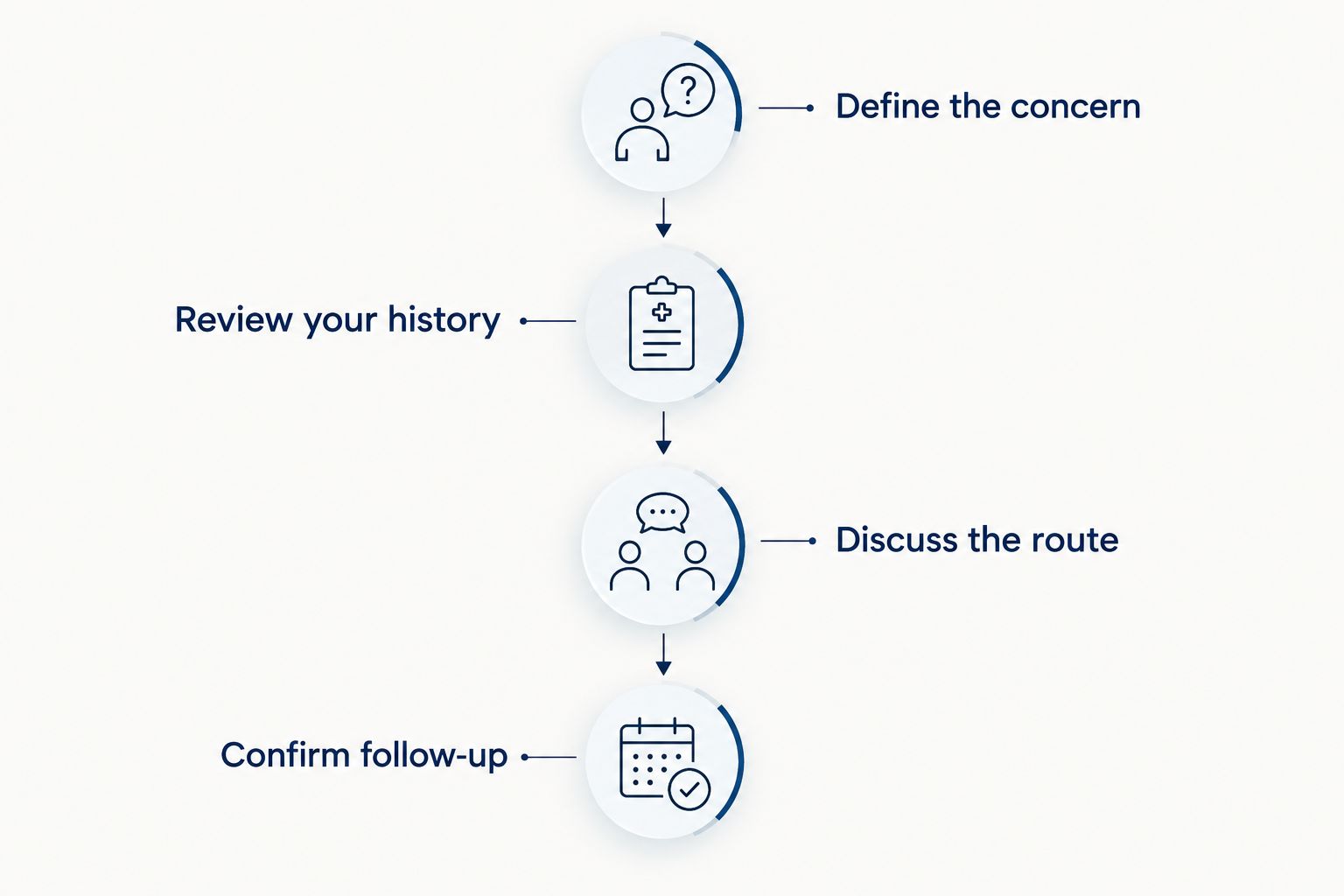
Use this sequence to keep the discussion focused:
- Define the concern: Explain what changed, how it affects daily life and what evaluation you have already had.
- Review your history: Discuss conditions, medications, allergies and previous reactions relevant to treatment.
- Discuss the route: Ask why an IV or injection approach is being considered and what alternatives need evaluation.
- Confirm follow-up: Establish how tolerability and benefit will be reviewed, including reasons to stop treatment.
Bainshealth emphasizes personalized care, continuity with the same provider, direct provider access and convenient appointments. Those features support an ongoing clinical discussion; they do not guarantee a treatment result or a particular response time.
Established patients may also see their own provider for minor ailments or work-note requests up to 2 visits per year, when clinically appropriate. This is a continuity-of-care feature, not unlimited primary care, urgent care or a guarantee of a work note.
Discuss your NAD+ options
Review your goals, medical history and self-pay treatment questions with a provider.
How these methods were ranked
The ranking uses route suitability, administration demands, risks, cost clarity and continuity—not a claim that either method produces better wellness outcomes. IV comes first for the infusion-delivery use case; injections occupy the non-infusion use case.
Neither receives an overall efficacy award. The best administration method is the one a clinician can justify for your situation, with a clear monitoring plan and an honest explanation of the evidence.
Which NAD+ administration method should you choose?
If you are undecided, choose an evaluation before choosing a route. Ask whether NAD+ treatment is appropriate, what other causes of your symptoms need attention and how a meaningful benefit would be assessed.
NAD+ IV fits an infusion-based plan; NAD+ injections fit a clinician-selected non-infusion plan. In 2026, neither route warrants a blanket recommendation for energy, anti-aging or recovery. You do not need to commit to treatment to have an informed discussion.
FAQ
What's better, NAD+ IV or NAD+ injections?
Neither NAD+ IV nor NAD+ injections has established superiority for general wellness outcomes. The routes differ in administration, absorption and practical demands; a clinician should assess whether either is appropriate for your concern.
Does NAD+ IV work faster than an injection?
NAD+ IV delivers directly into the bloodstream, while an intramuscular or subcutaneous injection requires absorption from tissue. That delivery difference does not establish faster symptom relief or better clinical results.
Are NAD+ injections safer than an IV?
NAD+ injections are not automatically safer than IV administration. Both involve needle-related risks, and the relevant risks depend on the route, medical history, preparation and administration setting.
Can I give myself NAD+ injections at home?
Do not assume NAD+ injections are appropriate for self-administration. Any home-use plan requires a prescribing clinician's assessment, instructions and follow-up; this comparison does not provide administration guidance.
How should I compare NAD+ IV and injection costs?
Compare the complete proposed treatment plan, including evaluation, administration and follow-up. Ask which services are included and billed separately rather than judging the options by a single treatment charge.
Does Bainshealth accept insurance for NAD+ care?
Bainshealth currently operates as a self-pay, cash-pay practice, and insurance credentialing has not been completed. Patients pay the practice directly; do not assume insurance billing, reimbursement or coverage.
Will NAD+ treatment fix fatigue or reverse aging?
NAD+ treatment does not have established benefits that justify a promise to fix fatigue or reverse aging. Persistent fatigue needs medical evaluation, and NAD+'s role in cellular metabolism does not by itself prove treatment effectiveness.
What should I ask at a NAD+ consultation in 2026?
Ask why NAD+ is being considered for your concern, what evidence supports it and how safety and benefit will be reviewed. Confirm the proposed route, complete self-pay costs and whom you contact with treatment concerns.
One last thing
Before agreeing to NAD+ treatment, ask: What finding would make us stop? A useful answer identifies lack of meaningful benefit, tolerability problems or a change in your clinical situation—not simply completion of a treatment schedule.
Your 2026 decision should include permission to decline treatment. A personalized consultation can end with further evaluation or a different plan, not necessarily an infusion or injection.