

A GLP-1 weight loss consultation reviews your medical history, weight-related health concerns, current medications and treatment goals before a clinician decides whether medication is appropriate. You also discuss potential side effects, nutrition, follow-up and payment arrangements; attending a consultation does not guarantee a prescription.
- A GLP-1 weight loss consultation assesses eligibility and safety before a prescribing decision.
- Semaglutide and tirzepatide require individualized review; neither is appropriate for every patient.
- Bainshealth offers personalized, self-pay medical weight loss care with direct provider access.
- Bring your medication list, relevant medical records and questions about treatment and follow-up.
Why this matters
The useful outcome of a consultation is a clear clinical plan, not simply access to medication. Your weight history, medical conditions and preferences help determine whether the proposed treatment fits your needs and what monitoring it requires.
Bainshealth is best for patients seeking personalized, self-pay medical weight loss care with continuity from the same provider. You can start with Bainshealth to discuss the practice’s services. For a consultation in 2026, confirm that care is available where you will physically be during the appointment, particularly if you are seeking telehealth care from California or Oregon.
What happens at a GLP-1 weight-loss consultation?
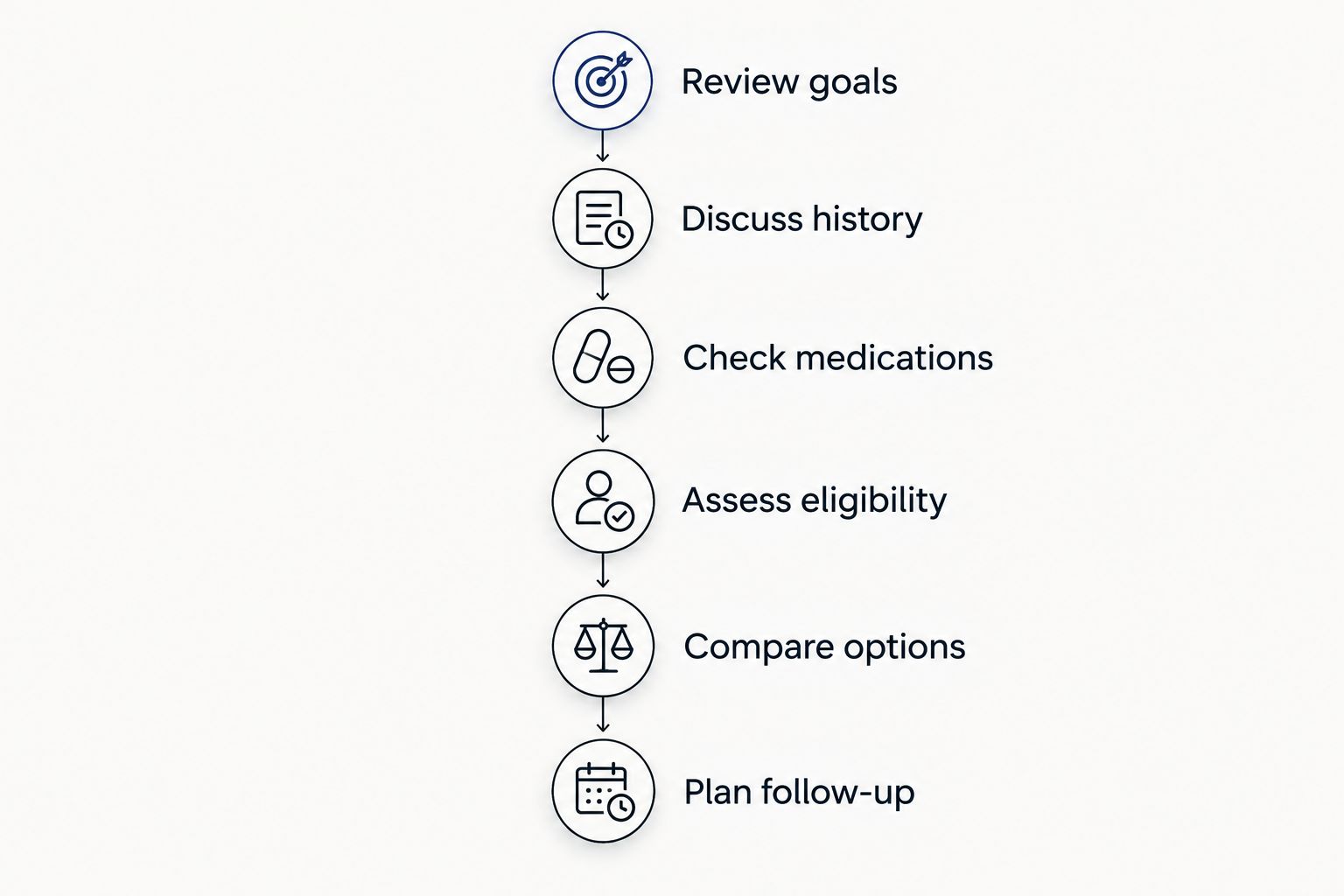
A clinician generally moves from understanding your health to evaluating treatment options and planning follow-up. The exact order varies, but the prescribing decision should follow a medical assessment rather than precede it.
- Review your goals. Explain what you want treatment to help with, including weight-related health concerns, appetite or daily function. Discuss realistic expectations without assuming a particular result.
- Discuss your history. Review previous weight-management efforts, medical diagnoses, surgeries, allergies and relevant family history. Describe what helped, what did not and why previous treatment ended.
- Check your medications. Include prescriptions, nonprescription medicines, supplements and any current weight-loss treatment. Medication combinations can change safety considerations.
- Assess eligibility. Review available height, weight and health information. The clinician determines whether additional measurements, examination or laboratory testing are needed.
- Compare treatment options. Discuss medication benefits, limitations, contraindications and alternatives. A recommendation should explain why a particular approach fits your situation.
- Plan follow-up. Clarify how progress, tolerability and new symptoms will be reviewed. Ask how to contact the provider and what requires urgent assessment instead.
These steps describe a clinical assessment, not a promise that every appointment includes testing or prescribing. Leave with an explanation of the decision and a clear next step, even when that next step is further evaluation rather than medication.
What determines whether you qualify for treatment?
Body mass index, or BMI, is one screening measure used in weight-management prescribing. It relates weight to height, but it does not directly measure body fat, muscle mass or your overall health.
For adults, FDA-approved weight-management indications for semaglutide and tirzepatide include a BMI of 30 kg/m² or higher, or a BMI of 27 kg/m² or higher with a weight-related health condition. These thresholds appear in the medications’ FDA-approved prescribing information; they are not a complete eligibility assessment.
A weight-related condition can include high blood pressure, type 2 diabetes or abnormal cholesterol. Your clinician still needs to assess the specific medication, your history and its contraindications. Meeting a BMI threshold does not automatically make treatment appropriate.
For your 2026 consultation, bring recent measurements if you have them, but do not treat an online BMI calculation as a prescribing decision. A clinician must interpret that number alongside your medical circumstances and the applicable prescribing information.
Semaglutide: a GLP-1 treatment option
Semaglutide acts on the glucagon-like peptide-1 receptor, commonly shortened to GLP-1. This signaling pathway helps regulate appetite and blood sugar, and the medication also delays stomach emptying.
Best for discussion: patients whose clinician identifies semaglutide as an appropriate weight-management option after reviewing eligibility and safety. Its potential benefit is support with appetite regulation as part of a broader treatment plan; its limitations include gastrointestinal side effects and the need for ongoing assessment.
Ask why semaglutide is being considered for your circumstances. The answer should address your health history and goals, not imply that everyone seeking weight loss needs the same medication.
Tirzepatide: a dual-receptor treatment option
Tirzepatide acts on both glucose-dependent insulinotropic polypeptide, or GIP, and GLP-1 receptors. These pathways are involved in appetite and blood sugar regulation.
Best for discussion: patients whose clinician identifies tirzepatide as appropriate after an individualized assessment. It offers a different medication option, but it also carries gastrointestinal risks, contraindications and monitoring requirements.
Neither medication is a universal winner. Selecting treatment requires more than comparing names or expecting a guaranteed change in weight.
| Option | How it works | Best for discussion | Benefit and limitation |
|---|---|---|---|
| Semaglutide | Acts on GLP-1 receptors | Patients whose assessment supports semaglutide treatment | Supports appetite regulation; gastrointestinal effects and safety restrictions require review |
| Tirzepatide | Acts on GIP and GLP-1 receptors | Patients whose assessment supports tirzepatide treatment | Provides another medication approach; gastrointestinal effects and medication interactions require review |
Bainshealth confirms prescribing both semaglutide and tirzepatide. That does not establish which medication, formulation or treatment plan is right for you; those decisions belong in the consultation.
Why your GLP-1 treatment plan varies
Personalized treatment means the clinician connects the recommendation to your health rather than treating weight alone. Explain these factors clearly during your appointment:
- Medical history: diabetes, gastrointestinal conditions, kidney problems and other diagnoses can affect assessment and monitoring.
- Current medications: insulin and certain other diabetes medicines can increase low-blood-sugar risk when combined with these treatments.
- Previous treatment: past benefits, side effects or reasons for stopping medication help inform the next decision.
- Pregnancy plans: pregnancy, breastfeeding and plans to conceive require discussion before treatment selection.
- Tolerability: nausea, vomiting, constipation or diarrhea can affect whether a treatment remains suitable.
- Follow-up needs: monitoring should reflect your health conditions, symptoms and response, rather than an assumed schedule.
These factors explain why two patients with the same BMI can receive different recommendations. Do not copy another patient’s prescription or medication schedule.
What should you bring to the consultation?
Prepare an accurate medication list and a short account of your weight-management history. Include previous prescriptions, relevant side effects and any medicines you currently obtain from another clinician.
Useful records include recent laboratory results, a list of diagnoses and details of relevant procedures or hospitalizations. Bring what you already have; ask the practice whether it needs additional records before arranging new testing yourself.
Write down your priorities and questions. If your concern is appetite, explain it; if your goal relates to blood pressure, mobility or another health issue, say so. Clear goals make it easier to discuss what progress would mean beyond the scale.
Is a telehealth consultation enough to start treatment?
Telehealth supports medical history review and treatment discussion, but it does not replace every physical assessment or test. Your clinician decides whether the information available is sufficient or whether you need additional evaluation.
For a telehealth appointment in 2026, provide your physical location and confirm the practice can treat patients there. Use a private setting where you can discuss your history openly, and keep your medication list available.
Which risks should you discuss before starting?
Common gastrointestinal side effects include nausea, vomiting, diarrhea, constipation and abdominal discomfort. Explain any existing digestive symptoms, because a new symptom is easier to assess when the clinician understands your baseline.
FDA-approved prescribing information also addresses serious risks and precautions, including pancreatitis, gallbladder problems and kidney injury associated with dehydration. Persistent vomiting or diarrhea deserves clinical attention, especially when you cannot maintain fluid intake.
Both medications carry a boxed warning concerning thyroid C-cell tumors observed in rodents. They are contraindicated in people with a personal or family history of medullary thyroid carcinoma or multiple endocrine neoplasia syndrome type 2, called MEN 2; the warning does not mean that every thyroid condition is the same.
Discuss pregnancy plans and contraception before prescribing. Tirzepatide can affect the effectiveness of oral hormonal contraceptives, so ask the clinician what precautions apply rather than assuming your usual method remains sufficient.
Seek urgent medical assessment for severe, persistent abdominal pain or a serious allergic reaction. Difficulty breathing or swelling of the face or throat requires emergency care, not a routine message to your weight-management provider.
Will you need laboratory tests?
Laboratory testing depends on your history, available records and the clinician’s assessment. There is no single universal laboratory checklist that applies to every person seeking GLP-1 weight loss treatment.
Testing can help assess concerns such as blood sugar or kidney function when clinically relevant. Ask what each requested test is intended to answer and whether existing results are adequate.
A useful question is whether a test is needed before the prescribing decision or as part of later monitoring. That distinction helps you understand the sequence of care without assuming every consultation includes the same tests.
How do payment and follow-up work?
Bainshealth operates as a self-pay, cash-pay practice: patients pay the practice directly, and it does not currently accept or bill insurance. Ask for transparent pricing and a clear explanation of what the proposed care includes before agreeing to treatment.
Keep practice charges, medication expenses and laboratory expenses separate in that discussion. Do not assume one payment includes all three, that insurance will reimburse you, or that an HSA or FSA can cover a particular expense.
For your 2026 treatment plan, ask how appointments are arranged, how to contact your provider and how follow-up is handled. Direct provider access supports communication, but it does not establish a guaranteed response time or replace emergency care.
Continuity is a practical benefit: established patients may see their own provider for minor ailments or work-note requests up to twice a year, when clinically appropriate. These visits are not described as free, and they do not guarantee an appointment, a work note or unlimited primary care.
Discuss your weight-management goals
Ask about personalized assessment, self-pay arrangements and follow-up care.
What happens if medication is not appropriate?
A consultation can end with a recommendation against medication, a request for more information or a different treatment approach. That is a clinical decision, not a failed appointment.
Ask which concern prevented prescribing and what needs to happen next. The answer should distinguish a contraindication from an unanswered question, such as a missing medical record or a symptom needing evaluation.
You can still discuss nutrition, physical activity and other weight-management support appropriate to your health. Do not obtain a prescription elsewhere simply to bypass a safety concern identified during the assessment.
What should you track after treatment begins?
Follow-up should review how you feel as well as changes in weight. Report appetite changes, gastrointestinal symptoms, difficulty eating or drinking, and any new medication or diagnosis.
Discuss nutrition and physical activity in practical terms, including how to maintain adequate intake and support muscle function. Your clinician can explain whether dietitian input or other support fits your circumstances.
For ongoing care in 2026, agree on what information to bring to reviews and which symptoms should prompt contact sooner. Do not change treatment based solely on a stalled scale reading; medication decisions require clinical review.
FAQ
What happens at my first GLP-1 weight loss consultation?
Your clinician reviews your medical history, medications, weight-related health concerns and goals before assessing treatment suitability. You also discuss risks, follow-up and the next steps; a prescription is not guaranteed.
Do I qualify for GLP-1 treatment based on my BMI?
A BMI of 30 kg/m² or higher, or 27 kg/m² or higher with a weight-related condition, meets the adult BMI criteria in FDA-approved weight-management indications for semaglutide and tirzepatide. Your clinician must still review contraindications and your individual health history.
Is tirzepatide better than semaglutide for me?
Neither medication is automatically the better choice for you. Semaglutide acts on GLP-1 receptors, while tirzepatide acts on GIP and GLP-1 receptors; your clinician assesses suitability, risks and preferences.
Do I need blood tests before a GLP-1 prescription?
Blood tests depend on your medical history, available results and the clinician’s assessment. Ask which tests are necessary and what each result will help determine.
Does Bainshealth accept insurance for weight-loss care?
Bainshealth currently operates as a self-pay, cash-pay practice and does not accept or bill insurance. Patients pay the practice directly; ask what the proposed care includes before proceeding.
Can I have a GLP-1 consultation online from Oregon?
Confirm that the practice can provide care where you will physically be during the appointment. An online consultation does not establish treatment eligibility or remove the need for additional evaluation when clinically necessary.
What should I do if I have severe symptoms during treatment?
Seek urgent medical assessment for severe, persistent abdominal pain, and emergency care for difficulty breathing or swelling of the face or throat. Do not wait for a routine provider message when symptoms require immediate care.
One last thing
Before your appointment ends, ask your clinician to explain the reason for the recommendation in plain language. You should understand why treatment is appropriate or why it is being deferred, what needs monitoring and whom to contact with a concern.
The best next step is a plan you understand—not a prescription you cannot explain. Keep the written instructions available and raise questions before making treatment changes.