

Adults generally qualify for GLP-1 weight loss when their body mass index (BMI) is 30 kg/m² or higher, or 27 kg/m² or higher with a weight-related condition, under FDA-approved adult weight-management criteria used in 2026. Meeting that threshold does not guarantee a prescription: your clinician must review the specific medication, medical history, pregnancy plans, current medicines and ability to participate in follow-up. Treatment supports nutrition and physical activity; it does not replace them.
- GLP-1 weight loss generally requires adult BMI of at least 30, or at least 27 with a weight-related condition.
- Semaglutide and tirzepatide require individual screening; meeting a BMI threshold does not guarantee a prescription.
- Bainshealth offers personalized, self-pay medical weight loss with provider continuity.
- Pregnancy, certain thyroid cancer histories and medication interactions affect treatment suitability.
Why this matters
Eligibility is not simply a request for a prescription. Your weight, health risks and treatment goals need to fit the medication's approved use, and your clinician needs a plan for monitoring safety and response.
Bainshealth prescribes both semaglutide and tirzepatide as part of personalized medical weight-loss care. The practice operates on a self-pay basis: you pay the practice directly, and it does not currently accept or bill insurance. Discuss the treatment plan and its payment terms before you commit.
For California and Oregon readers considering treatment in 2026, separate two questions: whether you meet medical criteria and whether the provider can legally treat you where you are physically located. An online appointment does not remove state licensing requirements.
Who qualifies for GLP-1 weight-loss treatment?
For adults, FDA-approved weight-management prescribing information for semaglutide and tirzepatide uses the following starting criteria. These are thresholds for considering treatment, not a substitute for an individual medical evaluation.
| Adult eligibility category | What the threshold means | What still needs review |
|---|---|---|
| BMI of 30 kg/m² or higher | The obesity threshold supports consideration of medication without an additional weight-related diagnosis | Contraindications, current medicines, treatment goals and follow-up |
| BMI of 27 kg/m² or higher with a weight-related condition | The overweight threshold requires an associated condition, such as high blood pressure, abnormal cholesterol or type 2 diabetes | Whether the condition and medication fit the approved indication |
| BMI below 27 kg/m² | This does not meet the usual adult starting criteria for these weight-management medications | Other explanations for weight concerns and appropriate care options |
BMI compares your weight with your height. It is a screening measurement, not a complete assessment of body composition: it does not distinguish muscle from fat or describe where you carry fat.
Your clinician should use BMI alongside your medical history, not as the entire decision. Bring an accurate height and current weight, plus information about weight changes and previous treatment. A weight-related diagnosis also needs clinical confirmation; a concern about blood pressure is not the same as documented hypertension.
BMI of 30 kg/m² or higher: the adult obesity threshold
A BMI of 30 kg/m² or higher meets the usual adult obesity threshold for considering these medications. You do not need an additional weight-related condition to meet that particular threshold, but you still need a safety assessment.
The benefit of this criterion is clarity: it establishes a measurable starting point. Its limitation is equally important. Two people with the same BMI can have different medical risks, nutritional needs and reasons a medication is unsuitable.
BMI of 27 kg/m² or higher: a related condition is required
A BMI of 27 kg/m² or higher generally qualifies under the adult overweight criterion only when you also have a weight-related condition. Examples in FDA weight-management labeling include hypertension, dyslipidemia and type 2 diabetes.
Hypertension means high blood pressure. Dyslipidemia means abnormal blood fats, such as elevated cholesterol or triglycerides. Your clinician will connect the diagnosis to the proposed treatment rather than treating the BMI number alone as sufficient.
BMI below 27 kg/m²: request an evaluation, not a prescription promise
A BMI below 27 kg/m² does not meet these usual adult starting criteria for weight management. Wanting to lose weight for appearance alone does not establish an approved indication.
You can still discuss weight changes, nutrition, body composition and symptoms with a clinician. The next step is to identify an appropriate care plan, not to assume that a different medication or formulation bypasses the eligibility threshold.
Semaglutide or tirzepatide: what changes the decision?
Semaglutide activates the GLP-1 receptor. Tirzepatide activates both GIP and GLP-1 receptors; these receptors participate in appetite and blood-sugar regulation. The distinction explains why the medicines are not interchangeable, even though both appear in weight-management discussions.
| Medication | How it works | Best for | Benefit and limitation |
|---|---|---|---|
| Semaglutide | Activates the GLP-1 receptor | An eligible patient whose clinician selects it after an individual assessment | Supports weight management; gastrointestinal effects and contraindications require review |
| Tirzepatide | Activates GIP and GLP-1 receptors | An eligible patient whose clinician selects its dual-receptor treatment | Supports weight management; gastrointestinal effects and medication interactions require review |
There is no universal winner for every patient. Choose treatment through clinical assessment, not through a medication popularity ranking. A medicine that fits one person's history can be inappropriate for someone else.
For your 2026 consultation, ask which exact medication is being considered and whether its indication matches your situation. Do not assume that every product containing the same active ingredient has the same approved use. A diabetes prescription and a weight-management prescription require their own clinical justification.
Why GLP-1 weight-loss eligibility varies
The adult BMI thresholds create a starting point. These factors determine whether treatment is appropriate for you:
- Weight-related conditions: High blood pressure, abnormal cholesterol or type 2 diabetes affect eligibility when BMI is below the obesity threshold.
- Medical history: Certain thyroid cancer histories, digestive problems and other illnesses change the safety assessment.
- Current medicines: Diabetes medicines and other prescriptions need review for interactions and overlapping effects.
- Pregnancy plans: Weight-loss treatment is not appropriate during pregnancy; plans to conceive require a medication-specific discussion.
- Follow-up needs: Symptoms, nutrition, weight changes and treatment response need ongoing review.
- Patient location: Telehealth care requires a provider authorized to treat you in the state where you are located.
Do not stop an existing prescription to make yourself eligible. Give your clinician the complete medication list and let the clinician determine whether any changes are necessary.
What health history can rule out treatment or require caution?
For semaglutide and tirzepatide weight-management products, a personal or family history of medullary thyroid carcinoma, or multiple endocrine neoplasia type 2, is a contraindication. A previous serious allergic reaction to the proposed medication is also a contraindication. Tell your clinician about the specific diagnosis rather than describing every thyroid condition as thyroid cancer.
The thyroid warning concerns tumors observed in rodents; whether these medicines cause medullary thyroid carcinoma in humans is unknown. Common thyroid conditions are not automatically the same as the conditions named in that warning.
Other histories require careful assessment without necessarily creating an automatic exclusion. These include pancreatitis, gallbladder disease, kidney problems and significant digestive symptoms. Severe gastroparesis—a condition in which the stomach empties too slowly—is particularly relevant because these medications delay stomach emptying.
If you have diabetes, discuss your glucose-lowering medicines and any diabetic eye disease. Combining treatment with insulin or a sulfonylurea can increase the risk of low blood sugar, and your diabetes plan needs individual review.
What side effects should you understand before starting?
Nausea, vomiting, diarrhea, constipation and abdominal discomfort are recognized gastrointestinal side effects. Their practical consequence matters: persistent vomiting or diarrhea can cause dehydration and require medical attention.
Severe or persistent abdominal pain, especially with vomiting, needs prompt assessment. Seek emergency help for signs of a serious allergic reaction, such as trouble breathing or swelling of the face or throat. Direct access to your usual provider does not replace emergency care.
Tell surgical and anesthesia teams about GLP-1 treatment before a procedure. Delayed stomach emptying is relevant to anesthesia planning; follow the treating team's instructions rather than changing medication yourself.
How do you prepare for a GLP-1 consultation?
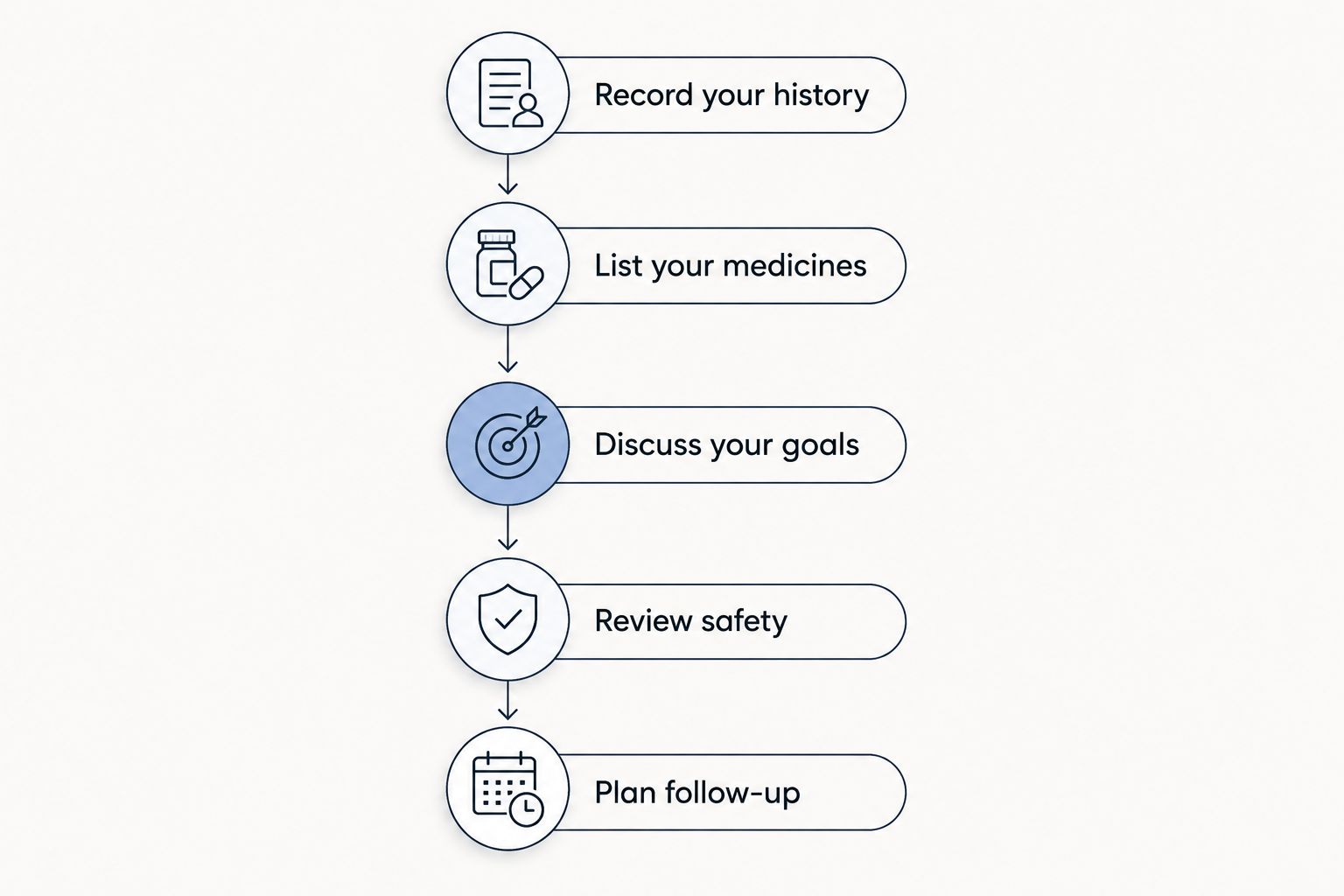
A useful consultation connects eligibility, safety and follow-up. You do not need to arrive with a preferred prescription, but you should arrive with accurate information.
- Record your history. Bring your current height, weight, weight changes, diagnosed conditions and previous weight-management attempts.
- List your medicines. Include prescriptions, supplements and any existing diabetes or weight-loss treatment.
- Discuss your goals. Explain what you want to improve, including health concerns and daily function, rather than focusing only on a target weight.
- Review safety. Mention pregnancy plans, relevant family history, digestive symptoms and previous medication reactions.
- Plan follow-up. Ask how the clinician will assess response, side effects, nutrition and whether treatment remains appropriate.
The same sequence applies to an online consultation in 2026. Your clinician decides whether laboratory testing, records or an in-person assessment are needed; do not assume every patient needs an identical test panel.
What should you ask a self-pay practice before treatment?
Medical eligibility and payment are separate decisions. For self-pay treatment in 2026, ask for a clear explanation of what you pay the practice directly and what the proposed care includes. Do not assume medication, laboratory testing or follow-up is included without confirmation.
Useful questions include:
- What services does the proposed treatment arrangement include?
- How are medication and laboratory expenses handled?
- What follow-up does the clinician recommend?
- How do you contact the provider about side effects?
- What happens if the treatment is unsuitable or needs to change?
Bainshealth GLP-1 weight-loss care is best for patients seeking personalized, self-pay treatment with provider continuity. The practice emphasizes attentive individual care, direct provider access, transparent pricing and convenient appointments. That model does not promise a response time, guaranteed results or unlimited primary care.
Established patients may see their own provider for minor ailments or work-note requests up to twice a year, when clinically appropriate. These visits are not described as free, and a work note or appointment is not guaranteed. The practical benefit is continuity with a clinician who already knows your care.
Discuss your weight-loss eligibility
Review your medical history, treatment options and self-pay care arrangements.
Can you qualify without having diabetes?
A BMI of 30 kg/m² or higher, or 27 kg/m² or higher with a weight-related condition, can meet adult weight-management criteria without diabetes. High blood pressure or abnormal cholesterol can satisfy the associated-condition requirement when clinically documented.
Diabetes is not a prerequisite for weight-management treatment. It does, however, change the medication review and monitoring discussion when present.
Does meeting the BMI threshold guarantee a prescription?
A BMI of 30 kg/m² or higher establishes an eligibility threshold, not a prescription guarantee. Contraindications, pregnancy, medication interactions and other clinical concerns can make treatment inappropriate.
The consultation should end with a clear explanation of the decision. If medication is not appropriate, ask what evaluation or nonmedication support addresses your concerns.
FAQ
Who qualifies for GLP-1 weight loss in 2026?
Adults generally meet weight-management eligibility at BMI of 30 kg/m² or higher, or 27 kg/m² or higher with a weight-related condition. A clinician must also confirm that the specific medication is appropriate and safe.
Can I get GLP-1 treatment if I do not have diabetes?
Yes, diabetes is not required for adult weight-management treatment. You still need to meet the applicable BMI and health criteria and complete a safety assessment.
Is tirzepatide the same as semaglutide?
No, tirzepatide activates GIP and GLP-1 receptors, while semaglutide activates the GLP-1 receptor. Your clinician selects treatment based on your health history and the specific medication's indication.
Can I use GLP-1 weight-loss medication during pregnancy?
Weight-loss medication is not appropriate during pregnancy. Discuss pregnancy plans before treatment because medication-specific guidance determines when treatment must stop.
Does Bainshealth accept insurance for weight-loss care?
Bainshealth currently operates as a self-pay, cash-pay practice and does not accept or bill insurance. Ask what you pay directly and what the proposed care arrangement includes.
Can an online appointment determine whether I qualify?
An online appointment can support an eligibility assessment, but the clinician determines whether records, testing or an in-person examination are needed. The provider must also be authorized to treat you where you are physically located.
What happens if I have side effects after starting treatment?
Contact your prescribing clinician about side effects so the treatment plan can be assessed. Severe persistent abdominal pain needs prompt medical assessment, and breathing difficulty or facial swelling requires emergency help.
One last thing
Ask how treatment will be reassessed, not just how it will begin. GLP-1 eligibility starts with a threshold, but responsible care continues with review of symptoms, nutrition, treatment response and your health goals.
Before your 2026 consultation, write down the question you most need answered: whether treatment fits your history, how follow-up works or what self-pay care includes. A clear answer to that question is more useful than a prescription promise.