

Yes, you can switch to online TRT from another provider if the receiving clinician determines that continued treatment is appropriate and can legally provide care where you are located. Your existing prescription does not guarantee a replacement prescription, an unchanged treatment plan or an immediate refill. A safe transfer requires a review of your diagnosis, treatment records, monitoring and responsibility for care during the handoff.
- Switching to TRT online requires a new clinical review, not just a prescription transfer.
- Bainshealth offers self-pay hormone therapy with personalized care, provider continuity and direct provider access.
- Gather diagnostic records, recent laboratory results and prescription details before your consultation.
- Confirm who manages prescriptions and monitoring until the receiving clinician accepts your care.
Can you switch to online TRT from another provider?
You can request a transfer, but the receiving clinician must make an independent prescribing decision. Taking testosterone already establishes your treatment history; it does not establish that the same prescription remains appropriate.
For a 2026 transfer, separate the administrative handoff from the medical decision. Sending records starts the review. Acceptance of care, prescribing and follow-up arrangements require confirmation from the receiving practice.
Bainshealth provides personalized hormone therapy and primary care services through a self-pay model. A consultation is the place to discuss whether transferring your existing TRT care fits your medical needs.
| Transfer situation | Best for | Practical advantage | Limitation to address |
|---|---|---|---|
| Transfer with diagnostic records and monitoring results | Patients with a documented treatment history | Gives the receiving clinician evidence to review | Additional evaluation can still be necessary |
| Transfer with incomplete records | Patients whose records are fragmented | Creates an opportunity to reconstruct the treatment history | Missing evidence can prevent a prescribing decision |
| Transfer while requesting a treatment change | Patients with symptoms, side effects or changing goals | Allows treatment concerns to be reviewed together | A provider change does not guarantee a different prescription |
None of these pathways is an automatic approval route. The deciding issue is whether the receiving clinician has enough information to prescribe safely.
Why this matters
A provider change can create uncertainty about who handles your next prescription, abnormal laboratory results or new symptoms. Do not assume that requesting an appointment transfers those responsibilities. Ask both practices to clarify the handoff.
Online care changes how you attend appointments, not the need for medical assessment. Testosterone replacement therapy requires attention to symptoms, laboratory findings, adverse effects and your broader health history.
How do you transfer TRT care safely?
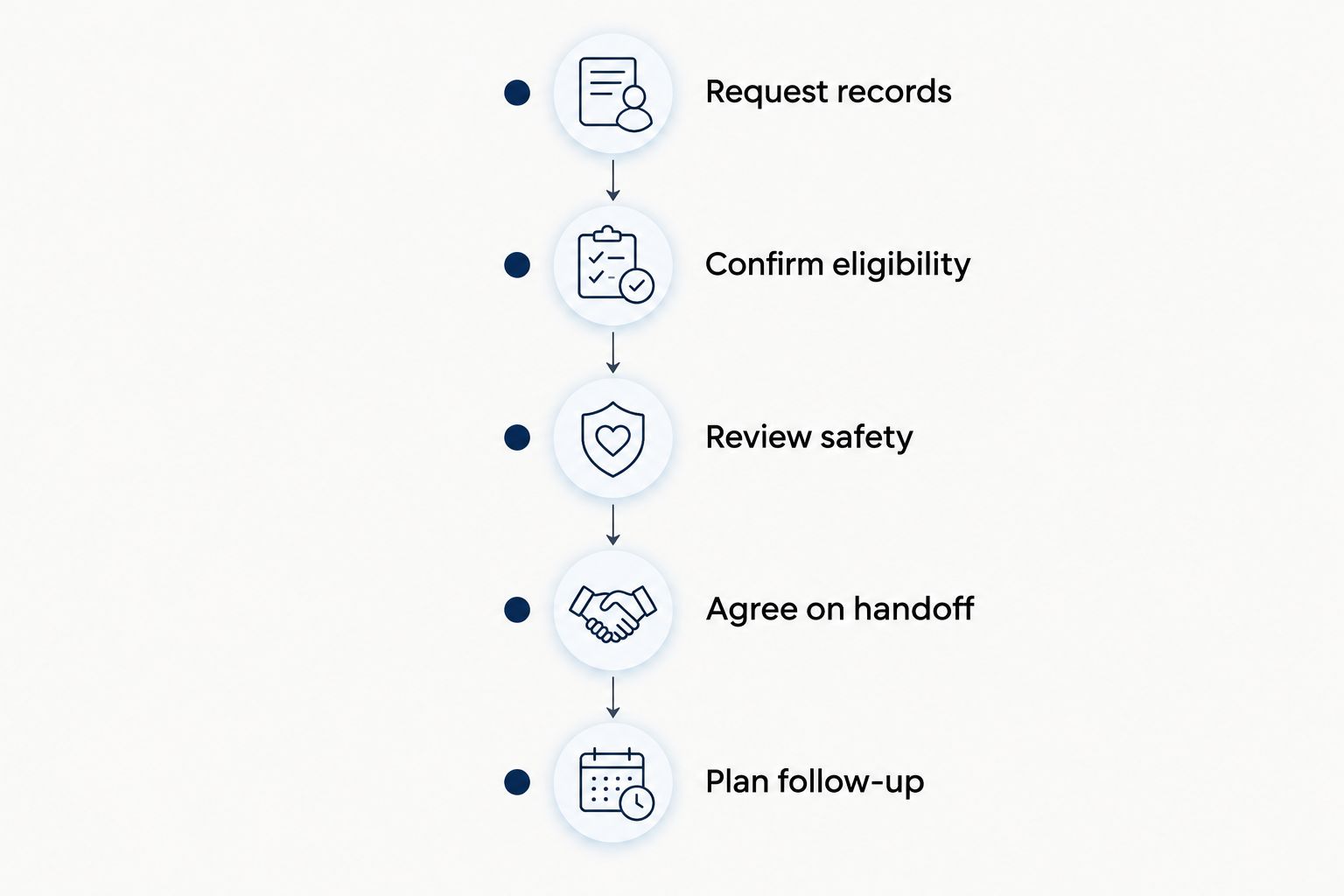
Use these 5 steps to organize a transfer. They are a preparation framework, not a promise that treatment will continue or that the process will follow a fixed timeline.
Request records
Ask your current practice how to authorize release of your medical records. Request the information supporting the original diagnosis as well as the records showing what happened after treatment started.
Useful documents include:
- Testosterone results obtained before treatment, including collection dates and times when available.
- Notes describing symptoms, examination findings and the reason treatment began.
- Your current prescription, formulation and administration schedule.
- Recent laboratory reports and notes explaining treatment changes.
- A medication list, including supplements and other hormone-related treatments.
A prescription label helps identify what you take, but it does not replace diagnostic records. Give the receiving clinician the actual reports rather than relying on a summary from memory.
Confirm eligibility
Tell the receiving practice where you will physically be during appointments. Ask whether the clinician can evaluate and prescribe for a patient in that location under the rules applicable to your situation.
For prospective patients in California and Oregon, confirm location eligibility directly before arranging a transfer. Online availability is not proof that every clinician can treat every patient in both states.
Also ask whether an in-person assessment is necessary. Do not assume that a prior telehealth prescription establishes eligibility for another practice's prescribing process.
Review safety
Discuss how you feel on treatment, not just whether your testosterone result is within a laboratory range. Report side effects, fertility plans, sleep concerns, urinary symptoms and changes in your health history.
Your clinician should also know about other prescriptions and nonprescription substances. Do not leave out treatments because they came from a different practice or were purchased without a prescription.
Agree on handoff
Ask who is responsible for prescriptions and clinical questions before the new practice accepts your care. Clarify whether your current clinician will continue managing treatment during the review; do not assume a bridging prescription will be available.
If you are running low, tell both practices promptly. Do not increase, reduce, stretch or stop treatment on your own to manage the transfer. Ask your prescribing clinician for individualized instructions.
Plan follow-up
Before agreeing to ongoing treatment, ask how laboratory monitoring, appointments and prescription requests will work. You should know whom to contact about symptoms and who will review results.
Convenient appointments help only when the clinical plan is clear. Leave the consultation understanding the next action, the responsible clinician and the circumstances that require an in-person assessment.
Why the online TRT transfer process varies
The amount of review depends on your clinical history and the information available. These factors explain why another patient's transfer experience is not a reliable schedule for yours:
- Diagnostic documentation: Records from before treatment help establish why testosterone was prescribed.
- Laboratory context: Collection timing, treatment changes and the formulation used affect how results are interpreted.
- Current symptoms: Persistent symptoms or adverse effects require assessment rather than automatic prescription renewal.
- Medical and fertility history: Conditions affecting treatment safety and plans for biological children can change the discussion.
- Patient location: The receiving clinician must meet the requirements applicable to your location and circumstances.
- Handoff arrangements: Records release, clinical acceptance and prescription responsibility are separate tasks.
Missing records do not establish that your original care was inappropriate. They mean the receiving clinician needs a clearer basis for the next decision.
What laboratory records matter for a 2026 transfer?
Bring both pretreatment and on-treatment results when available. They answer different questions: the first helps document the diagnosis, while the second helps assess treatment response and safety.
The Endocrine Society's clinical practice guideline for testosterone therapy in men recommends confirming low testosterone with repeat morning fasting testing as part of diagnosis. That generally means measurements on 2 separate mornings, interpreted alongside compatible symptoms and signs—not a diagnosis based on a single isolated result.
That diagnostic principle is not an instruction to interrupt existing TRT. Testosterone treatment changes laboratory results, so your receiving clinician must decide how to interpret your history and whether additional evaluation is needed.
Blood count testing is also relevant because testosterone can increase red blood cell concentration. Depending on your history, the clinician can assess other monitoring needs, including prostate-related evaluation and sleep apnea concerns.
Use the guide to blood tests before online TRT to prepare questions. Your required tests and collection timing remain individualized medical decisions.
Can you keep the same testosterone prescription after switching?
You can request continuation of your existing prescription, but the receiving clinician decides whether to continue it. Bring the exact medication details and explain both the benefits you have noticed and the problems you want addressed.
A change in clinician does not necessarily require a change in formulation. It also does not obligate the receiving clinician to continue a formulation, schedule or additional medication that does not fit the new assessment.
Ask what evidence would support keeping the current plan and what would justify changing it. That gives you a clinical explanation instead of treating prescription matching as the goal of the visit.
Can switching to online TRT affect fertility?
Switching providers does not itself determine fertility risk; testosterone treatment can suppress sperm production. Tell the receiving clinician before prescribing decisions if you want biological children now or in the future.
Do not assume that an additional medication eliminates this risk. Fertility planning needs a separate discussion, and some patients need evaluation by a clinician with relevant reproductive expertise.
What should you ask about self-pay care in 2026?
Bainshealth operates as a self-pay, cash-pay practice; patients pay the practice directly. Insurance credentialing has not been completed, so do not plan a transfer on the assumption that the practice accepts or bills insurance.
Ask for a clear explanation of the financial arrangements before committing to ongoing treatment. Transparent pricing means understanding what each charge covers, not assuming that every part of care is included.
Use these 4 questions:
- What does the initial consultation include?
- How are follow-up appointments and ongoing treatment charged?
- Are laboratory testing and medication separate expenses?
- What services fall outside the ongoing care arrangement?
Keep general insurance questions separate from the practice's self-pay model. Do not assume reimbursement, medication coverage, laboratory coverage or eligibility to use a particular benefit account.
What should you look for beyond prescription renewal?
Bainshealth is best suited to patients seeking self-pay TRT care with provider continuity and direct provider access. Personalized care includes reviewing your goals, explaining prescribing decisions and making the follow-up plan understandable.
Continuity has a practical benefit: established patients may see their own provider for minor ailments or work-note requests up to 2 times a year, when clinically appropriate. These visits are not a promise of free care, guaranteed appointments or guaranteed work notes, and they do not constitute urgent care or unlimited primary care.
Direct provider access also does not establish a response-time guarantee. Ask how to contact your provider, which concerns fit routine messaging and when you should seek in-person or emergency assessment.
The limitation remains clinical: a convenient relationship cannot replace an examination when one is needed. Choose care that explains those boundaries clearly.
Your 2026 transfer consultation checklist
Before your appointment, write down the reason you want to switch. Separate access concerns, financial questions and clinical concerns so each receives a clear answer.
Bring this short checklist:
- Your current prescription details and remaining supply.
- Pretreatment records and recent monitoring reports.
- Symptoms that improved, persisted or appeared during treatment.
- Fertility plans and changes in your medical history.
- Questions about direct payment, follow-up and provider access.
- The current practice's process for releasing records.
Request a consultation before treating the transfer as complete. An appointment request is the start of an evaluation, not confirmation of a prescription.
Discuss your TRT transfer
Review your treatment history, self-pay arrangements and follow-up needs.
FAQ
Can I switch to TRT online if I already have a prescription?
Yes, you can request a transfer to TRT online, but an existing prescription does not guarantee continuation. The receiving clinician must review your diagnosis, treatment history, safety monitoring and location eligibility.
Will my new TRT provider keep my current treatment unchanged?
The receiving clinician decides whether your current treatment remains appropriate. Bring the exact prescription details and explain your response, side effects and goals.
Do I need blood tests again when I change TRT providers?
Additional blood tests depend on your records, clinical history and the receiving clinician's assessment. Bring pretreatment and recent results, and ask for instructions about any new testing.
Should I stop testosterone before my transfer consultation?
Do not stop or change testosterone on your own before a transfer consultation. Ask your prescribing clinician for individualized instructions and explain any concern about running out.
Does Bainshealth accept insurance for TRT?
Bainshealth currently operates as a self-pay, cash-pay practice and has not completed insurance credentialing. Patients pay the practice directly; do not assume insurance billing or reimbursement.
Can I transfer TRT care while living in California or Oregon?
Confirm eligibility for your physical location directly with the receiving practice. The clinician must be able to provide care under the requirements applicable to your situation.
What if my previous TRT clinic will not send records immediately?
Ask your previous practice for its medical-record release process and tell the receiving clinician which documents are pending. Missing records can limit the prescribing decision, so clarify who manages treatment during the delay.
One last thing
For a 2026 transfer, ask one question before ending the consultation: Who is responsible for my next prescription and my next abnormal laboratory result? Clear ownership matters more than assuming that a new appointment means the handoff is finished.