

TRT cost depends on what you pay for, not just how often you pay: a subscription uses recurring charges, while pay-per-visit care charges for individual appointments. Neither model is automatically less expensive; compare the same evaluation, medication, laboratory monitoring, and follow-up needs over 12 months. Medication and laboratory charges can sit outside either arrangement, so a recurring fee is not proof of an all-inclusive plan.
- Compare TRT cost over 12 months, including testosterone replacement therapy visits, medication, laboratory testing, and follow-up.
- Subscriptions suit patients who prefer recurring billing; pay-per-visit care suits patients who prefer itemized appointment charges.
- Bainshealth provides personalized, self-pay care; patients pay the practice directly rather than through insurance billing.
- Choose the clinical follow-up plan first, then compare how each payment model charges for that care.
How do TRT subscription and pay-per-visit costs compare?
A subscription groups specified services under a recurring payment. Pay-per-visit care separates appointment charges, with medication, testing, and other services handled according to the provider's terms. The better financial fit is the arrangement that covers your actual care needs with clearly disclosed charges.
Use this comparison alongside the TRT pricing and insurance guide. For a useful 2026 comparison, request written terms rather than comparing headline fees alone.
| Comparison point | TRT subscription | Pay-per-visit TRT |
|---|---|---|
| Billing structure | Recurring charge for specified services | Separate charge for each appointment |
| Best for | Patients who prefer recurring billing and clearly defined inclusions | Patients who prefer appointment-level billing and itemized charges |
| Main advantage | Predictable billing for the services actually included | Clear separation of appointment charges |
| Main limitation | Recurring payments can continue during periods with fewer appointments | Total spending changes with the number and type of appointments |
| Medication | Confirm whether it is included or separate | Confirm whether it is included or separate |
| Laboratory testing | Confirm which tests and collection charges are included | Confirm test, collection, and review charges separately |
| Between-visit support | Ask what access includes and what creates another charge | Ask which concerns require a separately billed appointment |
| Ending care | Review renewal, cancellation, and transfer terms | Review outstanding charges and transfer arrangements |
The table describes payment structures, not a particular clinic's package. Do not assume a provider offers both models or includes any listed service without confirmation.
Why this matters
TRT requires more than obtaining a testosterone prescription. Evaluation, safety monitoring, symptom review, and decisions about continuing treatment are parts of medical care, regardless of the payment arrangement.
A lower recurring charge is not a complete comparison if necessary testing sits outside it. An appointment charge is not a complete comparison if medication and follow-up are separate. Compare a care plan with another care plan—not a subscription fee with a consultation fee.
For prospective patients in California and Oregon, confirm whether the provider can evaluate and treat you in your location. An online appointment format does not remove clinical eligibility requirements or guarantee prescribing.
TRT subscriptions: recurring billing with defined inclusions
A subscription is best for patients who prefer a recurring payment and understand exactly which services it covers. Its practical advantage is billing consistency for included care. Its limitation is that recurring billing does not necessarily match the timing of appointments or testing.
Before enrolling, ask the provider to identify each included service in writing. A description such as ongoing care does not explain whether laboratory collection, prescription management, or an additional clinical review creates another charge.
Clarify these terms:
- Included visits: Which appointment types are covered, and are there limits?
- Medication: Is medication part of the arrangement or purchased separately?
- Laboratory work: Which tests, collection services, and result reviews are included?
- Provider access: What can you discuss between appointments, and when is a visit required?
- Renewal terms: When does billing renew, and how do you end the arrangement?
For your 2026 decision, assess the recurring commitment as carefully as the advertised inclusions. A subscription can fit your preferences without being the least expensive option. It should also remain a financial arrangement—not a reason to continue treatment that your clinician no longer recommends.
Pay-per-visit TRT: itemized appointments with variable totals
Pay-per-visit care is best for patients who prefer to see appointment charges separately. Its advantage is a direct connection between a visit and its charge. Its limitation is that an individual appointment fee does not tell you the total expense of ongoing treatment.
Ask whether an initial evaluation differs from a routine follow-up. Also clarify how the practice handles review of outside records, laboratory results, new symptoms, and prescription-related concerns. These activities do not necessarily share the same billing arrangement.
Do not estimate pay-per-visit spending by choosing an arbitrary number of appointments. Ask the clinician what follow-up would be appropriate for your situation, then request the corresponding financial explanation.
Pay-per-visit care is not a reason to skip recommended monitoring. If the proposed schedule does not fit your budget, discuss that before starting rather than stretching intervals or changing medication use yourself.
Why TRT cost varies
TRT cost varies because the clinical work and the financial inclusions differ. For a fair comparison, separate the following factors instead of treating testosterone replacement therapy as a single purchase.
- Initial evaluation: History review, examination needs, and assessment of symptoms determine what work is needed before a prescribing decision.
- Laboratory testing: Baseline evaluation and follow-up testing serve different purposes; ask how each is billed.
- Medication and delivery method: The prescribed formulation affects the practical treatment plan and how medication is obtained.
- Follow-up needs: New symptoms, abnormal results, or treatment changes can require additional clinical review.
- Included provider access: Messaging, prescription questions, and scheduled appointments are different services; ask how the practice distinguishes them.
- Payment terms: Renewal, cancellation, and separately billed services affect the financial commitment beyond the initial appointment.
Medication selection belongs in a clinical discussion, not just a billing comparison. The comparison of TRT delivery methods explains the treatment-format questions to bring to that discussion. Do not switch formulations solely because a billing arrangement looks simpler.
How do you compare TRT plans fairly in 2026?
Use the same time period and the same anticipated care needs for both payment models. A 12-month worksheet is useful because it includes recurring commitments and less frequent services without claiming that every patient follows an identical schedule.
1. Define the care
Ask what evaluation is required before treatment and how the clinician decides whether TRT is appropriate. Record the expected appointment types, laboratory work, and follow-up approach. A consultation does not guarantee a prescription.
2. List the charges
Request an itemized explanation of practice charges, medication expenses, and laboratory expenses. Identify who collects each payment. A charge paid to a pharmacy or laboratory still belongs in your budget even when it does not appear on the practice's invoice.
3. Check the terms
Read the renewal and cancellation terms before agreeing to recurring billing. For either model, ask what happens financially if treatment does not start, changes, or stops. Keep the answer separate from the clinical decision about whether treatment is appropriate.
4. Compare the total
Place the expected charges over the same 12 months. Include only confirmed inclusions, and mark services that require a separate quote. Do not treat an unanswered billing question as an included service.
5. Confirm follow-up
Ask who reviews results, who handles concerns, and how you request another appointment. Continuity matters because a familiar provider can assess changes against your prior symptoms, results, and treatment history.
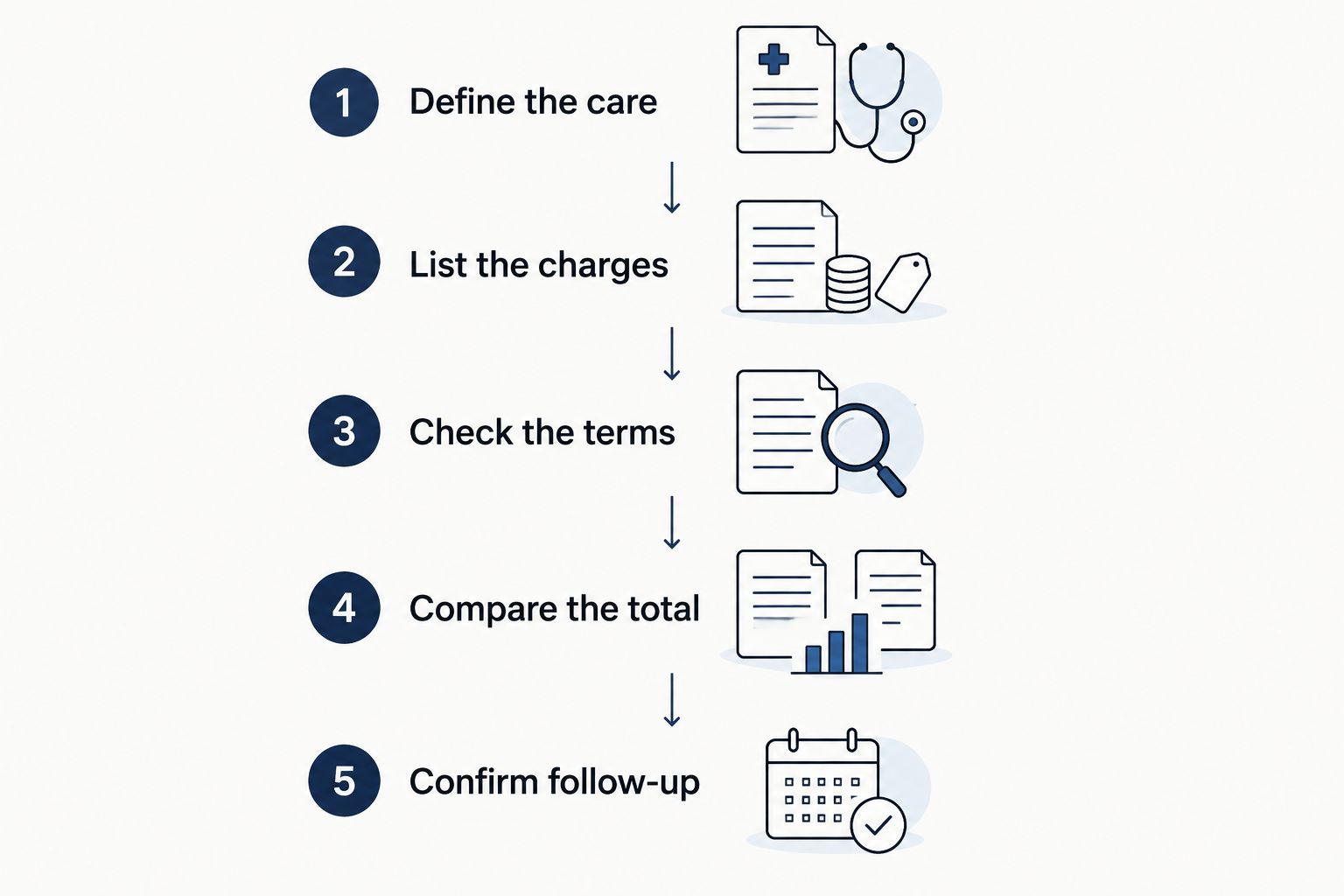
Keep the worksheet with the written terms. For a 2026 comparison, dated information is more useful than a saved advertisement that does not explain its inclusions.
What medical care should a TRT comparison include?
A financial comparison should preserve the clinical evaluation rather than assume testosterone is appropriate. The Endocrine Society's clinical practice guideline recommends diagnosing testosterone deficiency only when compatible symptoms or signs accompany consistently low testosterone concentrations, with repeat morning fasting testing to confirm the result.
That generally means 2 separate morning blood tests to confirm low testosterone, not a diagnosis from symptoms alone. Your clinician determines the appropriate testing and interprets results in context. Ask how collection and result review enter the billing arrangement.
Treatment discussions should also address fertility goals. Testosterone therapy can suppress sperm production, so plans for having children belong in the evaluation before a prescription decision—not after enrollment.
Ask about monitoring for an increased red blood cell concentration and other treatment-related concerns. Your clinician should explain which symptoms require review and which results affect treatment decisions. A payment plan does not establish medical eligibility or guarantee improvements in energy, sexual function, or body composition.
Is a TRT subscription cheaper over 12 months?
Over 12 months, a TRT subscription is cheaper only when its confirmed total is lower than the charges for comparable pay-per-visit care. The recurring fee alone cannot establish that result. Include separate medication, laboratory, and appointment charges before deciding.
Can you pay per visit and still receive ongoing TRT care?
Pay-per-visit billing can support ongoing TRT care when the clinical plan includes appropriate follow-up. Payment frequency and medical monitoring are separate decisions; your provider should set follow-up according to your care needs, not an assumption that fewer visits are better.
Does a subscription replace laboratory monitoring?
A subscription does not replace laboratory monitoring or clinical assessment. Ask which tests the clinician recommends, which are included financially, and how results are reviewed before agreeing to the arrangement.
How does self-pay TRT work at Bainshealth?
Bainshealth is best for patients seeking personalized, self-pay TRT evaluation rather than insurance-billed care. The practice currently operates on a cash-pay basis: patients pay the practice directly, and insurance credentialing has not been completed. Cash-pay describes the billing model, not a requirement to use physical cash.
Bainshealth emphasizes continuity with the same provider, direct provider access, transparent pricing, and convenient appointments. Those are practical considerations to discuss alongside charges. Direct access does not mean a guaranteed response time, unlimited appointments, or urgent care.
For established patients, continuity can also include seeing their own provider for minor ailments or work-note requests up to twice a year, when clinically appropriate. These visits are not described as free, and work notes are not guaranteed. Ask how an appropriate visit is arranged and billed.
The self-pay model requires you to understand your direct financial responsibility before treatment. Do not assume insurance reimbursement, medication or laboratory coverage, or HSA/FSA eligibility. Request current written terms and confirm whether evaluation is available in your location.
Discuss your TRT care options
Ask about clinical evaluation, follow-up, and the current self-pay billing arrangement.
FAQ
What's the fairest way to compare TRT cost in 2026?
Compare TRT cost over the same 12 months using equivalent evaluation, medication, laboratory testing, and follow-up needs. Request written inclusions and separate charges before choosing a payment model.
Is a TRT subscription always better than paying per visit?
A TRT subscription is not always better than paying per visit. Recurring billing suits patients who prefer defined recurring charges, while pay-per-visit billing suits patients who prefer itemized appointments; compare total obligations and clinical support.
Does a TRT subscription include testosterone medication?
Medication is included only when the provider's written terms explicitly say so. Confirm how medication is obtained and who collects payment rather than assuming a recurring fee covers it.
Do I still need blood tests if I pay for TRT monthly?
Monthly payment does not remove the need for appropriate blood testing. Your clinician determines baseline and follow-up testing, while the billing terms establish which services are included.
Does Bainshealth accept insurance for TRT?
Bainshealth currently operates as a self-pay, cash-pay practice and has not completed insurance credentialing. Patients pay the practice directly; do not assume insurance billing or reimbursement.
Can I stop TRT when I cancel a subscription?
Subscription cancellation and stopping TRT are separate decisions. Review the financial terms with the practice and discuss treatment changes with your clinician rather than changing medication use on your own.
Does paying for a consultation guarantee a TRT prescription?
Paying for a consultation does not guarantee a TRT prescription. The clinician must evaluate your symptoms, laboratory results, medical history, and treatment risks before making an individualized prescribing decision.
One last thing
Separate the cancellation policy from the treatment plan. A billing renewal date does not determine when medication should change, and a cancellation confirmation is not a medical transition plan. Before committing in 2026, ask how you would obtain records, review outstanding results, and arrange clinically appropriate follow-up if you changed providers.
This article provides general education, not individualized prescribing advice. Use the comparison to prepare for a consultation, then make treatment decisions with your clinician.