

Online TRT follow-up appointments review your symptoms, testosterone blood tests, side effects, and treatment plan through a remote consultation. Receiving TRT online does not replace blood testing or physical examination when needed; your clinician decides whether to continue treatment, adjust the plan, request additional testing, or arrange an in-person assessment.
- TRT online requires symptom review, blood testing, and safety monitoring—not just prescription renewal.
- Bainshealth offers personalized, self-pay care with continuity and direct provider access.
- Arrange blood testing around your prescribed treatment schedule and your clinician’s instructions.
- Report side effects promptly; do not change testosterone treatment yourself.
How do online TRT follow-up appointments work?
A follow-up connects what you feel with what your blood tests show. Your provider reviews both before deciding whether testosterone replacement therapy remains appropriate.
For personalized TRT care, Bainshealth emphasizes continuity with the same provider and direct provider access. Bring your current treatment details, recent results, and questions so the consultation addresses your actual experience rather than a prescription request alone.
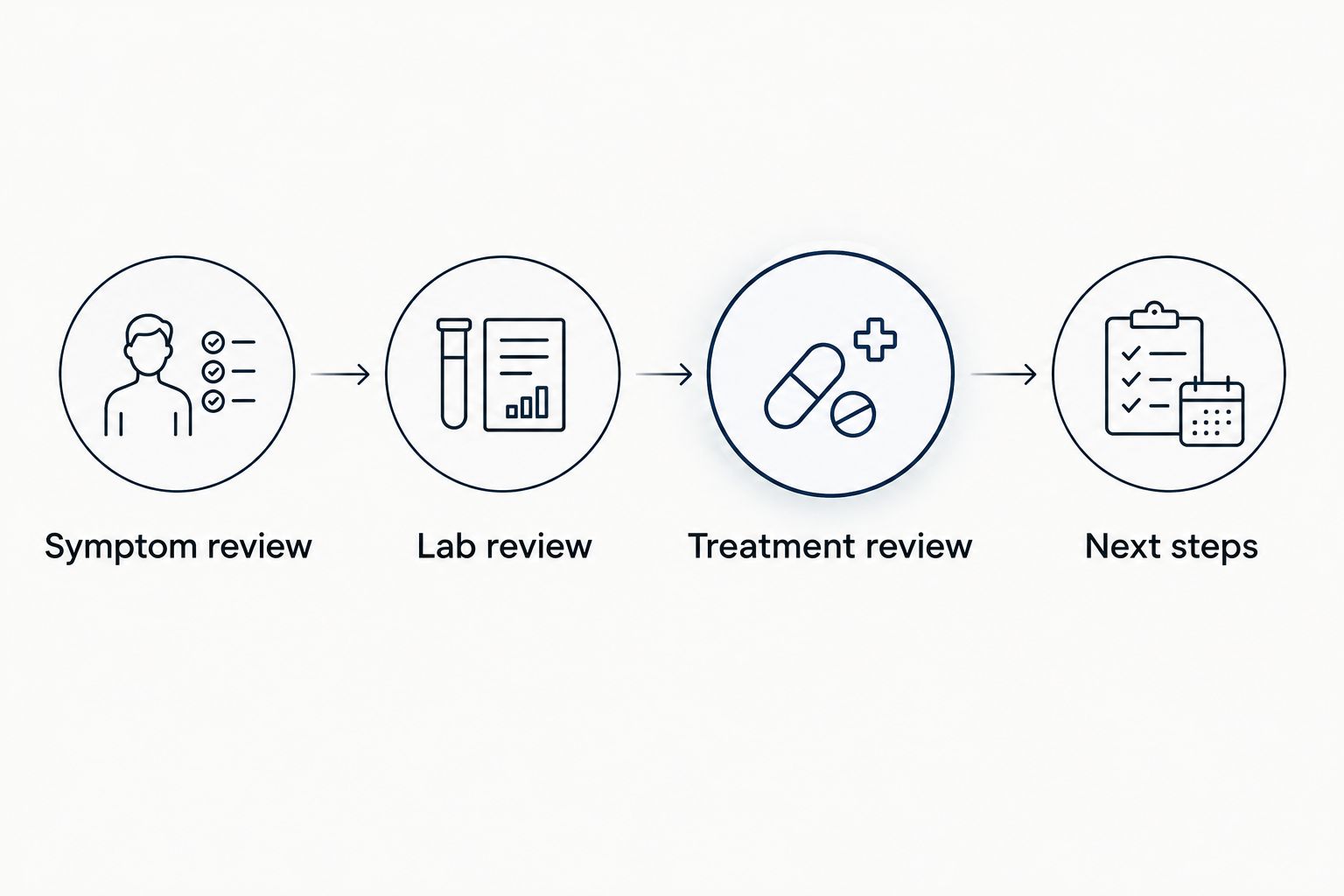
A typical follow-up follows this sequence:
- Symptom review: Discuss energy, sexual symptoms, sleep, mood, and changes since your previous appointment.
- Lab review: Review testosterone results and relevant safety tests, including blood counts when indicated.
- Treatment review: Confirm how you use the medication, identify missed treatment, and discuss adverse effects.
- Next steps: Agree on whether to continue treatment, investigate a concern, change the plan, or attend an in-person assessment.
The sequence is a general clinical framework, not a promise that every visit follows an identical script. Your medical history and current findings determine the discussion.
Why this matters
A convenient appointment is useful only if it supports safe treatment decisions. Testosterone can raise red blood cell levels, affect fertility, and cause adverse effects that require attention even when you feel better.
A refill is not the same as a clinical review. During your 2026 treatment planning, ask what the provider will monitor, who reviews abnormal results, and how you should report problems between appointments.
If you are still deciding how remote care fits your situation, review how online TRT works in California and Oregon. Confirm whether the provider can treat you in the state where you will physically attend the appointment.
What should you prepare before a TRT follow-up?
Preparation helps your provider distinguish a treatment problem from a separate health concern. Describe changes clearly rather than trying to interpret every symptom yourself.
Before the appointment:
- Gather your current medication list, including supplements and nonprescription products.
- Confirm the testosterone formulation you use and when you last used it.
- Complete ordered blood tests according to the clinician’s timing instructions.
- Write down improvements, persistent symptoms, and new concerns.
- Note missed treatment, difficulties administering medication, or skin reactions.
- Tell the provider about fertility plans, new diagnoses, or care received elsewhere.
Do not change your treatment schedule simply to produce a particular laboratory result. A sample collected at the wrong point in a treatment cycle can be difficult to interpret.
If you have not completed the requested testing, contact the practice before your visit. Ask what information is needed to make the appointment clinically useful; do not assume an automatic refill will follow.
What blood tests are reviewed during online TRT?
Testosterone measurements help your clinician assess treatment exposure, but they do not answer every safety question. A complete blood count can identify rising hematocrit—the proportion of blood made up of red blood cells.
The Endocrine Society’s guideline, Testosterone Therapy in Men With Hypogonadism, recommends checking testosterone and hematocrit after treatment begins. Prostate monitoring depends on age, risk, individual circumstances, and the monitoring decisions made with your clinician.
For your 2026 follow-up, ask what each ordered test is intended to answer. A useful explanation connects the result to a decision: continue, investigate, repeat testing, or reconsider treatment.
Do not judge your treatment by a testosterone result alone. Persistent fatigue, for example, can have causes other than testosterone deficiency, and increasing testosterone is not an appropriate response to every unresolved symptom.
Your provider should interpret results alongside symptoms, medical history, treatment timing, and adverse effects. Laboratory reference ranges are not a substitute for that assessment.
How often are TRT follow-up appointments needed?
The Endocrine Society guideline recommends clinical reassessment 3–12 months after starting testosterone treatment and annually thereafter. It recommends checking testosterone and hematocrit at 3–6 months, with hematocrit monitoring annually after that.
These are general guideline intervals, not a fixed appointment schedule for every patient. A change in treatment, an abnormal result, or a new symptom can require earlier review.
For a 2026 care plan, separate these questions:
- When is your next clinical appointment?
- When should you complete the next blood draw?
- Where does that blood draw fall relative to your treatment schedule?
- What should trigger contact before the planned appointment?
Write down the agreed plan before ending the consultation. Your provider’s individualized instructions take priority over a generic online calendar.
Why online TRT follow-up schedules vary
Follow-up timing depends on the clinical decision that needs to be made. A stable treatment plan and a new adverse effect do not call for the same response.
The main factors are:
- Treatment stage: Starting treatment requires assessment of response and tolerability; established treatment still requires ongoing monitoring.
- Medication formulation: Blood-test timing depends on how testosterone is delivered and when it was last used.
- Laboratory findings: Unexpected testosterone results or rising hematocrit require interpretation and a follow-up plan.
- Symptoms and side effects: New swelling, worsening sleep-related breathing symptoms, or treatment reactions warrant discussion.
- Medical history: Fertility goals, prostate-related concerns, and other health conditions affect monitoring decisions.
- Treatment changes: An adjustment can create a need to reassess symptoms and laboratory findings.
Ask why your proposed schedule fits your situation. The answer should describe a clinical reason, not simply an automatic renewal cycle.
When is an online visit enough, and when is in-person care needed?
Online follow-up is best for discussion and review; in-person care is best when examination or hands-on assessment is needed. Neither format removes the need for appropriate testing.
| Appointment format | Best for | Practical benefit | Main limitation |
|---|---|---|---|
| Online follow-up | Reviewing symptoms, completed laboratory results, and treatment questions | Lets you discuss ongoing care remotely | Cannot provide a hands-on examination or collect blood through the call |
| In-person assessment | Concerns requiring physical examination or office-based evaluation | Allows direct examination and appropriate onsite assessment | Requires travel and does not replace specialist or emergency care when indicated |
An online appointment is not a complete physical examination. If your provider identifies a concern that cannot be assessed remotely, the next step is an appropriate in-person evaluation rather than an assumption that everything can be managed by video.
For appointments in 2026, ask how the practice handles referrals or examination needs before a problem develops. Knowing the process makes it easier to act when the care setting needs to change.
What side effects should you report between appointments?
Report acne, breast tenderness, swelling, urinary changes, or worsening snoring and daytime sleepiness. Describe when the problem began and whether it followed a treatment change.
Testosterone can increase hematocrit. The Endocrine Society guideline identifies 54% as a hematocrit threshold requiring clinician-directed interruption and evaluation; this is not a self-treatment instruction or a number to wait for before reporting symptoms.
Fertility deserves a separate conversation. Testosterone treatment can suppress sperm production, so tell your provider if you want children now or in the future.
Seek emergency medical care for chest pain, severe shortness of breath, or signs of stroke. Do not wait for a routine telehealth appointment or a portal reply. Direct provider access does not mean emergency coverage or a guaranteed response time.
What does self-pay TRT follow-up mean for you?
Bainshealth operates as a self-pay, cash-pay practice. Patients pay the practice directly; insurance credentialing has not been completed, and current care should not be understood as insurance-billed treatment.
Before committing to follow-up care, request a clear explanation of consultation charges and which services are included or separate. Ask specifically about medication, laboratory testing, and additional assessments rather than assuming they are covered by a single payment.
For your 2026 budget, clarity matters more than a headline fee. Do not assume insurance reimbursement, medication coverage, or laboratory coverage from the practice’s self-pay model.
Transparent pricing means understanding your financial responsibilities before treatment decisions. Ask for the applicable terms directly, including how follow-up and additional testing are handled.
Can you keep seeing the same provider for follow-up?
Continuity lets you discuss changes with a clinician who knows your treatment history. You still need to report new medications, outside test results, and health changes; familiarity does not replace an updated assessment.
Bainshealth is best suited to patients seeking personalized, self-pay TRT care with provider continuity and direct access. Its self-pay model requires you to clarify your direct financial responsibilities rather than assume insurance billing.
Established Bainshealth patients may also see their own provider for minor ailments or work-note requests up to twice a year, when clinically appropriate. This is a practical continuity benefit, not unlimited primary care, urgent care, a guaranteed appointment, or a guaranteed work note.
Discuss your TRT follow-up plan
Ask about personalized monitoring, provider continuity, and self-pay care.
Will my testosterone prescription change at every follow-up?
Your testosterone prescription does not need to change at every follow-up. Continuing the existing plan can be appropriate when symptoms, laboratory findings, and safety monitoring support it; changes require an individualized prescribing decision.
What if I feel better but my blood tests are abnormal?
Feeling better does not cancel an abnormal safety result. Your provider should explain the finding and the next step, which can include repeat testing, investigation, or a treatment change rather than routine renewal.
What if my symptoms have not improved?
Persistent symptoms need reassessment, not an automatic increase in testosterone. Your clinician should review the diagnosis, medication use, test timing, and other possible causes before deciding what to do next.
FAQ
Do I need blood tests if I receive TRT online?
Yes, online TRT still requires appropriate blood testing. Your clinician determines which tests you need and when to complete them relative to your treatment schedule.
How soon should I have follow-up blood tests after starting TRT?
The Endocrine Society guideline recommends checking testosterone and hematocrit at 3–6 months after starting treatment. Your clinician can arrange earlier assessment when symptoms, treatment changes, or safety concerns require it.
Can an online TRT provider renew my prescription without reviewing my health?
Prescription renewal should follow an appropriate clinical assessment, not replace it. Your provider considers symptoms, safety monitoring, and whether treatment remains appropriate.
Does an online TRT follow-up replace an in-person examination?
No, an online TRT follow-up does not replace a physical examination when one is needed. Your clinician should direct you to the appropriate care setting if a concern cannot be assessed remotely.
Should I stop testosterone before my follow-up blood test?
Do not stop or change prescribed testosterone on your own to prepare for testing. Ask your clinician exactly when to have blood drawn relative to your prescribed treatment.
Can testosterone treatment affect my ability to have children?
Yes, testosterone treatment can suppress sperm production. Discuss current or future fertility plans before starting treatment and whenever those plans change.
What should I ask about paying for TRT follow-up?
Ask which consultation, medication, and laboratory expenses you are responsible for paying directly. Do not assume a quoted service includes all treatment-related expenses or that insurance reimbursement applies.
One last thing
Before you end a follow-up, ask: What would make you change my treatment plan? The answer should connect a symptom, examination finding, or laboratory result to a clear next step.
Also confirm who will review any outstanding results. An appointment can finish before every test is available; your monitoring plan needs to explain how those results reach a clinical decision.