

Online TRT in California and Oregon starts with a medical consultation, testosterone testing, and a review of whether treatment is appropriate; prescribing is not automatic. If you qualify, your clinician selects a treatment plan and monitors your symptoms, testosterone levels, and safety labs through follow-up care. In 2026, your provider must also confirm authorization to treat you in the state where you are physically located and follow current controlled-substance prescribing requirements.
- TRT online requires clinical evaluation, testosterone testing, and follow-up—not just a prescription request.
- Bainshealth offers self-pay hormone therapy with personalized care and continuity with the same provider.
- California and Oregon patients should confirm location eligibility and prescribing requirements before booking.
- Discuss fertility, blood counts, treatment risks, and the full payment scope before starting testosterone replacement therapy.
How does online TRT work in California and Oregon?
The clinical pathway combines remote appointments with testing that cannot happen through a video call. For patients considering Bainshealth, the practice provides personalized hormone therapy services on a self-pay basis. Oregon patients should confirm service eligibility for their location before booking.
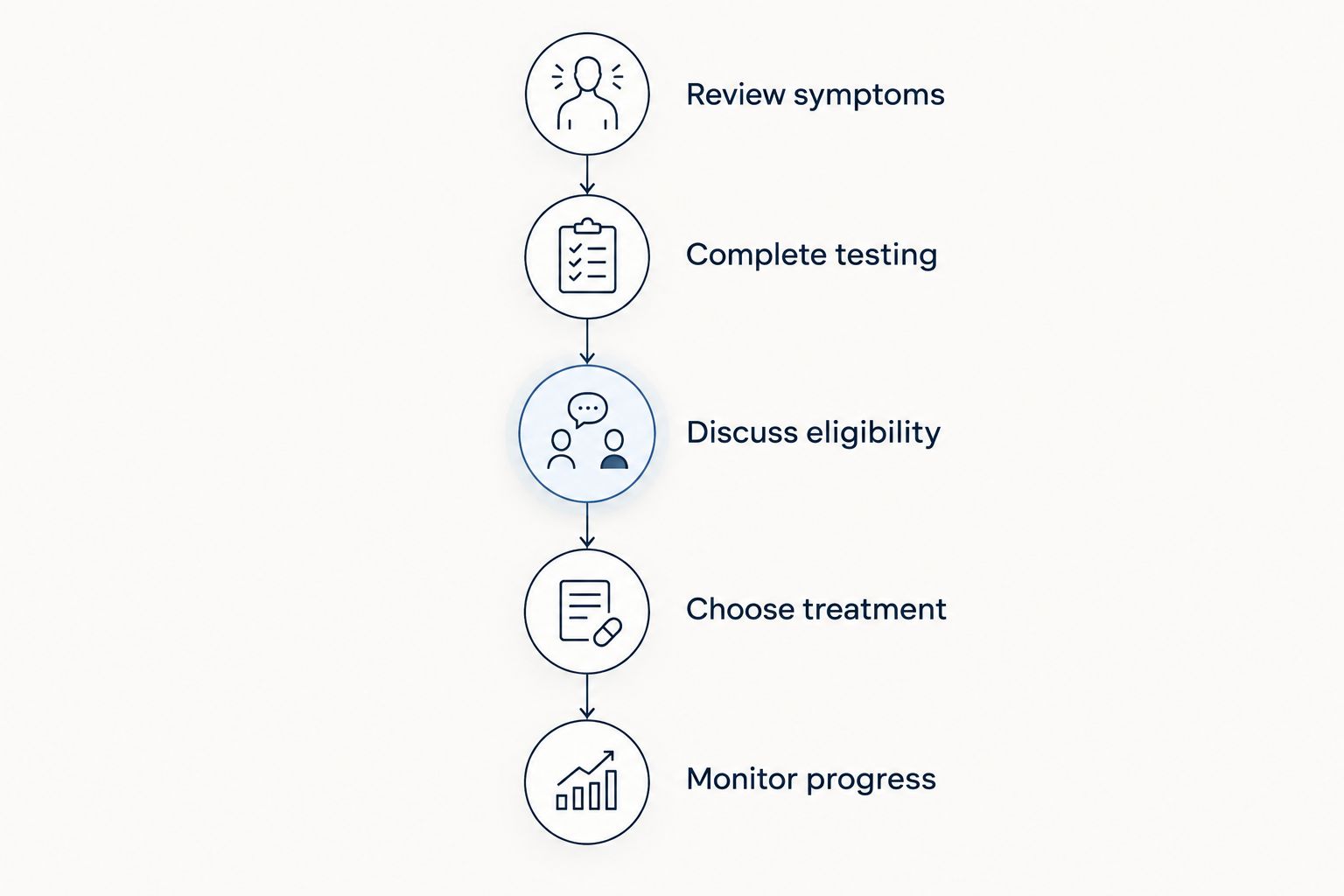
- Review symptoms. Explain what has changed, when it started, and how it affects daily life. Your clinician reviews sexual symptoms, energy, sleep, medical conditions, medications, and previous hormone treatment.
- Complete testing. A clinician orders appropriate blood tests and explains how to prepare. A diagnosis of testosterone deficiency generally requires symptoms or signs plus consistently low testosterone—not one isolated result.
- Discuss eligibility. Your clinician interprets the results, considers other causes of your symptoms, and reviews fertility plans and treatment risks. An appointment does not guarantee a prescription.
- Choose treatment. If TRT is appropriate, you discuss the administration method, practical responsibilities, expected monitoring, and costs. The clinician makes the prescribing decision.
- Monitor progress. Follow-up visits assess symptoms, side effects, testosterone levels, and relevant safety tests. Your plan changes according to clinical findings, not simply because you want a higher testosterone number.
Why this matters
Convenient access is not the same as clinical eligibility. Fatigue, reduced libido, and changes in body composition have several possible causes, including sleep problems, medication effects, and other medical conditions. Treating the wrong cause leaves the underlying problem unresolved.
Online appointments reduce the need to travel for conversations with your clinician. They do not eliminate laboratory visits, physical examinations when needed, or the responsibilities that come with a controlled medication. Choose a care pathway you can maintain after the initial consultation.
What testing do you need before online TRT?
The American Urological Association's Testosterone Deficiency Guideline recommends 2 separate early-morning total testosterone measurements to support diagnosis. Its diagnostic framework uses a total testosterone level below 300 ng/dL as a reasonable cutoff, alongside symptoms or signs. A result below that threshold does not, by itself, establish that treatment is appropriate.
For a 2026 consultation, bring previous laboratory reports with their collection times and reference ranges. Your clinician needs the actual results, not only a message saying your testosterone was low. Acute illness and other circumstances can affect interpretation.
Additional testing depends on your history and findings. Common considerations include:
- Blood count: Hemoglobin and hematocrit help assess whether you already have an elevated red blood cell concentration.
- Hormone signaling: Luteinizing hormone helps distinguish problems involving the testes from problems involving hormonal signaling.
- Additional hormone evaluation: Prolactin or free testosterone testing is appropriate in selected situations, not automatically for every patient.
- Prostate assessment: Your age, history, symptoms, and risk factors guide the discussion about prostate-specific antigen testing and further evaluation.
- Other causes: Your clinician considers whether thyroid disease, sleep apnea, medication effects, or another condition needs attention.
The laboratory panel should answer clinical questions. More tests do not automatically produce a better treatment plan, and you should not assume that laboratory charges are included in a consultation fee.
Which parts happen online, at a lab, or in person?
Online TRT is a mixed care pathway. The appointment format and the testing location serve different purposes; one cannot substitute for the other.
| Care setting | Best for | Practical benefit | Limitation |
|---|---|---|---|
| Telehealth appointment | History review, treatment discussion, and suitable follow-up | Lets you discuss care without traveling to the appointment | Cannot provide blood collection or a hands-on examination |
| Laboratory visit | Measuring testosterone and relevant safety markers | Provides objective information for diagnosis and monitoring | Requires a separate blood draw and preparation instructions |
| In-person evaluation | Findings that require examination or other direct assessment | Allows a clinician to assess concerns that video cannot resolve | Requires travel and separate scheduling |
Ask who orders the labs, where you can complete them, and how the results reach your treating clinician. If you already have recent testing, send it before the appointment when the practice requests it. Your provider decides whether those results are sufficient or need repeating.
Can you receive a testosterone prescription entirely online?
A testosterone prescription depends on medical eligibility and the prescribing rules that apply to your appointment. Testosterone is a Schedule III controlled substance under federal law, so remote prescribing involves requirements beyond those for an ordinary video consultation.
For California and Oregon patients seeking TRT online in 2026, confirm these points before making plans around a prescription:
- Whether the clinician is authorized to treat patients in your state.
- Whether your physical location during the appointment is eligible.
- Whether an in-person evaluation is required for your situation.
- Whether the practice can manage your ongoing follow-up in that location.
- How prescription questions and pharmacy coordination are handled.
Do not assume that a California treatment relationship automatically extends to Oregon. Tell the practice if you travel or move. Your location can affect what care the clinician is permitted to provide, even when you remain an established patient.
How do you choose a TRT administration method?
Your clinician selects an administration method with you after confirming that treatment is appropriate. The decision accounts for your medical history, preferences, ability to use the medication correctly, and monitoring results.
Injections involve needles and administration responsibilities. Topical gels involve skin application and precautions against transferring testosterone to another person. Neither method removes the need for laboratory monitoring or follow-up, and neither is automatically the right choice for every patient.
Use the TRT delivery methods comparison to prepare questions rather than select a prescription yourself. Ask your clinician which practical trade-offs matter in your situation, including application routines, household exposure precautions, and what to do if administration becomes difficult.
Why your online TRT care plan varies
Personalized treatment means the evaluation and follow-up reflect your needs rather than a fixed prescription package. These factors affect the clinical plan and the questions you should ask:
- Symptoms and goals: Describe the specific problems you want evaluated rather than requesting a target testosterone number.
- Laboratory findings: Repeated testosterone results and safety markers inform eligibility and monitoring.
- Fertility plans: Testosterone treatment can suppress sperm production, making future pregnancy plans relevant before prescribing.
- Medical history: Sleep apnea, elevated blood counts, cardiovascular history, and prostate concerns require attention.
- Administration preferences: Your comfort with medication use affects the practical discussion, but does not override safety considerations.
- Location and follow-up: State authorization, examination needs, and your ability to attend testing shape the care pathway.
What risks should you discuss before starting TRT?
Discuss fertility before the first prescription, not after treatment begins. Testosterone supplied from outside the body can reduce the hormonal signals needed for sperm production. If you want children now or later, tell your clinician so the evaluation addresses that goal.
TRT can also increase red blood cell concentration. The American Urological Association guideline identifies hematocrit of 54% or higher during treatment as requiring intervention. This is a safety threshold for clinician management, not an instruction to change or stop medication yourself.
Other issues to discuss include acne, swelling, breast symptoms, sleep apnea, blood pressure, prostate-related symptoms, and medication-specific effects. With topical testosterone, accidental transfer to another person is a separate safety concern. Ask for clear instructions appropriate to the prescribed formulation.
Clinical references for this 2026 educational guide include the American Urological Association's Testosterone Deficiency Guideline and the Endocrine Society's testosterone therapy guideline. These guidelines address diagnosis, patient selection, fertility considerations, and monitoring; your clinician applies them to your history and current findings.
How should you compare self-pay TRT costs?
Bainshealth currently operates as a self-pay, cash-pay practice. Patients pay the practice directly; insurance credentialing has not been completed. Do not interpret possible future insurance participation as current acceptance, or assume that cash-pay means a particular payment method.
For a 2026 consultation, request a clear explanation of the total payment scope before agreeing to treatment. Separate the following items in your questions:
- Initial evaluation and any additional assessment.
- Medication and pharmacy charges.
- Initial and repeat laboratory testing.
- Follow-up appointments and treatment-plan reviews.
- Charges associated with changing or discontinuing care.
Ask which items are included, which are paid separately, and who receives each payment. Transparent pricing means understanding the scope of care—not assuming that an advertised consultation covers every later expense. Insurance benefits elsewhere do not establish coverage or reimbursement for this practice's services.
What happens after you start treatment?
Follow-up evaluates both benefit and safety. Tell your clinician whether the original symptoms have changed, whether medication use is manageable, and whether you have noticed new problems. A laboratory value alone does not describe the whole treatment response.
Bainshealth emphasizes continuity with the same provider and direct provider access. That continuity gives an established clinician context for interpreting changes in your symptoms and health. Ask how to send questions between appointments without assuming a specific response time.
Established patients may also see their own provider for minor ailments or work-note requests up to twice a year, when clinically appropriate. These visits are not described as free, and work notes or appointments are not guaranteed. This practical continuity benefit is not urgent care or unlimited primary care.
Bainshealth is best for patients seeking self-pay TRT care with continuity from the same provider. Book a consultation to discuss suitability, location eligibility, and the full payment scope.
Discuss your TRT options
Ask about evaluation, state eligibility, monitoring, and self-pay costs.
What should you bring to an online TRT consultation?
Bring your medication and supplement list, previous hormone results, relevant medical records, and a clear account of your symptoms. Include previous testosterone use, fertility plans, sleep concerns, and any history of elevated blood counts. Accurate information helps your clinician assess the next step.
Write down the practical questions too: where testing happens, who reviews the results, how follow-up works, and what you pay separately. Leave the consultation with a clinical plan, not merely a prescription expectation. That plan can include further testing or treatment of another condition instead of TRT.
FAQ
Can I start TRT online in California or Oregon in 2026?
You can seek an online evaluation, but starting TRT requires medical eligibility and compliance with applicable prescribing rules. Confirm that the clinician can treat you where you are physically located and ask whether an in-person evaluation is required.
Do I need two testosterone tests before starting TRT?
The American Urological Association recommends 2 separate early-morning total testosterone measurements to support diagnosis. Your clinician also considers symptoms, signs, and the circumstances of the tests.
Does a testosterone level below 300 ng/dL mean I need treatment?
A testosterone level below 300 ng/dL does not automatically mean you need TRT. Diagnosis requires clinical assessment and confirmation of consistently low levels, with other causes and treatment risks considered.
Does Bainshealth accept insurance for online TRT?
Bainshealth currently operates as a self-pay, cash-pay practice and has not completed insurance credentialing. Ask what you pay the practice directly and which medication, laboratory, or follow-up charges are separate.
Can online TRT affect my ability to have children?
TRT can suppress sperm production and affect fertility. Tell your clinician about current or future pregnancy plans before starting treatment so those goals shape the evaluation.
How much does online TRT cost in 2026?
Your payment depends on the specific evaluation, medication, testing, and follow-up arrangement. Request the current fees and included services directly from the practice rather than assuming a consultation covers the entire treatment pathway.
Can I use online TRT care instead of urgent care?
Online TRT follow-up does not replace urgent or emergency care. New or severe symptoms need an appropriate level of assessment, and routine provider messaging does not guarantee an immediate response.
One last thing
A normal follow-up testosterone result does not remove the need to assess side effects, blood counts, and whether treatment is helping the symptoms that prompted care. Before starting, ask: What findings would make us change the plan? That question turns monitoring into a clear shared decision rather than a routine prescription renewal.