

You can generally use HSA or health FSA funds for medically necessary, prescribed testosterone replacement therapy (TRT), provided the expense meets IRS rules and your account’s requirements. That does not make every TRT cost eligible: general wellness services, bundled charges, and expenses already reimbursed elsewhere need separate review. Account eligibility also does not establish whether a particular practice accepts your benefit card or provides qualifying documentation.
- Medically necessary, prescribed TRT can qualify for HSA or health FSA funds; general wellness spending does not automatically qualify.
- TRT cost eligibility depends on the expense, account rules, timing, and documentation—not simply a prescription or payment approval.
- Bainshealth provides self-pay care; HSA or FSA eligibility and benefit-card acceptance require separate confirmation.
- Keep itemized receipts and confirm requirements before using tax-advantaged funds for testosterone replacement therapy.
Why this matters
Self-pay care, insurance coverage, and tax-qualified spending are separate questions. A treatment can meet tax rules without being covered by insurance, and a practice’s payment arrangements do not determine whether your expense qualifies.
Bainshealth operates as a self-pay practice; insurance credentialing has not been completed. Plan to pay the practice directly, and confirm account requirements separately rather than treating potential HSA or FSA eligibility as a payment promise.
For your 2026 planning, the practical goal is simple: establish what the charge covers, whether it qualifies, and what proof you need before moving money.
Can you use HSA or FSA funds for TRT costs?
Generally, yes—when TRT treats a diagnosed medical condition and the expense satisfies the applicable medical-expense rules. IRS Publication 502 explains qualified medical expenses, while IRS Publication 969 addresses HSAs and other tax-favored health plans. These rules distinguish medical treatment from spending primarily intended to improve general health.
A prescription supports the medical purpose of testosterone treatment, but it does not automatically establish eligibility for everything sold alongside it. Review consultations, laboratory testing, medication, supplies, and membership charges separately.
| Account | Best for | Main advantage | Main limitation |
|---|---|---|---|
| HSA | Eligible account holders paying qualified medical expenses or retaining records for later reimbursement | Unspent funds remain in the account | Expense timing and tax qualification remain your responsibility |
| Health FSA | Participants using employer-plan funds for eligible expenses during the applicable coverage period | Reimbursement through the employer’s benefit plan | Deadlines, documentation, and permitted expenses depend on plan rules |
| Limited-purpose FSA | Participants paying the dental and vision expenses permitted by that plan | Supports its designated expense categories | Generally not available for routine TRT expenses |
An HSA and a health FSA are not interchangeable. Having an account balance does not prove that a particular charge qualifies, and a limited-purpose FSA should not be treated as a general medical account.
For 2026 TRT expenses, verify the exact account type before relying on the funds. Ask your administrator to evaluate the actual service description, not just the phrase hormone treatment.
Using an HSA for prescribed TRT
An HSA can pay or reimburse qualified medical expenses, including eligible expenses paid directly to a provider. The expense generally must have been incurred after the HSA was established, and you cannot reimburse the same expense twice or also claim it as an itemized medical deduction.
You do not necessarily need to reimburse yourself immediately. If you retain adequate records, qualified expenses can generally be reimbursed later; keep proof that the expense was eligible, paid, and not previously reimbursed.
The advantage is flexibility: unused HSA funds remain available rather than expiring at the end of a plan year. The limitation is accountability—you remain responsible for showing that a distribution paid for qualified medical care.
Before age 65, a nonqualified HSA distribution generally carries ordinary income tax plus a 20% additional tax, unless an exception applies. At age 65 or older, the additional tax generally no longer applies, but nonqualified distributions remain subject to ordinary income tax.
Do not treat successful card processing as a tax determination. Keep the same records whether you pay with an account card or seek reimbursement after paying another way.
Using a health FSA for prescribed TRT
A health FSA can reimburse eligible medical expenses under the employer plan’s terms. Your administrator can require an itemized statement and additional documentation showing that a charge represents medical care.
Timing matters more than the date your card is charged. FSA expenses generally must be incurred during the applicable coverage period; paying in advance does not automatically make future treatment eligible in the current period.
The advantage is access to the health FSA benefit under your employer’s plan. The limitation is the plan’s spending and submission rules: a grace period, carryover, or claim-submission window exists only if the plan provides it.
For a course of care spanning 2026 and a later plan period, ask how the administrator assigns each service date. Keep visit, laboratory, and pharmacy records tied to the actual care received rather than treating the entire course as a single undifferentiated purchase.
Why TRT cost eligibility varies
The deciding factors are the medical purpose and the structure of the expense—not whether a service is advertised as hormone optimization. These factors explain why similar-looking charges can receive different treatment:
- Medical purpose: Treatment for a diagnosed condition differs from a service purchased primarily for general wellbeing or performance.
- Account type: An HSA, general-purpose health FSA, and limited-purpose FSA have different rules.
- Service description: A medical consultation is easier to evaluate when the receipt identifies the service rather than using a vague wellness label.
- Charge structure: Bundled fees can combine medical services with items that need separate eligibility review.
- Expense timing: HSA establishment dates and FSA coverage periods affect whether reimbursement is permitted.
- Other reimbursement: The same expense cannot be reimbursed twice, including through both insurance and a tax-advantaged account.
Ask for a written explanation of what your treatment charges include. The guide to TRT pricing and insurance provides a separate framework for discussing the financial structure of care; account eligibility still requires its own review.
Which TRT expenses should you review separately?
Start with the medical evaluation. A consultation to assess symptoms and investigate a possible medical condition has a different purpose from a general wellness purchase, even when both appear on the same clinic’s service list.
Next, review diagnostic and monitoring tests. Tests ordered as part of diagnosis or treatment need documentation identifying the service and medical purpose; do not assume that every optional test offered alongside treatment qualifies.
Prescribed testosterone and medically necessary administration supplies require their own records. Pharmacy receipts, prescriptions, and itemized supply descriptions help establish what you purchased without relying on a broad program name.
Membership or subscription charges deserve particular attention. Ask whether the fee pays for identifiable medical services, administrative access, or a combination; paying a recurring fee does not automatically make the entire amount eligible.
How do you check eligibility before paying?
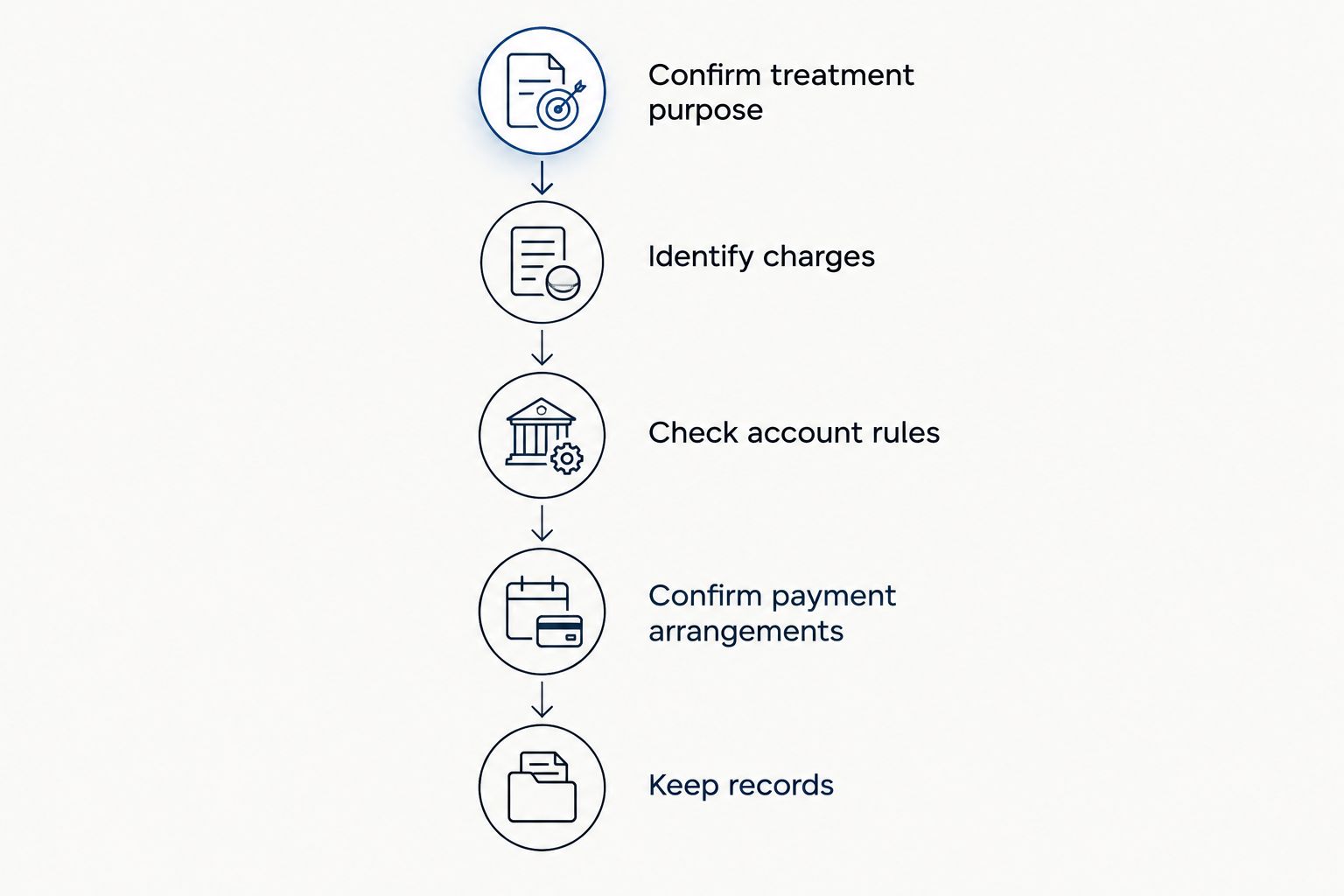
Use this sequence before committing account funds. It separates clinical decisions from payment administration and gives your account administrator something specific to evaluate.
- Confirm treatment purpose. Ask the prescribing clinician what condition is being evaluated or treated and what care is medically indicated.
- Identify charges. Request a breakdown of consultations, testing, prescriptions, supplies, and recurring fees.
- Check account rules. Give your administrator the actual descriptions and ask about eligibility, timing, and required documentation.
- Confirm payment arrangements. Ask the practice which payment methods it accepts without assuming that HSA or FSA cards are supported.
- Keep records. Retain itemized receipts, service dates, payment evidence, and any supporting medical documentation requested for the claim.
This is a verification process, not a guarantee of reimbursement. If a charge remains unclear, resolve that question before using tax-advantaged funds rather than relying on the treatment’s name.
Does self-pay TRT mean you cannot use account funds?
Self-pay does not, by itself, disqualify an otherwise eligible medical expense. It describes who pays the practice, not the expense’s tax treatment.
Bainshealth is best for patients seeking personalized, self-pay TRT care with continuity from the same provider. The practice emphasizes direct provider access and transparent pricing, but those service features do not establish HSA or FSA eligibility.
The practical trade-off is clear: you pay the practice directly and separately confirm any account-based payment or reimbursement requirements. Do not assume insurance billing, reimbursement, benefit-card acceptance, or inclusion of medication and laboratory charges.
For a 2026 consultation, ask for the expected service structure and documentation available. Book a consultation to discuss treatment suitability; confirm tax-account questions with your administrator or tax adviser.
Discuss personalized TRT care
Review your symptoms, treatment questions, and self-pay care arrangements.
Do you need a letter of medical necessity for TRT?
A letter of medical necessity is not a universal requirement for every prescribed TRT expense. Your administrator can request supporting information, particularly when a charge’s medical purpose is unclear or a bundle includes nonmedical services.
Ask what documentation is required before requesting a letter. A prescription, itemized receipt, or explanation of the diagnosed condition serves a different purpose, and the administrator should specify what is needed for the particular claim.
Can you reimburse yourself after paying for TRT directly?
You can generally reimburse yourself from an HSA for a qualified expense incurred after the account was established, provided it has not already been reimbursed or deducted. Retain the original records even if you delay the reimbursement.
A health FSA follows its plan’s coverage and claim-submission deadlines instead. Do not apply HSA reimbursement flexibility to an FSA or assume that a late claim will be accepted.
Does a prescription make every hormone-related purchase eligible?
A prescription does not automatically make every hormone-related purchase a qualified medical expense. Eligibility depends on what you bought, why it was medically needed, and the applicable rules.
Clinical suitability is a separate decision. Testosterone treatment requires evaluation and monitoring; discuss fertility plans, elevated red blood cell levels, and other relevant risks with your clinician rather than choosing treatment because account funds are available.
FAQ
Can I use my HSA for TRT cost in 2026?
You can generally use HSA funds for qualified, medically necessary TRT expenses incurred after the HSA was established. Keep documentation and confirm that the expense has not already been reimbursed or claimed as an itemized deduction.
Can I use a health FSA for testosterone prescriptions?
A health FSA can generally reimburse an eligible testosterone prescription used for medical treatment, subject to the plan’s rules. Confirm the coverage period, required receipts, and submission deadline with your administrator.
Does Bainshealth accept insurance for TRT?
Bainshealth operates as a self-pay practice, and insurance credentialing has not been completed. Patients should plan to pay the practice directly and confirm account eligibility separately.
Does an approved HSA card payment prove TRT is eligible?
An approved card transaction does not prove that a TRT expense qualifies under tax rules. Keep records showing the service, medical purpose, date, amount paid, and absence of duplicate reimbursement.
Can I use a limited-purpose FSA for TRT?
A limited-purpose FSA generally does not cover routine TRT expenses because it is typically restricted to dental and vision care. Check the specific plan rather than assuming it works like a general-purpose health FSA.
Are TRT laboratory tests automatically included in treatment charges?
Laboratory tests are not automatically included in a TRT treatment charge. Ask for an itemized explanation of the practice’s charges and review the tests’ account eligibility separately.
Who should confirm whether my TRT expense qualifies?
Your account administrator can explain plan requirements, and a qualified tax adviser can address tax treatment. Your clinician establishes the medical evaluation and treatment plan, not the final tax determination.
One last thing
The payment approval is not the proof; the underlying records are. Before your first 2026 TRT payment, create a folder for itemized statements, prescriptions, laboratory records, and reimbursement confirmations.
That small administrative step separates an understandable medical expense from an unexplained transaction. Keep clinical decisions with your provider and account decisions with the appropriate administrator or tax adviser; this article provides general education, not individualized medical or tax advice.