

Telehealth primary care can assess mild cold symptoms, seasonal allergies, uncomplicated skin concerns, digestive complaints, and some urinary symptoms when your history and a remote examination provide enough information. Assessment does not guarantee a diagnosis or prescription: symptoms that require hands-on examination, testing, or emergency treatment need a different setting.
- Telehealth primary care suits stable, mild symptoms; testing or a physical examination can still be necessary.
- Bainshealth suits established patients seeking minor-ailment assessment with their own provider, when clinically appropriate.
- Chest pain, severe breathing difficulty, and stroke symptoms require emergency care, not an online appointment.
- Prepare your symptom timeline, medication list, allergies, and relevant photographs before your consultation.
Why this matters
The useful question is not simply whether you can discuss a symptom online. It is whether the clinician can safely decide what to do without examining you in person. A video appointment can establish the next step even when it cannot settle the diagnosis.
For patients considering Bainshealth telehealth primary care in 2026, continuity means discussing a new concern with a provider who knows your treatment history. Established patients may see their own provider for minor ailments or work-note requests up to twice a year, when clinically appropriate. This is not urgent care or unlimited primary care, and a work note is not guaranteed.
Which minor ailments can telehealth primary care assess?
Telehealth primary care can assess common, nonemergency symptoms through your history, visible findings, and available home measurements. The examples below describe general telehealth use, not a promise that a particular practice treats every condition remotely.
| Concern | Best for remote assessment | Useful information | Main limitation |
|---|---|---|---|
| Cold, cough, or sore throat | Mild symptoms without breathing or swallowing difficulty | Symptom onset, fever history, exposures | Lung examination or throat testing can be necessary |
| Seasonal allergies | Familiar sneezing, itching, or watery eyes | Triggers, seasonal pattern, previous treatment | Wheezing, eye pain, or unusual symptoms need closer assessment |
| Limited skin concerns | A visible, localized rash without systemic illness | Clear photographs, spread, new exposures | Touch, a full examination, or testing can change the diagnosis |
| Mild digestive symptoms | Stable symptoms while you can drink fluids | Pain location, vomiting, bowel changes | Severe pain, bleeding, or dehydration needs in-person assessment |
| Urinary symptoms | Initial review of burning, urgency, or frequency | Fever, back pain, pregnancy possibility | Urine testing or an examination can be necessary |
| Mild headache | A familiar pattern without neurological symptoms | Onset, usual pattern, associated symptoms | Sudden or unusual headache needs prompt assessment |
An online assessment is a decision about safe care, not a guarantee of remote treatment. Tell the clinician about the symptom that worries you most before discussing convenience or requesting medication.
Can cold, cough, and allergy symptoms be assessed online?
A clinician can review mild congestion, sneezing, sore throat, and cough by asking about onset, exposures, fever, and breathing. Video can show your general appearance and breathing effort, but it cannot replace listening to your lungs or performing a throat swab.
Describe what you can still do. Being able to drink, speak comfortably, and manage ordinary activity helps explain symptom severity, although none of these observations rules out serious illness.
For allergy-type symptoms, describe itching, watery eyes, likely triggers, and whether the pattern feels familiar. New wheezing, eye pain, or symptoms that differ from your usual allergies deserve separate attention rather than an automatic assumption that allergies explain everything.
Do not treat an antibiotic prescription as the measure of a successful visit. Antibiotics do not treat viral colds, and some throat or respiratory complaints require testing before treatment decisions. A useful consultation gives you an assessment, symptom-management guidance, and clear instructions about when to seek further care.
Can a provider assess a rash over video?
A remote visit can help assess a localized rash, mild acne concerns, or an apparent irritation when the skin is clearly visible. Photographs help the clinician review location and change over time, but an image does not show warmth, tenderness, or every detail needed for diagnosis.
Prepare photographs in good light without filters. Include a wider view showing the affected body area and a closer view showing the skin change; share sensitive images only through the practice's approved process.
Explain whether the rash itches, hurts, blisters, spreads, or follows a new medicine or skin product. Mention fever and involvement of your eyes, mouth, or genitals rather than relying on the photograph alone.
A rapidly spreading painful rash, widespread blistering, or skin symptoms with significant illness require prompt in-person assessment. Lip or tongue swelling with breathing difficulty is an emergency, not a routine rash appointment.
Can digestive or urinary symptoms be assessed remotely?
Mild nausea, brief diarrhea, constipation, or familiar reflux symptoms can start with a remote assessment if you are otherwise stable. The clinician needs to know whether you can keep fluids down, where pain occurs, and whether there is blood in vomit or stool.
Abdominal pain is a particular limitation of telehealth because a clinician cannot reliably examine your abdomen through a screen. Severe or worsening pain, persistent vomiting, fainting, or signs of dehydration call for in-person evaluation rather than repeated online reassurance.
Burning with urination, urgency, and frequency can also be discussed remotely. These symptoms do not establish a urinary tract infection by themselves; urine testing or examination can be necessary, especially when symptoms are recurrent or accompanied by other concerns.
Tell the clinician about fever, back or flank pain, pregnancy possibility, genital symptoms, and difficulty passing urine. These details change the assessment and help avoid treating a potentially complicated problem as a simple infection.
Why the right care setting varies
The symptom name alone does not determine whether telehealth is appropriate. In 2026, the same complaint can still lead to home-care advice, testing, an office examination, or emergency referral depending on the circumstances.
- Severity: Mild congestion and severe breathing difficulty require different responses, even when both begin during a respiratory illness.
- Progression: A stable complaint differs from symptoms that are rapidly worsening or changing character.
- Medical history: Pregnancy, immune suppression, and significant underlying disease affect how cautiously a clinician assesses a new problem.
- Examination needs: Ear pain, abdominal pain, and some breathing complaints require information that video cannot reliably provide.
- Testing needs: A suspected infection or another condition can require a sample, measurement, or diagnostic test before treatment.
- Visit limitations: Poor connection quality, unclear images, or inability to describe symptoms can prevent a safe remote assessment.
Choose the setting that can answer the clinical question, not simply the setting that is easiest to book. If an examination is necessary, switching to in-person care is part of appropriate treatment rather than a failed telehealth visit.
What happens during a minor-ailment telehealth assessment?
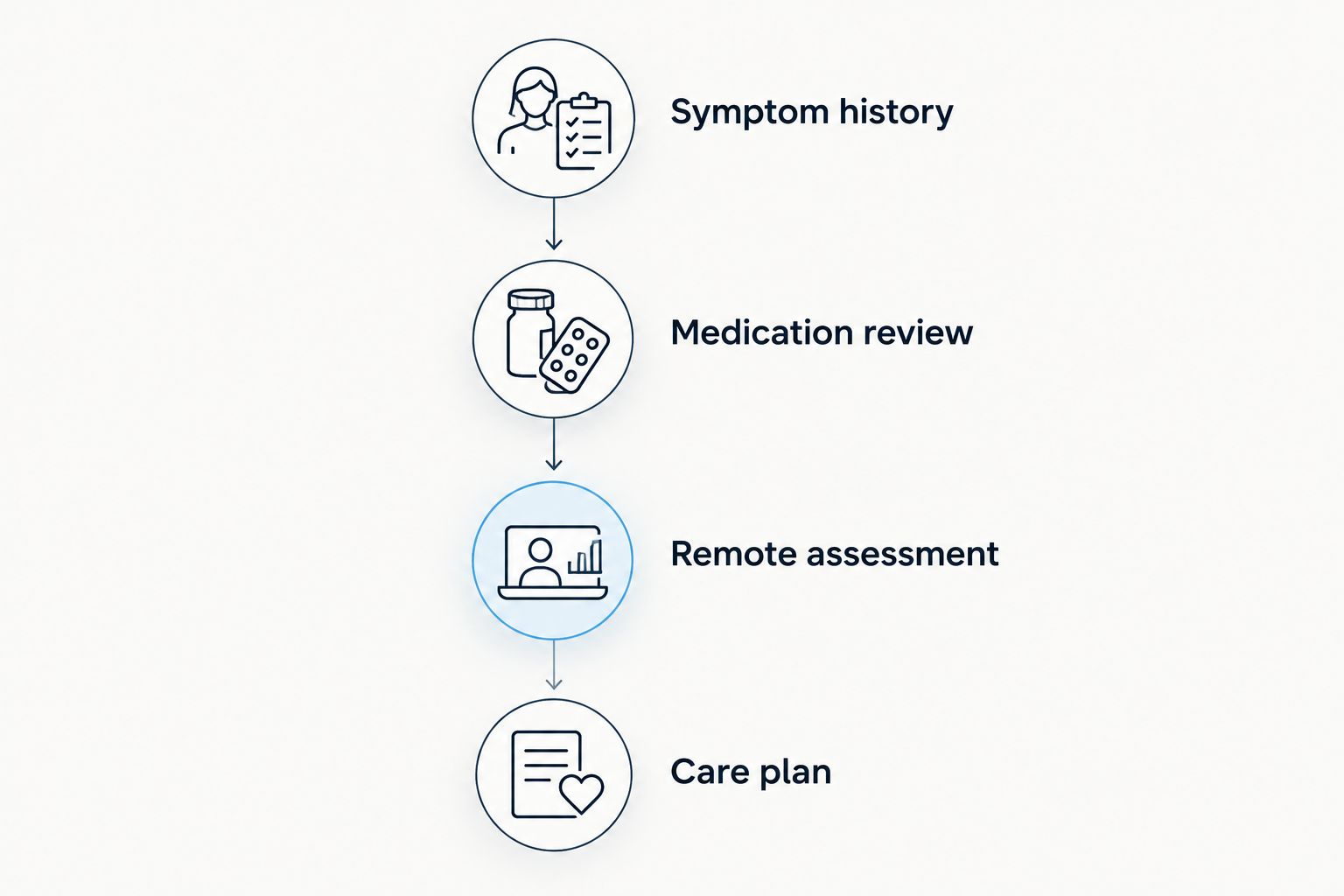
A useful consultation follows a clinical sequence: describe the problem, review relevant risks, assess what can be observed remotely, and agree on the next step. This preparation checklist applies to a 2026 telehealth appointment without assuming that every practice uses the same booking process.
- Symptom history: State what started first, when it began, what has changed, and what makes it better or worse. Describe severity in practical terms, such as whether discomfort interrupts sleep or prevents drinking.
- Medication review: List prescriptions, over-the-counter medicines, supplements, allergies, and recent medication changes. Include ongoing hormone therapy or weight-loss treatment when relevant.
- Remote assessment: Have photographs and any available home readings ready. Explain how you obtained a reading; do not buy equipment or delay needed care just to collect measurements.
- Care plan: Ask what the clinician thinks is happening, what remains uncertain, and whether testing or an examination is needed. Confirm what to do if symptoms change.
Before the appointment ends, repeat the plan back in your own words. Ask where to obtain any recommended testing and how results will be reviewed, rather than assuming that ordering a test completes the follow-up.
When should you skip telehealth and seek emergency care?
Call 911 for symptoms suggesting an immediate threat to life, including severe breathing difficulty, possible stroke, or severe chest pain. Do not wait for a portal reply, a scheduled video visit, or confirmation from your usual provider.
Emergency warning signs include:
- New facial drooping, arm weakness, or difficulty speaking.
- Severe chest pressure, especially with breathlessness, sweating, or fainting.
- Marked difficulty breathing, blue or gray lips, or inability to stay awake.
- Swelling of the tongue or throat with breathing difficulty.
- Sudden, extremely severe headache or headache with new neurological symptoms.
These examples are not an exhaustive list. If you believe the situation is immediately dangerous, use emergency services; if you are unsure about the appropriate setting for a nonemergency concern, seek timely clinical guidance rather than waiting for symptoms to become severe.
Can your usual provider help with a minor illness?
Bainshealth telehealth primary care is best for established patients seeking clinically appropriate minor-ailment assessment with their own provider. Familiarity with your medication history and ongoing care gives the conversation context; it does not remove the need for an examination or testing when indicated.
The practical benefit is continuity and direct provider access, not a promised response time or guaranteed appointment. Bring minor symptoms to your provider's attention without assuming they are unrelated to an existing treatment.
For example, nausea during medical weight-loss treatment deserves a medication review rather than an automatic diagnosis of a stomach illness. A symptom's timing is useful evidence, but timing alone does not prove its cause.
Discuss your care needs
Ask whether your symptoms are appropriate for a consultation with your provider.
What should you clarify before booking?
Bainshealth operates as a self-pay practice in 2026. You pay the practice directly; do not assume insurance billing, reimbursement, medication coverage, or laboratory coverage.
Before booking, ask what the appointment includes, how additional testing is handled, and how follow-up is arranged. Transparent pricing means understanding the scope of care before agreeing to it, not assuming that every related service is included.
For prospective patients in California and Oregon, confirm whether the provider can see you in the state where you will physically be during the appointment. Also explain whether you are seeking ongoing care or help with a new symptom so the practice can clarify the appropriate visit.
FAQ
Can telehealth primary care diagnose a cold or the flu?
Telehealth primary care can assess symptoms consistent with a respiratory infection, but symptoms alone do not always identify the cause. Testing or an in-person examination can be necessary before a diagnosis or treatment decision.
Can I get antibiotics through a telehealth visit?
A telehealth visit does not guarantee antibiotics. A clinician prescribes them only when appropriate, and some suspected infections require testing or an examination first.
Can a virtual appointment assess a urinary tract infection?
A virtual appointment can assess urinary symptoms and determine whether testing or in-person care is needed. Fever, flank pain, pregnancy possibility, or difficulty passing urine changes the assessment.
Can I show a rash to a provider on video?
You can show a rash on video and provide clear photographs through the practice's approved process. Pain, rapid spread, blistering, or significant illness can make an in-person assessment necessary.
Can my provider write a work note after a telehealth visit?
A provider can consider a work-note request after an appropriate assessment, but a note is not guaranteed. The decision depends on the clinical circumstances and what the provider can reasonably document.
Does Bainshealth accept insurance for minor-ailment appointments?
Bainshealth currently operates as a self-pay practice and does not accept insurance. Ask what your consultation includes and clarify any separate testing or treatment charges before booking.
What should I bring to a telehealth appointment in 2026?
Bring your symptom timeline, medication list, allergies, and any relevant photographs or available home readings. Be ready to state your current physical location and describe any worsening symptoms.
One last thing
Leave the consultation knowing what would change the plan. A working assessment is useful only when you also know which symptoms require reassessment, where to obtain recommended testing, and when in-person care becomes necessary. Ask that question even when your symptoms seem minor.