

Ask an online TRT provider how they confirm low testosterone, assess fertility and other risks, arrange laboratory monitoring, and support you between appointments. Before starting TRT online in 2026, also establish who manages your care, whether they can treat you in your state, and what you will pay directly for consultations, medication, testing, and follow-up.
- TRT online requires a clinical assessment, appropriate testosterone testing, and a follow-up plan—not just a prescription.
- Bainshealth suits self-pay TRT patients seeking personalized care, provider continuity, and direct provider access.
- Discuss fertility before testosterone replacement therapy; treatment can suppress sperm production.
- Ask who reviews laboratory results, manages side effects, and explains separate treatment charges.
What should you ask an online TRT provider?
Ask for the clinical plan before discussing a prescription. Your consultation should establish whether testosterone replacement therapy is appropriate, what information supports that decision, and how your provider will assess treatment over time.
For patients considering Bainshealth, the practice's self-pay model means you pay the practice directly. Discuss the scope of care and payment responsibilities before agreeing to treatment; do not assume medication or laboratory testing is included.
Use these questions during your 2026 consultation:
| Question to ask | What the answer should establish |
|---|---|
| How will you confirm that I need TRT? | Symptoms, medical history, and appropriate laboratory evidence |
| Can you treat me where I am located? | State-specific eligibility and any required in-person assessment |
| How will TRT affect my fertility? | Reproductive goals and the consequences of testosterone treatment |
| Which baseline tests do I need? | Safety assessment and a plan for interpreting results |
| Why are you recommending this treatment method? | Practical benefits, limitations, and individual suitability |
| Who handles follow-up and side effects? | A named treating provider and clear communication arrangements |
| What will I pay directly? | Written clarification of included services and separate charges |
| What happens if treatment is not helping? | Reassessment rather than automatic continuation |
You do not need to interpret every laboratory result yourself. You need a provider who explains how the findings affect your care and gives you a clear next step.
Why this matters
Online appointments change where you meet your clinician, not the need for diagnosis and monitoring. Fatigue, reduced libido, and changes in body composition do not establish testosterone deficiency on their own. Sleep problems, medication effects, and other health conditions can produce overlapping symptoms.
In 2026, evaluate TRT online as an ongoing medical relationship rather than a one-time purchase. Convenient appointments help you attend care; they do not replace a careful assessment or a plan for responding to abnormal results.
A consultation should leave you understanding both the reason to treat and the reasons not to treat. If those explanations are missing, ask for clarification before proceeding.
How will you confirm that I need TRT?
Ask which symptoms and laboratory findings support the diagnosis. In general clinical practice, testosterone deficiency is assessed using compatible symptoms and consistently low testosterone measurements, typically confirmed with 2 separate early-morning blood tests. Your clinician should explain whether illness, disrupted sleep, or other circumstances affect how your results are interpreted.
A useful question is: What else could explain my symptoms? This keeps the assessment focused on your health rather than assuming testosterone is the answer to every concern.
Ask whether additional testing is needed to understand the cause of a low result. Depending on your history, your provider can explain whether tests of related hormones or free testosterone would change the treatment decision. Not every patient needs an identical laboratory panel.
What if my symptoms and test results do not match?
Ask the provider to explain the mismatch rather than treating a single number. Symptoms with normal testosterone results warrant assessment for other causes; a low measurement without compatible symptoms also needs clinical interpretation.
Bring previous laboratory reports with their collection times and reference ranges. A screenshot showing only the testosterone value leaves out information your clinician needs.
Can you treat me in California or Oregon?
For a 2026 telehealth appointment, confirm that the clinician can provide care in the state where you will physically be during the visit. Tell the practice your location when booking, including any planned travel that would change where you attend follow-up appointments.
Patients in California and Oregon should ask this question before submitting records or arranging testing. A website offering online consultations does not, by itself, establish that a particular clinician can prescribe for every patient in either state.
Also ask whether your assessment requires an in-person examination or another local service. Telehealth is useful for discussion and follow-up, but some findings need physical examination. Know how the practice handles that situation before you need it.
How will TRT affect my fertility?
Discuss fertility before starting testosterone—not after a prescription has been issued. Testosterone treatment can suppress sperm production because externally supplied testosterone reduces the hormonal signals involved in sperm production.
Tell your provider whether you want children now, later, or are uncertain. Ask how those goals change the assessment and whether referral to a reproductive specialist is appropriate. TRT is not a reliable contraceptive, even though it can reduce fertility.
Do not assume a fertility concern can be solved by adding another medication. Any alternative approach requires an individual prescribing decision, and no treatment should come with a guarantee that fertility will be preserved or restored.
What other health history should I disclose?
Bring a complete medication and supplement list, including testosterone or anabolic steroid use outside prescribed care. Discuss sleep apnea, cardiovascular history, prostate concerns, previous abnormal blood counts, and any relevant cancer history.
These details help your clinician assess safety. They are not reasons to hide information out of concern that treatment will be delayed; they are reasons to make the consultation more accurate.
Which tests will you order and monitor?
Ask what each proposed test is intended to answer. Testosterone measurements help assess the diagnosis and treatment response. A complete blood count includes hematocrit, the proportion of blood made up of red blood cells; testosterone can increase this measurement.
Prostate assessment, including whether PSA testing is appropriate, depends on factors such as age, history, and individual risk. Your provider should explain the purpose of testing rather than presenting every test as necessary for every patient.
Make the monitoring arrangement concrete:
- Who orders the laboratory tests?
- Where can you have blood collected?
- Who reviews the results and explains them to you?
- How does the timing of your medication affect the timing of testing?
- What happens if a result requires reassessment?
A laboratory order is not a monitoring plan. The plan also needs responsibility for reviewing findings and deciding what happens next. Do not adjust medication yourself in response to a laboratory portal alert.
Why are you recommending this TRT delivery method?
Ask how the proposed method fits your routine, medical history, and ability to use it correctly. The consultation should cover practical demands and safety precautions, not simply describe the method as convenient.
For a preparation applied to the skin, ask about preventing accidental transfer to another person. For an injectable preparation, ask what administration training and disposal arrangements you need. The provider should explain the precautions relevant to the treatment actually prescribed.
You can review TRT delivery methods for men compared to prepare questions. The final choice belongs in a clinical discussion, not a preference selected without reviewing the trade-offs.
Also ask what would justify changing the method. Difficulty following the routine, adverse effects, or an inadequate response should prompt discussion rather than an unsupervised switch.
Who will support me between appointments?
Ask whether you will follow up with the same clinician and how to contact that clinician about symptoms, results, or medication questions. Direct provider access is useful only when you understand the appropriate communication route and the limits of that service.
Bainshealth emphasizes continuity with the same provider, convenient appointments, and direct provider access. These are practical features for self-pay TRT patients who want their ongoing care connected to an established clinical relationship; they do not imply a guaranteed response time or unlimited appointments.
Established patients may also see their own provider for minor ailments or work-note requests up to twice a year, when clinically appropriate. This does not guarantee a work note, urgent care access, or waived charges.
Ask how care is handled when symptoms require an examination or a service outside the practice's scope. For severe chest pain, sudden breathing difficulty, or stroke symptoms, seek emergency care rather than waiting for a telehealth message.
What will I pay directly for TRT online?
Request a written explanation of the financial arrangement before starting. Separate the clinical services from medication dispensing and laboratory testing so you understand which charges belong to which part of care.
Bainshealth currently operates as a self-pay, cash-pay practice. Insurance credentialing has not been completed, so patients should not expect the practice to bill or accept insurance. Self-pay does not mean cash is the only payment method; ask which payment methods the practice accepts.
For your 2026 consultation, clarify whether the payment arrangement includes follow-up visits, result review, prescription management, and communications between visits. Ask separately about medication and laboratory expenses rather than assuming they are covered by a consultation or ongoing-care charge.
Insurance can be relevant as general background when comparing healthcare arrangements, but it does not change this practice's current self-pay model. Do not assume reimbursement, medication coverage, or HSA/FSA eligibility without confirming the applicable requirements independently.
Why does an online TRT care plan vary?
An appropriate plan reflects the person being treated. These factors explain why your evaluation or follow-up can differ from another patient's:
- Symptoms and laboratory findings: The diagnosis depends on the clinical picture, not a testosterone value alone.
- Fertility goals: Plans for children affect whether testosterone treatment is appropriate.
- Medical history: Blood counts, sleep apnea, prostate concerns, and other conditions shape safety decisions.
- Treatment method: Administration requirements and testing timing differ by the prescribed preparation.
- Location: Your physical location affects telehealth eligibility and arrangements for local care.
- Response to treatment: Symptoms, adverse effects, and laboratory findings guide reassessment.
A different plan is not automatically better or worse. Ask your clinician to connect each recommendation to a specific clinical or practical reason.
What happens if TRT is not helping?
Ask how the provider will distinguish an inadequate response from symptoms caused by something else. Follow-up should review your original concerns, adverse effects, medication use, and laboratory findings—not just renew the prescription.
Agree on the concerns you want to track before treatment starts. Examples include libido, energy, and the symptoms that led you to seek evaluation. Improvement is not guaranteed, and a higher testosterone measurement does not automatically mean your overall health has improved.
If treatment needs to change or stop, ask for a supervised plan. Do not change the dose, add hormones, or discontinue prescribed treatment based solely on online advice.
How should you prepare for the consultation?
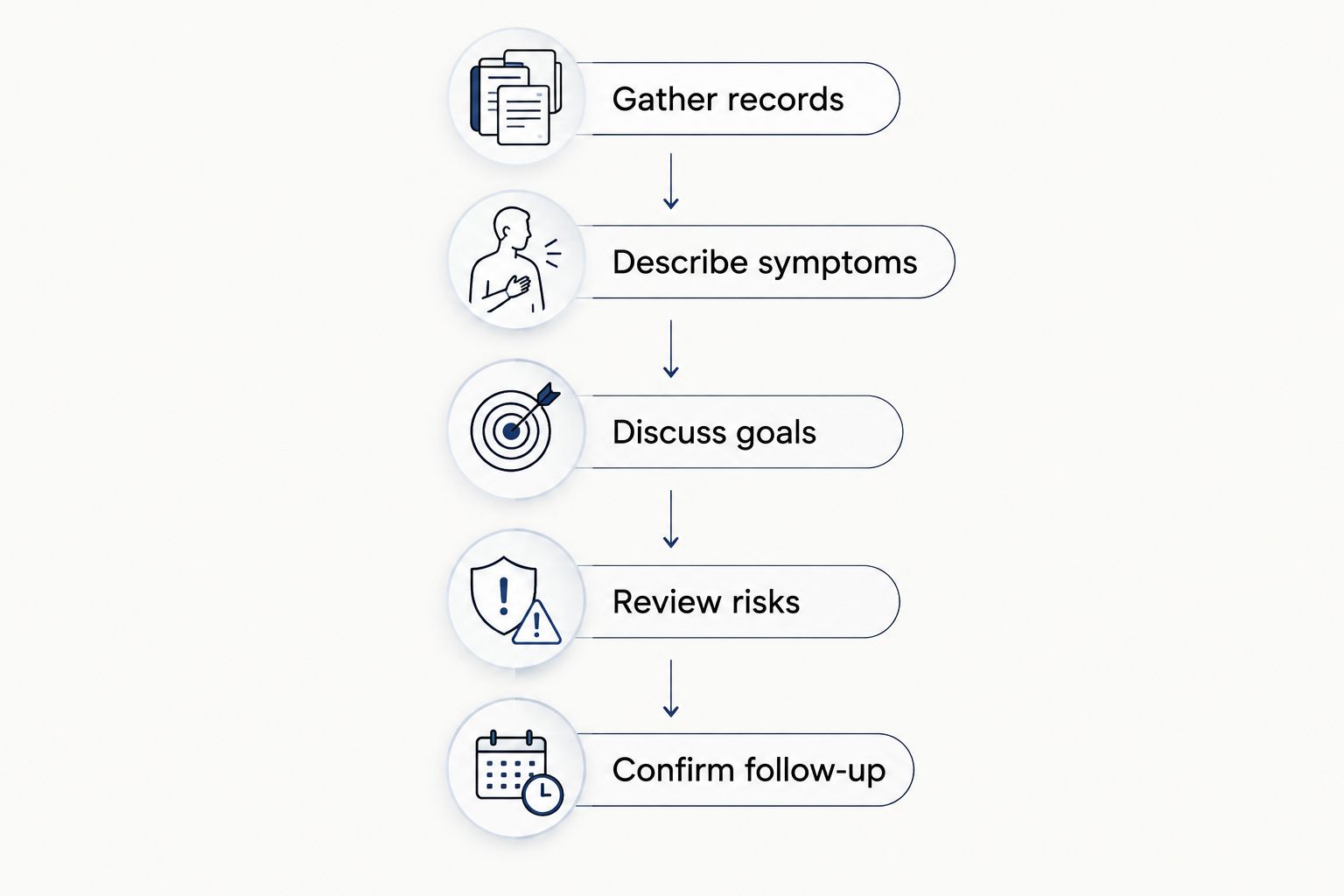
Use this sequence to turn general questions into an individual discussion:
- Gather records. Bring previous testosterone results, other relevant laboratory reports, and your medication and supplement list.
- Describe symptoms. Explain what has changed, when it began, and how it affects daily life.
- Discuss goals. Include fertility plans and what you hope treatment will address.
- Review risks. Ask which concerns apply to your history and what monitoring is needed.
- Confirm follow-up. Establish communication arrangements and payment responsibilities before proceeding.
The goal is a decision you understand, including the possibility that TRT is not appropriate. You do not need to arrive with a preferred prescription.
FAQ
Can I start TRT online without blood tests?
TRT should not begin without an appropriate clinical assessment and laboratory evidence. Diagnosis generally uses compatible symptoms and 2 separate early-morning testosterone measurements, interpreted by your clinician.
What should I ask an online TRT provider about fertility?
Ask how testosterone treatment could affect sperm production and whether your reproductive goals change the treatment recommendation. TRT can suppress sperm production and is not reliable contraception.
Can an online TRT provider treat me in California or Oregon?
The clinician must be able to provide care where you are physically located during the appointment. Confirm eligibility with the practice before booking, including any need for an in-person assessment.
Does Bainshealth accept insurance for TRT?
Bainshealth currently operates as a self-pay, cash-pay practice and does not accept or bill insurance. Ask what you will pay directly and which medication or laboratory charges are separate.
How often will I need TRT laboratory monitoring?
Your clinician should set the monitoring schedule based on your treatment, history, and results. Ask when tests are due, how medication timing affects testing, and who explains the findings.
Can established patients ask their provider about minor ailments?
Established patients may see their own provider for minor ailments or work-note requests up to twice a year, when clinically appropriate. This does not promise waived charges, guaranteed appointments, or guaranteed work notes.
What should I do if TRT causes side effects?
Contact your treating clinician for assessment rather than changing medication yourself. Severe chest pain, sudden breathing difficulty, or stroke symptoms require emergency care rather than a routine telehealth message.
One last thing
Before committing to TRT online in 2026, ask who will explain your next abnormal laboratory result. That question tests whether you are choosing an ongoing care relationship or simply arranging access to a prescription.
Request a consultation to discuss your symptoms, fertility goals, monitoring needs, and self-pay responsibilities. The right next step is an informed clinical decision—not an assumed prescription.