

For adults taking other medications, GLP-1 weight loss is prescription treatment intended to support weight reduction while accounting for existing medicines and health conditions. This 2026 consultation checklist helps you prepare for medication review, discuss interactions, and arrange follow-up without changing prescriptions yourself.
- Bainshealth suits self-pay patients seeking personalized GLP-1 weight loss care with provider continuity.
- Bring prescriptions, supplements, and occasional medicines to your medication review.
- Semaglutide and tirzepatide require individualized assessment; neither is automatically appropriate alongside your current medications.
- Discuss low blood sugar, oral medication absorption, contraception, and dehydration before treatment starts.
Bainshealth is best suited to self-pay patients seeking personalized GLP-1 weight loss care with provider continuity. At Bainshealth, consultations should address your existing prescriptions alongside your treatment goals—not treat weight management as a separate medical issue.
Why GLP-1 weight loss matters for adults taking other medications
GLP-1 medicines affect appetite, blood glucose, and stomach emptying. Tirzepatide acts on both GIP and GLP-1 receptors; semaglutide acts on GLP-1 receptors. These differences matter, but a medication list alone cannot establish which treatment is appropriate.
Your existing medicines create specific questions. Insulin and sulfonylureas can increase low-blood-sugar risk when combined with these treatments. Delayed stomach emptying can affect oral medication absorption, while vomiting or diarrhea can disrupt hydration and your ability to take medicines reliably.
The goal is a coordinated prescribing plan, not simply permission to add another medication. For your 2026 consultation, identify who manages each condition and who will review symptoms, glucose readings, or other monitoring results. Do not stop or adjust existing treatment to prepare for the visit.
Build your consultation checklist
List your medications
Start with a written list or photographs of medication containers. Include the prescribed amount and schedule as recorded on the label, the reason you take each medicine, and the clinician responsible. This is documentation for your prescriber—not an invitation to change your regimen.
Include medicines you use occasionally. Pain relievers, sleep aids, cold remedies, vitamins, herbal products, and other supplements belong in the review. A pharmacy record is useful, but it does not necessarily capture everything you take.
For your 2026 medication list, mark recent starts, stops, and changes. Note any previous semaglutide, tirzepatide, or other weight-management treatment, including the reason you stopped. If your recollection is incomplete, bring the available records rather than guessing.
Close this preparation step with:
- List every prescription, including medicines from other clinicians.
- Record over-the-counter medicines and supplements.
- Add allergies and previous medication reactions.
- Identify the pharmacy and prescriber for each prescription.
- Note recent changes and medicines you sometimes miss.
Flag interaction risks
Highlight diabetes medicines first. Insulin and sulfonylureas need particular attention because adding semaglutide or tirzepatide can increase hypoglycemia risk. Hypoglycemia means blood glucose is too low; symptoms can include sweating, shaking, confusion, or feeling faint.
Ask whether delayed stomach emptying changes the monitoring needed for your oral medicines. The concern is particularly important when reliable absorption or close laboratory monitoring is essential. Do not assume every oral medicine becomes ineffective, and do not change administration times without advice.
Tirzepatide has a specific oral-contraceptive precaution. Its prescribing information advises switching to a non-oral contraceptive method or adding a barrier method for 4 weeks after starting treatment and 4 weeks after each dose increase. Discuss a clinician-directed plan before treatment begins.
Also disclose another GLP-1 medicine or weight-loss prescription. Combining treatments is a prescribing decision, not something to try independently.
Bring these questions:
- Does my diabetes treatment increase low-blood-sugar risk?
- Which oral medicines need closer monitoring?
- Does tirzepatide affect my contraceptive plan?
- Am I already taking a medicine with overlapping effects?
- Who will coordinate any changes with my existing prescribers?
Review your history
Write down your health conditions and previous treatment experiences before booking. Include pancreatitis, gallbladder problems, kidney disease, significant digestive symptoms, and any diagnosis of severe delayed stomach emptying. These details help your clinician assess risks and determine whether further evaluation is needed.
Tell your clinician about a personal or family history of medullary thyroid carcinoma, a specific thyroid cancer, or multiple endocrine neoplasia type 2, known as MEN2. These conditions are contraindications in relevant semaglutide and tirzepatide prescribing information. A routine thyroid diagnosis is not the same history; name the actual condition.
Discuss pregnancy, breastfeeding, and pregnancy plans. Semaglutide prescribing information recommends discontinuation at least 2 months before a planned pregnancy because the medicine remains in the body for an extended period. Your clinician should direct the plan, including any alternative care.
Bainshealth prescribes both semaglutide and tirzepatide; your history helps determine whether either belongs in your care plan. Bring questions about lab tests before GLP-1 weight loss, but do not order a standard panel independently.
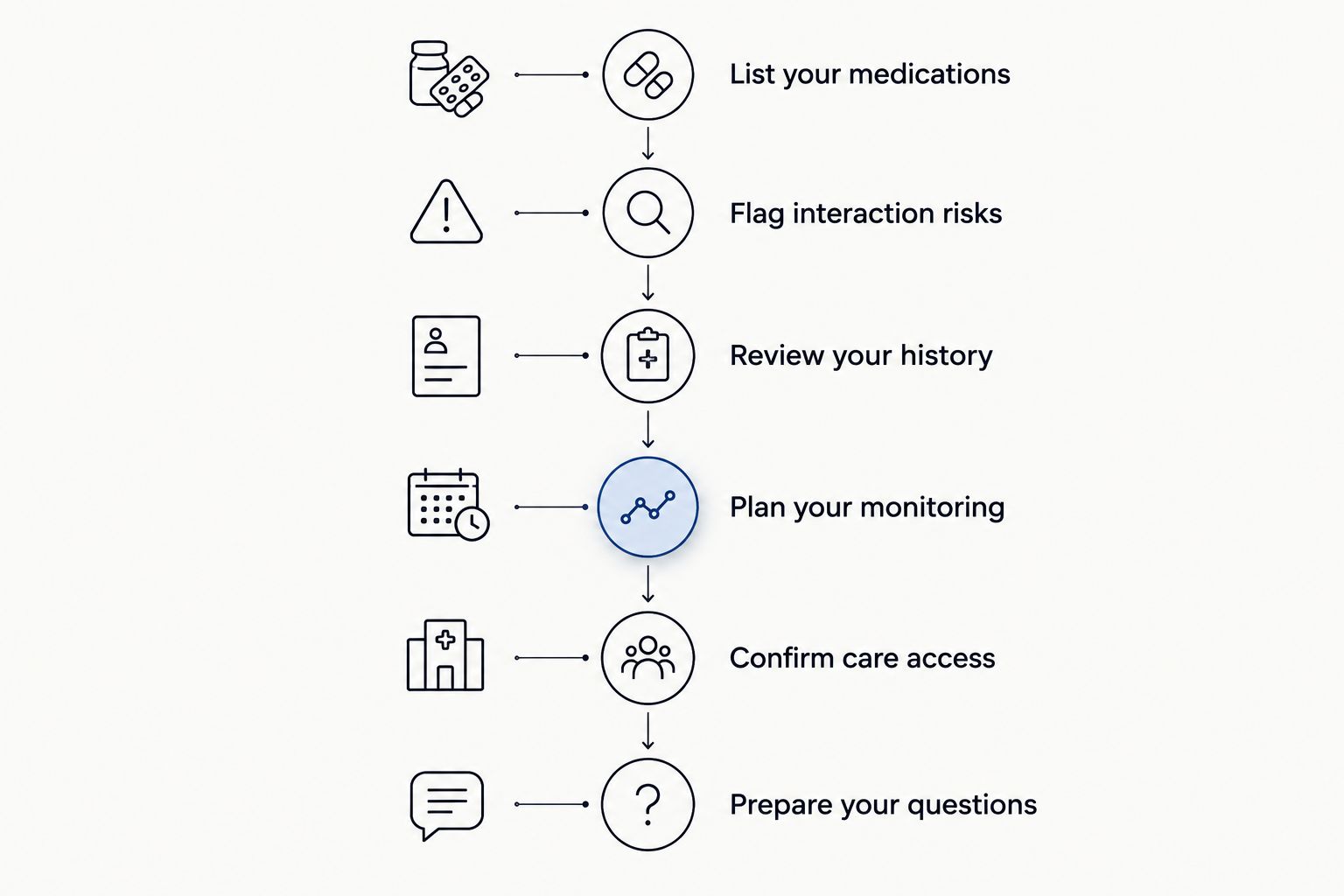
This checklist follows a consultation sequence: document current treatment, identify risks, review history, then establish monitoring and access.
Complete your history summary:
- Name diagnosed conditions rather than describing them vaguely.
- Record previous weight-management medicines and side effects.
- Disclose relevant thyroid cancer or MEN2 history.
- Discuss pregnancy intentions and current contraception.
- Bring recent laboratory results and relevant medical records.
Plan your monitoring
Ask what the clinician needs to follow and why. Monitoring can involve weight, symptoms, hydration, blood glucose, blood pressure, or laboratory tests, depending on your medical history and prescriptions. Not every patient needs the same measurements or testing schedule.
If you take diabetes medicines, request a clear plan for recognizing and responding to low blood sugar. If you take blood-pressure medicines or diuretics, ask how dizziness, reduced intake, vomiting, or diarrhea should be assessed. Weight loss and changes in intake can make an existing treatment plan need review.
Separate routine side effects from warning symptoms. Nausea or constipation deserves discussion; severe or persistent abdominal pain, repeated vomiting, inability to keep fluids down, or fainting requires prompt medical assessment. Severe allergic symptoms, including breathing difficulty, require emergency care.
A monitoring plan should name the responsible clinician and the action to take—not just say “watch for side effects.” Agree on how to report problems before the first prescription.
Ask your clinician to clarify:
- Which symptoms and measurements should I record?
- What findings require a routine message or appointment?
- What symptoms require prompt assessment or emergency care?
- Who reviews changes in glucose or blood pressure?
- How will my other prescribers receive relevant updates?
Confirm care access
A written checklist is a useful starting point. A clinician-led medication review is the next step when deciding whether treatment fits your health history. Bainshealth emphasizes personalized care, continuity with the same provider, direct provider access, and convenient appointments; confirm how those features apply to your treatment plan.
Ask how follow-up works between appointments. Direct access does not mean an immediate response or emergency coverage. Know where to seek urgent help and how to communicate nonurgent concerns, particularly if another clinician manages your diabetes or other long-term conditions.
The practice operates on a self-pay, cash-pay basis. Patients pay the practice directly; do not assume insurance billing, reimbursement, or inclusion of medications and laboratory testing. Request transparent information about what each part of the care plan includes before committing.
If you are seeking care from California or Oregon, confirm whether appointments and prescribing are available for your location. Do not infer state eligibility from the availability of online booking.
Check these practical details:
- Confirm care eligibility for your state and location.
- Ask how to contact your provider between visits.
- Identify who handles prescription and pharmacy questions.
- Request written clarification of service inclusions and separate charges.
- Establish an alternative plan for urgent symptoms.
Prepare your questions
Turn your notes into a short appointment agenda. Start with the medicines or conditions that create the greatest safety concern, then discuss treatment goals and practical barriers. This keeps the consultation focused on decisions rather than reconstructing your history.
Ask what makes semaglutide, tirzepatide, or deferring medication appropriate for you. A good explanation connects the recommendation to your clinical history, current prescriptions, and ability to participate in follow-up. It should also explain limitations and the reasons treatment might not proceed.
For your 2026 care plan, confirm how progress will be assessed beyond the scale. Discuss nutrition, physical activity, muscle health, tolerability, and whether your existing medicines need reassessment. Do not expect a guaranteed weight-loss result or a fixed timeline.
Leave with answers to these questions:
- What is the clinical reason for the recommended approach?
- Which existing medicines need coordination or monitoring?
- What should I do if side effects disrupt eating or drinking?
- When and how will treatment be reviewed?
- What would make us pause, change, or stop treatment?
Compare options for your consultation
The right comparison in 2026 is not simply which medicine produces more weight loss. It is which approach fits your health history, medication risks, follow-up needs, and preferences. These options require individualized assessment; the table is not a prescribing recommendation.
| Option | Best for | Practical benefit | Key limitation |
|---|---|---|---|
| Semaglutide assessment | Patients whose history and medication review support considering semaglutide | Allows discussion of GLP-1 treatment alongside existing care | Gastrointestinal effects, contraindications, and oral-medication considerations require review |
| Tirzepatide assessment | Patients whose history and medication review support considering tirzepatide | Allows discussion of combined GIP and GLP-1 activity | Includes an oral-contraceptive precaution and requires individualized safety assessment |
| Defer medication while clarifying risks | Patients with unresolved medical concerns or incomplete treatment records | Gives clinicians time to coordinate care before adding treatment | Does not start a weight-loss prescription immediately |
| Nutrition and activity support | Patients preparing for treatment or using a non-medication approach | Addresses eating patterns, movement, and muscle health | Does not replace medical evaluation or management of existing prescriptions |
Bainshealth offers personalized medical weight-loss care, but a consultation does not guarantee a prescription. Its self-pay model also requires you to understand direct payment responsibilities before starting.
Discuss your weight-loss care
Prepare your medication list and questions for a personalized, self-pay consultation.
Common mistakes adults taking other medications make
- Leaving occasional medicines off the list. A medicine taken only during migraines, allergies, or illness still belongs in the review. Supplements also count.
- Treating all oral medicines as the same interaction risk. Delayed stomach emptying does not justify stopping every tablet. Ask about the specific medicine, its purpose, and any monitoring needed.
- Adjusting diabetes treatment independently. Low-blood-sugar concerns need a coordinated plan. Do not reduce insulin or other prescribed medicines because you expect to eat less.
- Separating contraception from weight-management care. Oral contraception requires a specific discussion with tirzepatide, and pregnancy plans affect treatment selection.
- Assuming direct provider access replaces emergency care. Routine messaging supports continuity; it is not the right pathway for breathing difficulty, collapse, or other emergency symptoms.
FAQ
Can I use GLP-1 weight loss treatment while taking other medications?
Some patients can use GLP-1 weight loss treatment alongside other medications after an individualized review. Your clinician should check prescriptions, supplements, health conditions, and monitoring needs before prescribing.
Can I take semaglutide or tirzepatide with insulin?
Combining semaglutide or tirzepatide with insulin requires clinician-directed assessment because low-blood-sugar risk can increase. Do not adjust insulin independently; ask for a coordinated monitoring and treatment plan.
Does tirzepatide affect birth control pills?
Tirzepatide can reduce the effectiveness of oral hormonal contraceptives. Prescribing information advises a non-oral method or an added barrier method for 4 weeks after initiation and 4 weeks after each dose increase; discuss the plan with your clinician.
Should I stop my usual medicines before a weight-loss consultation?
Do not stop prescribed medicines just to prepare for a consultation. Bring a complete medication list and let the responsible clinicians coordinate any necessary changes.
Is semaglutide better than tirzepatide when I take other medicines?
Neither medicine is automatically the better choice based only on taking other prescriptions. Selection depends on your diagnoses, contraindications, interaction concerns, tolerability, and follow-up plan.
Does Bainshealth accept insurance for GLP-1 weight-loss care?
Bainshealth currently operates as a self-pay, cash-pay practice rather than billing insurance. Ask what the consultation and treatment arrangement includes, and do not assume reimbursement or medication and laboratory coverage.
What symptoms should I report during GLP-1 treatment?
Report side effects and changes that interfere with eating, drinking, or taking your usual medicines. Severe or persistent abdominal pain, repeated vomiting, inability to keep fluids down, or fainting needs prompt assessment; breathing difficulty requires emergency care.
One last thing
Bring your existing prescribers into the plan before a side effect forces the conversation. For your 2026 consultation, a concise list of their names and treatment responsibilities helps clarify who reviews diabetes medicines, blood pressure, and other ongoing conditions.
Continuity also has a defined practical benefit: established patients may see their own provider for minor ailments or work-note requests up to twice a year, when clinically appropriate. This is not unlimited primary care, urgent care, a promise of waived charges, or a guaranteed work note.