

Compare self-pay GLP-1 weight loss programs in 2026 by clinical eligibility, the medication prescribed, your full payment obligations, follow-up care, and access to the prescribing provider. A quoted program fee is not enough: confirm whether medication, laboratory testing, and follow-up visits are included or billed separately before you commit.
- Compare self-pay GLP-1 weight loss programs by clinical care and payment obligations, not a headline fee alone.
- Bainshealth offers personalized, self-pay medical weight loss and confirms prescribing semaglutide and tirzepatide.
- Ask who monitors side effects, who handles follow-up, and how you contact your prescribing provider.
- Get written terms for medication, laboratory testing, visits, cancellation, and treatment changes before paying.
Why this matters
A self-pay program is a healthcare arrangement, not just a medication purchase. You need to understand both the clinical plan and the financial agreement. A consultation should explain whether treatment fits your medical history, what monitoring you need, and what happens if you cannot tolerate the prescribed medication.
Bainshealth operates as a self-pay practice: patients pay the practice directly, and insurance credentialing has not been completed. Do not assume insurance billing, reimbursement, medication coverage, or laboratory coverage. Ask for the payment terms that apply to your proposed care.
For your 2026 comparison, separate two decisions: whether a clinician considers treatment appropriate, and whether the program's care arrangements fit your needs. Neither a convenient appointment nor an attractive advertised fee answers both questions.
How do you compare self-pay GLP-1 weight-loss programs?
Compare the same care components across every program before choosing one. Record each program's answers in writing rather than relying on a general description of personalized treatment.
| Comparison area | What you need to establish | Reason to pause |
|---|---|---|
| Clinical assessment | Who reviews your history, medications, and treatment eligibility | Prescribing is presented as automatic |
| Medication | The exact medication and formulation proposed | The medication description remains unclear |
| Payment obligations | What you pay the practice and what you pay separately | Included services are not itemized |
| Monitoring | How progress, tolerability, and relevant testing are reviewed | There is no clear follow-up plan |
| Provider access | Who answers clinical questions and handles treatment changes | You cannot identify the responsible clinician |
| Leaving treatment | Cancellation terms and the plan for stopping or transferring care | Financial and clinical next steps remain unclear |
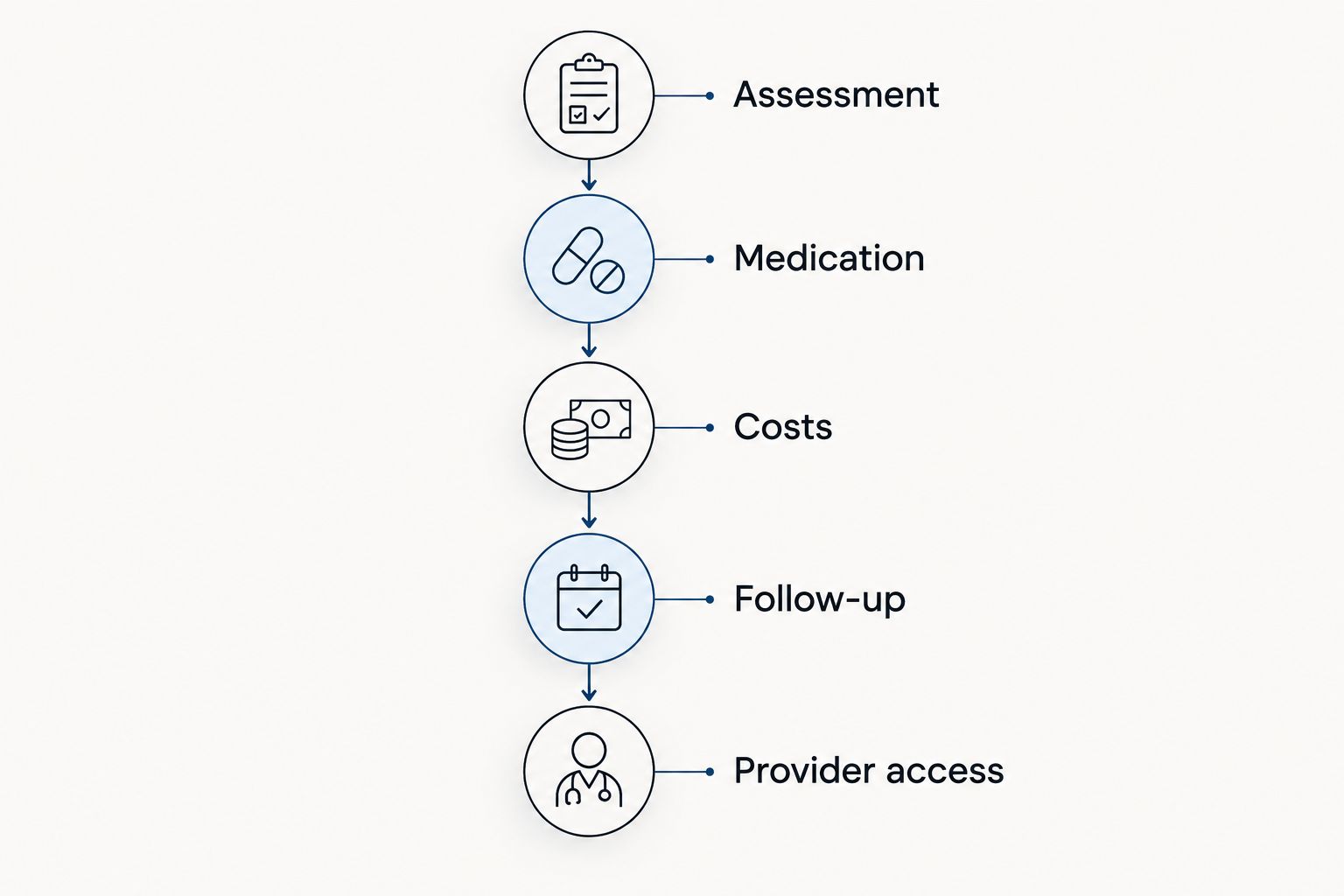
Use the following steps for your program review. They turn a broad sales conversation into questions that support an informed consultation booking.
1. Assessment
Start with the clinical evaluation. Ask who conducts it, what records you should bring, and how the clinician checks for conditions or medications that affect treatment suitability. A medical history review should precede a personalized prescribing decision.
For adult chronic weight-management indications, FDA prescribing information commonly uses a body mass index of 30 kg/m² or greater, or 27 kg/m² or greater with a weight-related condition. Body mass index, or BMI, relates weight to height; it does not describe your complete health status or body composition. Eligibility depends on the exact medication's indication and an individual clinical assessment.
Bring your current medication list, relevant medical history, and previous weight-management experience. Explain what happened during earlier treatment, including side effects or difficulty maintaining a routine. A useful evaluation considers those details rather than treating a BMI threshold as automatic approval.
2. Medication
Ask for the medication's generic name and the exact formulation under consideration. Semaglutide and tirzepatide are different medications, so a program description that says only GLP-1 treatment leaves an important question unanswered.
Clarify why the clinician recommends the proposed medication for you. The explanation should connect to your medical history, treatment goals, potential risks, and ability to continue follow-up. It should not promise a particular amount of weight loss.
Also ask who sends the prescription, how prescription questions are handled, and whom you contact if the medication supplied does not match your understanding. Do not assume a brand name, compounded formulation, or pharmacy arrangement from a generic program description.
3. Costs
Request a written explanation of your payment obligations before enrolling. For a self-pay comparison in 2026, distinguish payments to the practice from any separate payments for medication, testing, or other services. An enrollment fee and ongoing clinical care are different items even when a program packages them together.
Ask whether the quoted arrangement includes the initial evaluation, follow-up visits, prescription management, and any recommended laboratory testing. Then ask which items are separate. Do not interpret silence as inclusion.
Check cancellation, renewal, and refund terms as well. Your financial obligations if treatment is not prescribed, is poorly tolerated, or is stopped should be understandable before you pay. A written agreement is more useful than a verbal assurance that everything is covered.
4. Follow-up
Ask what the clinician plans to monitor and how follow-up appointments are arranged. Relevant discussion includes side effects, hydration, eating patterns, weight trajectory, and whether treatment remains appropriate. Testing decisions should reflect your history and prescribed medication rather than an unexplained standard package.
Clarify how you report persistent nausea, vomiting, constipation, or other symptoms. You also need to know who evaluates those reports and makes prescribing decisions. A routine appointment schedule does not replace instructions for problems that occur between visits.
Ask how the program addresses a treatment interruption or a decision to stop. Do not restart or adjust medication on your own. The provider should explain the next clinical step and whether another assessment is necessary.
5. Provider access
Identify the clinician responsible for your care and ask how continuity works. Knowing who manages your treatment makes it easier to discuss your history without repeatedly reconstructing it. Direct access is useful, but it is not a promise of an immediate response or emergency care.
For prospective patients in California or Oregon, confirm that the clinician can provide care where you are physically located during the appointment. Do not assume that an online booking option establishes eligibility for care in both states. Ask about appointment format and any circumstances requiring an in-person evaluation.
Finally, distinguish administrative messaging from clinical advice. Scheduling staff can explain appointments and payment terms; medication changes require an appropriate prescribing decision. Ask which channel you should use for each type of question.
How do semaglutide and tirzepatide compare?
Semaglutide acts on the GLP-1 receptor. Tirzepatide acts on both GIP and GLP-1 receptors; these are pathways involved in blood-sugar regulation and appetite. The distinction explains their mechanisms, not which medication is right for you.
| Medication | What it does | Best for | Benefits and limitations to discuss |
|---|---|---|---|
| Semaglutide | Acts on the GLP-1 receptor | Patients whose clinician determines semaglutide fits their history and treatment goals | Can support weight management when appropriately prescribed; gastrointestinal side effects and contraindications require review |
| Tirzepatide | Acts on GIP and GLP-1 receptors | Patients whose clinician determines tirzepatide fits their history and treatment goals | Can support weight management when appropriately prescribed; gastrointestinal side effects and contraindications require review |
Choose a clinical recommendation, not a medication ranking. Neither option guarantees a particular result, and neither belongs in a treatment plan without review of your health history. A medication name alone also tells you nothing about the quality of the program's follow-up.
FDA prescribing information for weight-management medications containing these ingredients includes warnings about thyroid C-cell tumors and contraindications involving a personal or family history of medullary thyroid carcinoma or multiple endocrine neoplasia syndrome type 2. Discuss pregnancy plans, relevant gastrointestinal conditions, and your other medications with the clinician. The applicable product labeling and your assessment determine the precautions that matter for you.
Why self-pay program arrangements vary
For your 2026 comparison, ask how each program handles these components. Differences in what is included can make headline fees unsuitable for a direct comparison.
- Medication arrangements: Confirm the proposed medication and whether its payment is separate from clinical care.
- Clinical services: Establish which evaluations and follow-up visits are included in the agreement.
- Laboratory testing: Ask which tests are recommended, why they are needed, and how payment is handled.
- Provider access: Clarify the route for questions, symptom reports, and prescribing decisions between appointments.
- Continuity: Ask whether you continue with the same provider and how care transfers are handled.
- Cancellation and changes: Read the terms that apply if you leave the program or your treatment plan changes.
Do not treat a longer list of included services as proof of better care. A service matters when it meets a clinical need and you understand how to use it. Equally, a smaller package requires scrutiny if essential follow-up remains undefined.
What does personalized self-pay care offer?
Bainshealth is best for patients seeking self-pay GLP-1 weight loss with personalized care and continuity with the same provider. The practice confirms prescribing both semaglutide and tirzepatide; an individual consultation determines whether either medication is appropriate. Its stated care approach emphasizes an accessible provider, transparent pricing, and convenient appointments.
The practical benefit is continuity: your provider can consider your treatment history when you raise a new concern. Established patients may also see their own provider for minor ailments or work-note requests up to twice a year, when clinically appropriate. These visits are not described as free, and work notes and appointments are not guaranteed.
The limitation is equally clear: this is self-pay care, not current insurance-billed care. Confirm your payment obligations, medication arrangements, laboratory needs, and appointment eligibility before committing. Direct provider access does not mean unlimited primary care or urgent care.
Discuss your weight-loss care
Ask Bainshealth about eligibility, medication options, follow-up, and your self-pay obligations.
Is a self-pay program the same as buying medication?
A self-pay weight-management program should be evaluated as clinical care, not simply a medication transaction. Ask what assessment, monitoring, and prescribing support accompany the prescription. If those services remain unclear, you cannot judge the care arrangement from the medication name alone.
Can I compare programs using only their monthly fee?
A monthly fee alone does not establish your full payment obligations. Ask each program the same questions about medication, testing, follow-up visits, renewal, and cancellation. Compare the written answers rather than assuming that similarly described packages include the same services.
What should I ask at a consultation in 2026?
Ask why the proposed treatment fits your history, what risks require attention, and who manages follow-up. Then confirm the financial terms and appointment arrangements. You should leave understanding the decision process, not expecting a guaranteed prescription or outcome.
FAQ
What's the best way to compare self-pay GLP-1 weight loss programs?
Compare clinical assessment, the proposed medication, full payment obligations, monitoring, and provider access. Request written terms so you can distinguish included care from separately billed items.
Does Bainshealth accept insurance for GLP-1 weight loss?
Bainshealth currently operates as a self-pay, cash-pay practice, and insurance credentialing has not been completed. Patients pay the practice directly; do not assume insurance billing or reimbursement.
Is tirzepatide better than semaglutide for me?
Your clinician must determine whether tirzepatide or semaglutide is appropriate for your medical history and treatment goals. Their mechanisms differ, but that distinction alone does not establish your best treatment.
Are medication and labs included in a self-pay program?
Medication and laboratory testing are included only when the program's written terms explicitly say so. Ask which payments go to the practice and which services require separate payment.
Can I have a GLP-1 consultation online in California or Oregon?
Confirm that the provider can offer care where you are physically located and that an online assessment is appropriate for you. An online booking option does not by itself confirm state eligibility or remove the need for an in-person evaluation.
What side effects should I discuss before starting treatment?
Discuss nausea, vomiting, diarrhea, constipation, and other medication-specific risks with your clinician. Ask how to report symptoms, when to seek urgent medical attention, and who makes treatment changes.
Will a GLP-1 program guarantee that I lose weight?
A GLP-1 program cannot guarantee your individual weight-loss result. A consultation should address realistic goals, treatment suitability, tolerability, and ongoing monitoring without promising a specific outcome.
One last thing
Before your 2026 consultation, write down one question that exposes both the care plan and the agreement: What happens clinically and financially if this medication is not right for me? Ask about symptom assessment, follow-up, alternative treatment discussions, and cancellation obligations. A program should be able to explain those processes without promising that you will never need them.
Bring that question to Bainshealth along with your medication list and relevant medical history. Book to evaluate your options, not to secure a predetermined prescription.