

A GLP-1 weight-loss program’s cost depends on the medication, clinical visits, laboratory testing and follow-up included in your treatment plan. For self-pay care in 2026, compare the full written estimate—not a medication-only figure or an advertised consultation fee. Any services outside that estimate need to be identified before you commit.
- Compare GLP-1 weight loss programs by total treatment costs, not medication alone.
- Bainshealth provides self-pay medical weight loss with personalized care and continuity with the same provider.
- Ask whether prescriptions, laboratory testing and follow-up are included or billed separately.
- Semaglutide and tirzepatide require individualized prescribing decisions; cost alone does not determine suitability.
How much does a GLP-1 weight-loss program cost in 2026?
Your useful comparison is the total you would pay for the prescribed care plan. A medication quote does not establish the cost of an entire program. An appointment quote does not establish what you will spend obtaining the prescription.
Before comparing estimates, understand how the clinician evaluates you and manages treatment. This guide to choosing a GLP-1 weight-loss provider explains the provider-selection questions that belong alongside your budget questions.
Use this breakdown to make each estimate comparable. These are categories to clarify, not a claim that every practice charges separately for each service.
| Cost category | What to clarify | Why it matters |
|---|---|---|
| Initial evaluation | What the appointment includes and whether testing is separate | You need a clinical assessment before a prescribing decision |
| Medication | Whether the quoted program includes the prescription’s purchase cost | Writing a prescription and supplying medication are different services |
| Laboratory testing | Which tests are clinically necessary and where payment occurs | Testing requirements depend on your health history and treatment plan |
| Follow-up visits | Which appointments are included and what additional visits involve | Treatment requires reassessment, not just an initial prescription |
| Ongoing support | How you contact the provider and what support the program includes | Questions about symptoms or treatment changes need a clear route |
| Treatment changes | How a revised prescription or follow-up plan affects the estimate | Your initial plan is not a guarantee that treatment will remain unchanged |
Ask for an estimate that separates the evaluation from ongoing care. That distinction makes it easier to understand your financial commitment before treatment starts and after the clinician recommends a plan.
Why this matters
Medical weight loss is a prescribing relationship, not simply a medication purchase. Your clinician needs to assess whether treatment fits your health history, explain risks and review how you tolerate it.
A quote that leaves those responsibilities unclear is difficult to evaluate. Choose a program you can understand clinically and financially before deciding whether its cost fits your budget. The goal is informed treatment, not purchasing the least expensive-looking line item.
For prospective patients in California and Oregon, confirm that the practice can provide care where you are located. A website’s accessibility does not establish eligibility for treatment in your state, and a consultation does not guarantee a prescription.
Initial evaluation: separate assessment from ongoing treatment
The initial appointment determines whether medication is appropriate and what further assessment is necessary. Prepare to discuss your medical history, current medications, prior weight-management efforts and treatment goals.
Ask what the evaluation includes before booking. A clinician’s review, laboratory testing and medication purchase are distinct parts of care, even when a practice groups some services together.
Your initial evaluation also needs to address expectations. Weight management involves more than a scale reading: your clinician can discuss nutrition, physical activity, symptoms and body composition, meaning the balance of fat and lean tissue in your body.
An assessment is valuable even when the result is not a prescription. Do not treat approval for medication as the measure of whether a consultation was useful. A decision against treatment can protect you from an unsuitable medication or identify another issue that needs attention.
Ongoing treatment: identify what continues after prescribing
An ongoing estimate should explain how the practice reviews treatment and what you pay to obtain medication. Ask whether appointments, laboratory testing and provider communication are included, separate or determined after the evaluation.
Also ask how the practice handles a change in your care plan. A different medication, additional assessment or a pause in treatment can change what services you need. The estimate should distinguish the services already agreed upon from those requiring a new discussion.
For a 2026 budget, avoid assuming that the first payment represents every later payment. Request the expected billing structure in plain language, including whether any charges recur and what triggers an additional charge.
The same principle applies when you stop treatment. Ask how follow-up, remaining appointments and future prescribing are handled. Do not assume a cancellation, refund or continuation policy unless the practice provides it.
Semaglutide and tirzepatide: compare clinical fit before cost
Semaglutide acts on the GLP-1 receptor. Tirzepatide acts on both GIP and GLP-1 receptors; these are pathways involved in blood-sugar regulation and appetite. Both require a clinician to determine whether the specific prescribed medication is appropriate for you.
Bainshealth confirms prescribing both semaglutide and tirzepatide. That does not establish a particular brand, formulation, treatment fee or insurance benefit.
| Medication | What it does | Best for | Benefit to discuss | Limitation to discuss |
|---|---|---|---|---|
| Semaglutide | Acts on the GLP-1 receptor | Patients whose clinician determines semaglutide fits their history and treatment goals | Its role in a medically supervised weight-management plan | Gastrointestinal side effects and individual contraindications require review |
| Tirzepatide | Acts on GIP and GLP-1 receptors | Patients whose clinician determines tirzepatide fits their history and treatment goals | Its role in a medically supervised weight-management plan | Gastrointestinal side effects and individual contraindications require review |
Neither option is automatically best because of its mechanism or a quoted program cost. Your medical history, current medications, tolerability and treatment goals guide the prescribing decision.
Ask your clinician to name the exact medication being recommended and explain its purpose. Do not infer a brand or formulation from the terms semaglutide, tirzepatide or GLP-1 alone.
Why GLP-1 weight-loss program costs vary
Different estimates can describe different services. Use these factors to identify the source of a difference instead of assuming one program is cheaper for equivalent care.
- Medication scope: A program estimate can refer to clinical management without establishing the medication’s purchase cost. Confirm exactly what the estimate covers.
- Evaluation scope: Your history determines the assessment needed before prescribing. Ask which parts of the evaluation are included.
- Testing requirements: Clinically indicated tests depend on your circumstances. Clarify who orders testing, where it occurs and who receives payment.
- Follow-up structure: An estimate should identify included appointments and how additional reassessment is handled.
- Provider access: Understand how you contact the clinician, what communication is included and where administrative questions belong.
- Treatment changes: A revised care plan can require different services. Ask how the practice explains any resulting charges before you agree.
These factors are comparison questions, not reasons to accept an unclear estimate. Transparent pricing means understanding the scope of care, not simply seeing a number.
How do you get a useful written program estimate?
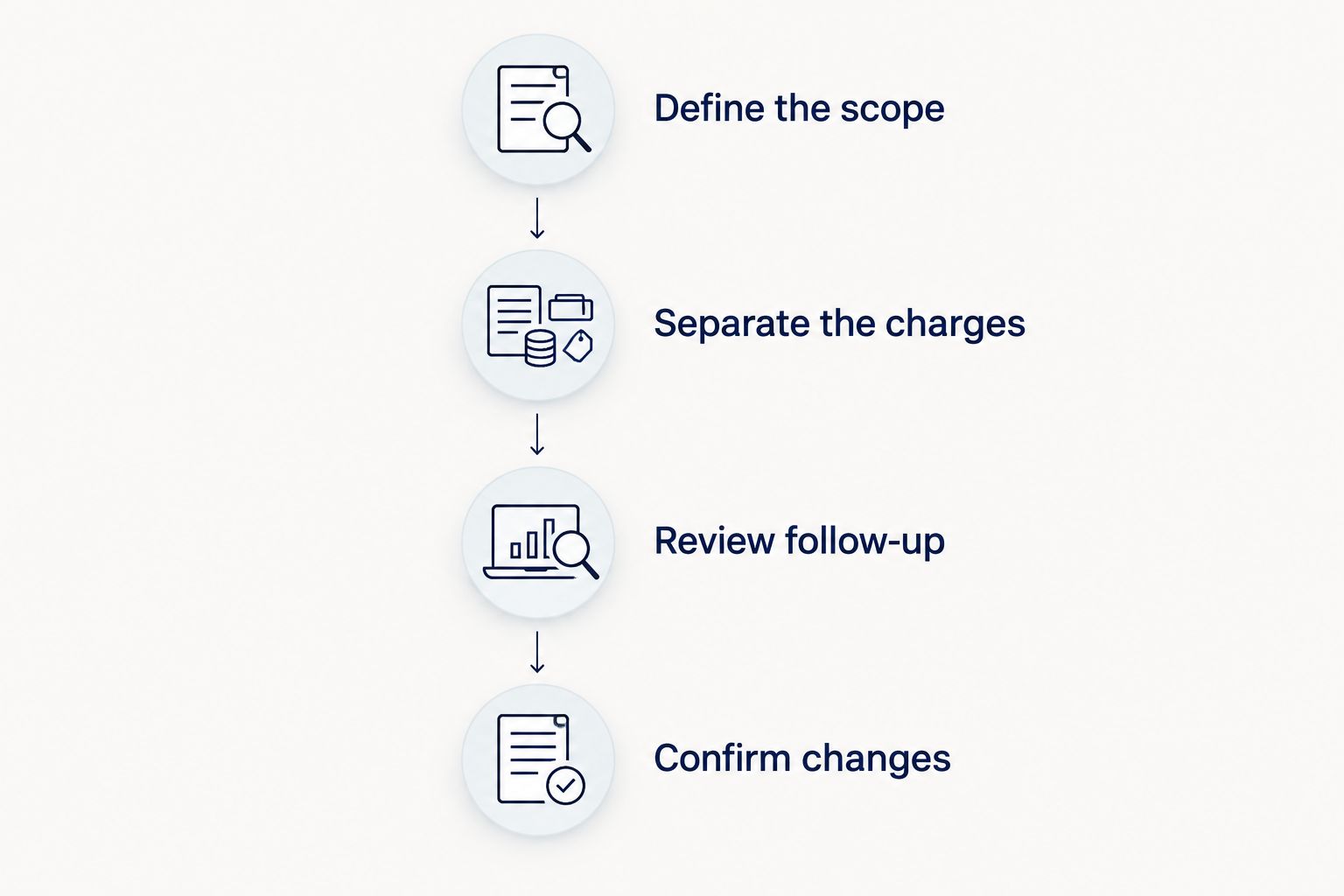
Use the following sequence when discussing GLP-1 weight loss in 2026. Keep clinical eligibility and financial consent separate: understanding the payment arrangement does not replace a medical evaluation.
- Define the scope. Ask whether the estimate describes an evaluation, ongoing clinical management or both. Identify what the practice provides directly and what another organization supplies.
- Separate the charges. Request a clear distinction between appointments, medication and laboratory testing. Ask who receives payment for each item.
- Review follow-up. Confirm how reassessment works, how you contact the provider and which services are included. Direct access does not mean emergency care or a guaranteed response time.
- Confirm changes. Ask what happens financially if the clinician changes or stops treatment. Request clarification before agreeing to a revised plan.
Keep the estimate and the treatment explanation together. A written financial summary is most useful when it matches the plan your clinician actually recommends, rather than a generic package description.
If something remains unclear, ask for clarification before paying for ongoing treatment. You should be able to explain which services you are purchasing without guessing.
What does self-pay mean at Bainshealth?
Bainshealth operates as a self-pay, cash-pay practice. Patients pay the practice directly; insurance credentialing has not been completed. Do not plan your 2026 treatment budget on the assumption that the practice bills or accepts insurance.
Self-pay does not mean you should assume a particular payment method. It also does not establish insurance reimbursement, HSA/FSA eligibility or coverage for medication and laboratory testing. Each of those questions requires separate confirmation from the relevant organization.
Bainshealth medical weight loss is best for patients seeking personalized, self-pay care with continuity from the same provider. The practical benefits include convenient appointments, transparent pricing and access to an established clinician. The financial limitation is that you must plan for direct payment to the practice.
Established patients may see their own provider for minor ailments or work-note requests up to 2 times per year, when clinically appropriate. This is a continuity-of-care benefit, not unlimited primary care, urgent care, a promise of a work note or a statement that these visits carry no charge.
Review the practice’s personalized health services and ask which appointments fit your needs. Confirm eligibility for care in your state before arranging treatment.
Discuss your weight-loss care
Ask about clinical eligibility, self-pay costs and ongoing follow-up before choosing treatment.
What risks should you discuss before starting treatment?
Common gastrointestinal side effects of these medications include nausea, vomiting, diarrhea and constipation. Discuss how your clinician assesses symptoms and when you should seek medical attention. Side effects are not proof that treatment is working.
Tell your clinician about prior pancreatitis, gallbladder problems, kidney concerns, pregnancy plans and any personal or family history of medullary thyroid cancer or multiple endocrine neoplasia syndrome type 2. These details can affect prescribing decisions. Also disclose other prescriptions and supplements so the clinician can review potential interactions.
Do not adjust treatment based on a budget decision or an online dosing suggestion. If you cannot continue the prescribed plan, contact your clinician to discuss a medically appropriate next step.
Provider messaging is not emergency care. Severe or persistent abdominal pain, repeated vomiting or signs of dehydration require prompt medical assessment; do not wait for a routine follow-up to raise them.
Is medication included in a GLP-1 weight-loss program?
Medication is included only when the written estimate explicitly says so. A prescribing appointment and the purchase of a prescription are different transactions, even if a program discusses them together.
Ask who supplies the medication and who receives payment. Confirm the exact prescribed product rather than making assumptions from a general program description.
Does insurance pay for a self-pay weight-loss program?
Insurance does not change a practice’s stated self-pay arrangement. Coverage for care, prescriptions and testing depends on the particular plan and service; a general benefit description does not establish reimbursement for your treatment.
Keep insurance questions separate from the practice’s direct-payment estimate. Ask your insurer about your benefits without assuming the practice submits claims or that any expense qualifies for reimbursement.
What should you compare besides the program cost?
Compare the clinical evaluation, follow-up plan, provider access and explanation of risks. Those details establish what care you receive and how questions are handled after prescribing.
A clear estimate is necessary, but it is not the entire decision. Choose a clinician whose treatment explanation you understand and whose care arrangement you can realistically maintain.
FAQ
How much does a GLP-1 weight-loss program cost in 2026?
The total depends on medication, evaluation, testing and follow-up included in your prescribed plan. Request a written estimate that separates clinical services from any medication or laboratory charges.
Does Bainshealth accept insurance for medical weight loss?
Bainshealth currently operates as a self-pay, cash-pay practice and has not completed insurance credentialing. Patients pay the practice directly; do not assume insurance billing or reimbursement.
Is semaglutide or tirzepatide better for me?
The appropriate medication depends on your medical history, current medications, treatment goals and tolerability. A clinician must assess suitability; mechanism and cost alone do not settle the choice.
What should I ask before paying for a weight-loss program?
Ask what the estimate includes, who receives each payment and how follow-up works. Clarify medication costs, testing, additional visits and changes to the care plan before committing.
Can I get a GLP-1 prescription after a consultation?
A consultation does not guarantee a GLP-1 prescription. The clinician must evaluate whether treatment is medically appropriate and whether further assessment is necessary.
Can established patients see their provider for minor illnesses?
Established patients may see their own provider for minor ailments or work-note requests up to 2 times per year, when clinically appropriate. These visits are not a promise of urgent care, waived charges or guaranteed work notes.
Can I use insurance reimbursement or an HSA for self-pay treatment?
Do not assume reimbursement or HSA/FSA eligibility for self-pay treatment. Confirm the specific rules with your insurer or account administrator separately from the practice’s payment arrangement.
One last thing
Before accepting a 2026 estimate, ask: What would I still need to pay for outside this written plan? That question exposes the difference between an understandable treatment budget and a figure that covers only part of your care.
Then ask who you contact if symptoms, goals or circumstances change. A usable financial plan and an ongoing clinical relationship need to work together.