

Before starting GLP-1 weight loss, ask whether you qualify, which medication fits your medical history, what risks require attention, and how follow-up and direct-pay expenses will work. You also need a plan for nutrition, strength, pregnancy considerations, medication interruptions, and maintaining progress—not just a prescription.
- GLP-1 weight loss requires an eligibility review, medication-risk discussion, and a follow-up plan before prescribing.
- Bains Health & Wellness offers personalized medical weight loss through a self-pay practice.
- Semaglutide and tirzepatide require individualized prescribing; neither is automatically the right choice for every patient.
- Ask who handles side effects, what you pay directly, and how treatment changes are reviewed.
What should you ask before starting GLP-1 weight loss?
Ask for a treatment plan, not simply a medication name. At Bains Health & Wellness, GLP-1 weight loss care includes personalized prescribing decisions within a self-pay practice. Use these questions to make your 2026 consultation specific to your health and expectations.
- Am I an appropriate candidate? Ask how your weight, weight-related conditions, medical history, and previous treatment affect eligibility. Meeting a weight threshold does not establish that a particular medication is safe for you.
- Why are you considering this medication? Ask the clinician to explain the proposed treatment and alternatives in plain language. The explanation should connect to your health history rather than a general claim that one drug is best.
- What should I expect beyond weight change? Discuss appetite, nutrition, activity, and the health concerns you want to address. Agree on how you will assess progress without treating a promised result as a medical expectation.
- Which side effects can wait, and which need prompt care? Get instructions for nausea, vomiting, constipation, and difficulty eating or drinking. Ask specifically about severe abdominal pain and signs of dehydration.
- Who will monitor treatment? Clarify who reviews symptoms, medication changes, and any testing the clinician recommends. Ask how to reach the provider between scheduled appointments.
- What will I pay directly? Request a written explanation of consultation, follow-up, medication, and testing charges. Confirm which items are included and which require separate payment.
- What happens if treatment needs to change? Discuss intolerable side effects, pregnancy plans, inadequate benefit, and interruptions. Ask how the clinician will reassess the plan rather than leaving you to adjust treatment yourself.
Bring this checklist to the appointment. You do not need to arrive knowing which medication you want; you need enough information to understand the clinician's recommendation.
Why this matters
A prescription answers only one part of the decision. GLP-1 treatment also affects eating patterns and requires attention to tolerability, hydration, medication interactions, and ongoing care.
Your 2026 consultation should separate general education from decisions about your own treatment. An article can explain common risks, but a clinician must evaluate whether those risks apply to you.
The quality of the plan depends on what happens after prescribing. Before committing, understand how concerns reach the provider, how progress is assessed, and what triggers a change in treatment. These details make follow-up practical rather than leaving you with an unanswered question when symptoms develop.
Ask how eligibility applies to your health
For adults, FDA-approved chronic weight-management indications commonly use a BMI of 30 kg/m² or higher, or 27 kg/m² or higher with a weight-related health condition. BMI means body mass index: a screening measure calculated from height and weight. The indication for the specific medication still matters.
Those thresholds are starting points, not automatic approval. Your clinician also needs to review contraindications, current medications, relevant medical conditions, and treatment goals.
Ask these questions during the eligibility review:
- Which weight-related conditions affect my treatment options?
- Does my medical history rule out a proposed medication?
- Do I need testing before a prescribing decision?
- What information do you need from previous clinicians?
- What would make a different treatment approach more appropriate?
Bring an accurate medication and supplement list. Include previous weight-loss medications and the reasons you stopped them; a prior side effect is relevant even when the treatment came from another practice.
The BMI thresholds above reflect FDA prescribing information for adult chronic weight-management use. They are not a substitute for an individual clinical assessment during your 2026 consultation.
Ask why semaglutide or tirzepatide fits your situation
Semaglutide is a GLP-1 receptor agonist, meaning it acts on a receptor involved in appetite and glucose regulation. Tirzepatide acts on both GIP and GLP-1 receptors; GIP is another hormone involved in metabolic regulation.
Both medications can support weight management in appropriately selected patients. Both also have limitations and risks, so a medication comparison should explain suitability—not declare a universal winner.
| Medication | How it works | Best for discussion | Potential benefit | Important limitation |
|---|---|---|---|---|
| Semaglutide | Acts on GLP-1 receptors | Patients considering a GLP-1 treatment after medical review | Supports appetite regulation and weight management | Gastrointestinal side effects and contraindications require review |
| Tirzepatide | Acts on GIP and GLP-1 receptors | Patients considering a dual-receptor treatment after medical review | Supports appetite regulation and weight management | Gastrointestinal side effects and contraindications require review |
Ask why the clinician recommends a particular option for you. Discuss previous medication experiences, other prescriptions, relevant conditions, and your ability to maintain follow-up.
Do not assume the drug name establishes a brand, formulation, or payment arrangement. Confirm exactly what is being prescribed and where you will obtain it. Do not combine treatments or change your medication schedule without the prescriber's instructions.
Ask about risks before the first prescription
Nausea, vomiting, diarrhea, constipation, and abdominal discomfort are recognized gastrointestinal side effects of these medications. Ask what you should do if symptoms interfere with eating, drinking, or daily activities.
More serious concerns also belong in the consultation. FDA prescribing information for semaglutide and tirzepatide products used for chronic weight management addresses the following issues:
- Thyroid history: Tell the clinician about a personal or family history of medullary thyroid carcinoma or multiple endocrine neoplasia syndrome type 2, also called MEN2.
- Pancreatitis: Discuss any history of pancreatic inflammation. Ask how to respond to severe or persistent abdominal pain.
- Gallbladder problems: Report gallstones or previous gallbladder disease and ask which symptoms need assessment.
- Dehydration and kidney injury: Persistent vomiting or diarrhea can lead to dehydration. Ask what to do if you cannot keep fluids down.
- Other glucose-lowering medications: Insulin and certain diabetes medications can increase the risk of low blood sugar when used alongside these treatments.
- Pregnancy and procedures: Discuss pregnancy plans, contraception, breastfeeding, and upcoming anesthesia or sedation before prescribing.
Severe symptoms require medical assessment, not a routine message left unanswered. Ask which concerns belong with your prescribing clinician and which require urgent or emergency care.
Tell the anesthesia team about GLP-1-related medication before a procedure. Do not stop treatment on your own; the prescribing and procedural teams should provide individualized instructions.
Ask what follow-up actually includes in 2026
Follow-up should assess more than the number on a scale. Ask how the clinician reviews tolerability, eating patterns, hydration, activity, and the health conditions that prompted treatment.
Use this sequence to clarify the care process:
- Health review: Identify the medical history, medications, and goals that shape the initial decision.
- Treatment decision: Understand the proposed medication, relevant risks, and alternatives.
- Follow-up plan: Confirm how appointments and between-visit concerns are handled.
- Treatment reassessment: Establish what happens when symptoms, goals, or circumstances change.
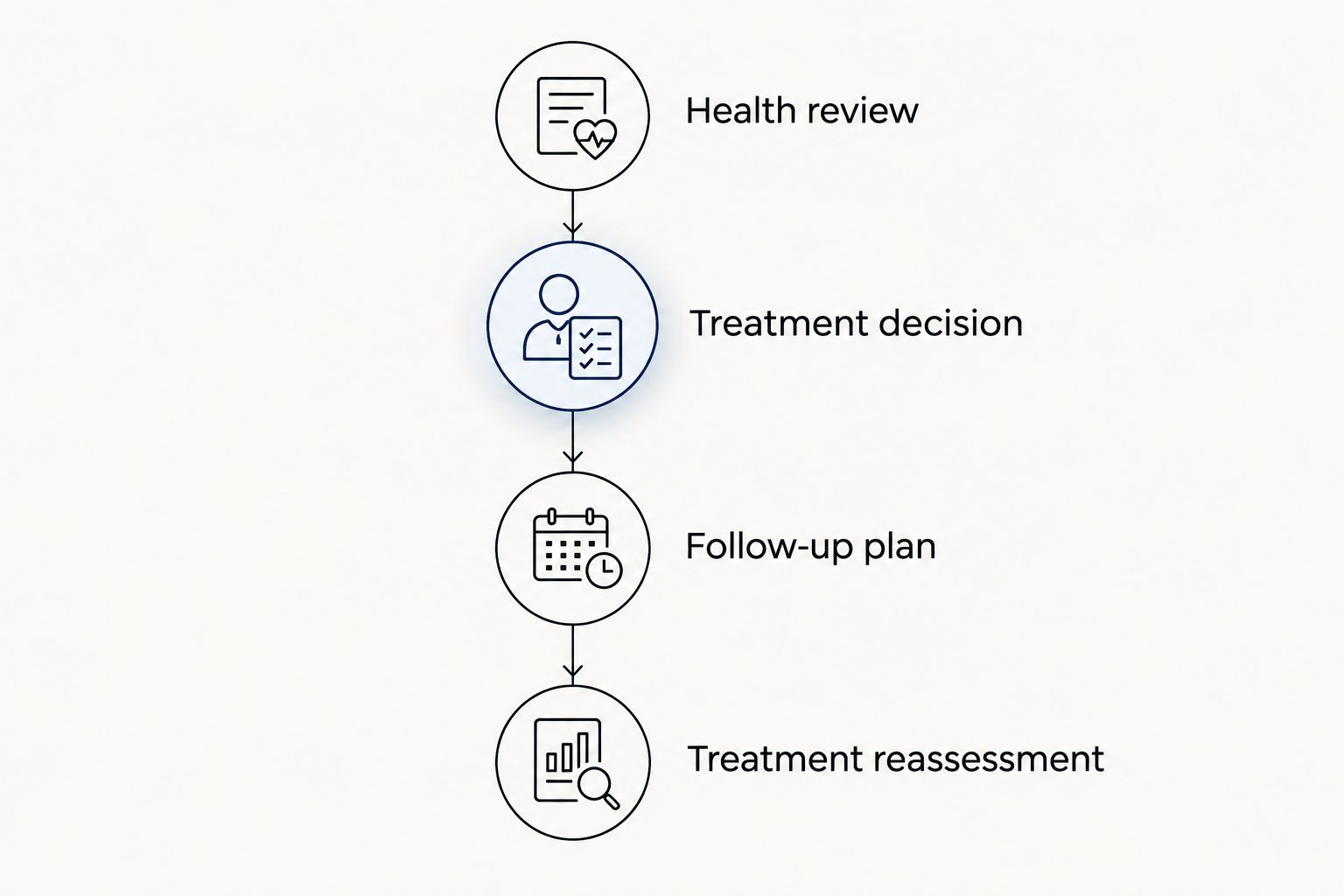
Ask who makes medication changes and whether you will continue with the same provider. Also ask how missed appointments, medication interruptions, and new prescriptions from another clinician affect the plan.
A useful follow-up agreement tells you what to report and whom to contact. It does not require a promised response time or a guarantee that every concern can be managed remotely.
Why your GLP-1 treatment plan varies
Personalized care changes the conversation from obtaining a prescription to understanding the care around it. At Bains Health & Wellness, these practice details are relevant to your consultation:
- Individualized prescribing: The practice prescribes semaglutide and tirzepatide, but the choice requires a patient-specific assessment.
- Continuity: Care with the same provider supports an ongoing discussion of your treatment and concerns.
- Direct provider access: Ask how to contact your provider; access does not mean a guaranteed response time.
- Self-pay arrangements: Patients pay the practice directly. Request transparent information about the charges relevant to your plan.
- Defined additional care: Established patients may see their own provider for minor ailments or work-note requests up to twice a year, when clinically appropriate.
That additional-care option does not mean unlimited primary care, urgent care, guaranteed appointments, or guaranteed work notes. Ask how it applies to your situation without assuming those visits carry no charge.
Ask what self-pay treatment includes
Bains Health & Wellness is a self-pay practice; it does not currently accept or bill insurance. Your 2026 planning should therefore start with what you will pay the practice directly, not an assumed insurance benefit.
Request a written explanation of the proposed treatment arrangement. Ask whether the consultation, follow-up visits, medication, and any recommended laboratory testing are included or charged separately. These are questions to resolve, not assumptions about what the practice provides.
Also clarify payment timing and what happens financially if treatment changes or stops. Do not assume reimbursement, medication coverage, or eligibility to use a health savings account or flexible spending account.
If you investigate insurance independently, keep that discussion separate from the practice's self-pay model. A possible benefit elsewhere does not establish that the practice accepts your plan.
What should you ask about nutrition and body composition?
Ask how to maintain adequate nutrition and physical function while your appetite changes. Body composition describes the proportions of fat and lean tissue; weight alone does not explain every change in your health.
Discuss strength-building activity, food intake, and any difficulty meeting nutritional needs. Ask whether additional nutrition support is appropriate for your circumstances rather than following a fixed protein target from social media.
Report persistent difficulty eating or drinking. A lower appetite is not a reason to ignore dehydration, weakness, or inadequate intake. Your clinician should know when the treatment interferes with basic needs.
What should California and Oregon patients confirm before booking?
California and Oregon patients should confirm whether the clinician can provide care where they will physically be during an appointment. Telehealth does not remove state-specific licensing and prescribing requirements.
Ask what can be evaluated remotely and when an in-person examination or local testing is necessary. Also explain any travel plans that could affect appointments or communication.
Convenient scheduling is useful, but it does not replace a plan for symptoms requiring hands-on assessment. Confirm where to seek appropriate care when a remote appointment cannot address the problem.
Should you discuss stopping treatment before you start?
Yes—discuss stopping or changing treatment before the first prescription. Ask how the clinician handles side effects, pregnancy planning, treatment interruptions, and maintaining weight-related health improvements after a change.
Do not interpret a maintenance plan as a promise of permanent results. Establish what follow-up will look like if appetite or weight changes after treatment ends.
FAQ
What should I ask at my first GLP-1 weight loss appointment?
Ask about eligibility, medication selection, side effects, follow-up, and direct-pay expenses. Bring your medication list, relevant medical history, previous treatment experiences, and questions about pregnancy or procedures.
Do I automatically qualify if my BMI is high enough?
No—meeting a BMI threshold does not automatically establish that treatment is appropriate. Adult chronic weight-management indications commonly include a BMI of 30 kg/m² or higher, or 27 kg/m² or higher with a weight-related condition, alongside an individual safety review.
Is tirzepatide always better than semaglutide?
No—neither medication is the right choice for every patient. The clinician should explain the recommendation using your medical history, other medications, treatment goals, and previous experiences.
Does Bains Health & Wellness accept insurance for weight loss care?
Bains Health & Wellness currently operates as a self-pay practice and does not accept or bill insurance. Ask what you will pay directly and which elements of the proposed plan are included or separate.
What side effects should I discuss before starting?
Discuss nausea, vomiting, diarrhea, constipation, and abdominal discomfort, along with serious warning symptoms. Ask for clear instructions about severe abdominal pain, dehydration, and symptoms requiring urgent assessment.
Can I start treatment while planning a pregnancy?
Pregnancy plans require a prescribing discussion before treatment starts. Ask about contraception and stopping treatment before a planned pregnancy; do not make medication changes without individualized instructions.
Can GLP-1 treatment replace nutrition and strength work?
No—medication does not replace adequate nutrition or physical activity. Ask how your plan will address food intake, strength, and symptoms that make eating or drinking difficult.
One last thing
Before leaving your 2026 consultation, ask: What would make you change this plan? The answer should connect treatment decisions to your symptoms, health, and goals—not just a weight target.
Bains Health & Wellness is best for patients seeking personalized, self-pay medical weight loss with continuity from the same provider. Its self-pay model requires direct-payment planning, and prescribing remains an individual clinical decision.
Discuss your weight loss questions
Review your health history, treatment options, follow-up needs, and self-pay arrangements.