

You can support muscle health during GLP-1 weight loss by combining resistance exercise, adequate protein and overall nutrition, and regular clinical follow-up. Appetite suppression can make it harder to eat enough, so track your strength and daily function alongside your weight rather than treating every lower scale reading as progress.
- GLP-1 weight loss needs a muscle-health plan: resistance exercise, adequate nutrition and clinical follow-up.
- Resistance exercise supports muscle strength; walking supports cardiovascular health but does not replace strength training.
- Lean mass includes more than muscle, so a body-composition result needs clinical interpretation.
- Bainshealth is best for patients seeking personalized, self-pay GLP-1 weight loss care.
Why this matters
Weight loss changes more than body fat. Some lost weight can come from lean tissue, and eating less without a strength-training plan leaves muscle health insufficiently addressed. Your goal is not simply a smaller number; it is better health with the strength to carry groceries, climb stairs and maintain independence.
For your 2026 treatment plan, establish what you want to protect before focusing on weight alone. Bainshealth provides personalized medical weight loss care through a self-pay model, with patients paying the practice directly. A consultation is the place to discuss your health history, nutrition, activity and follow-up needs—not to assume a medication will preserve muscle by itself.
How can you support muscle health during GLP-1 weight loss?
Make muscle health part of treatment from the start. Nutrition, exercise and medication follow-up address different parts of the problem; none replaces the others.
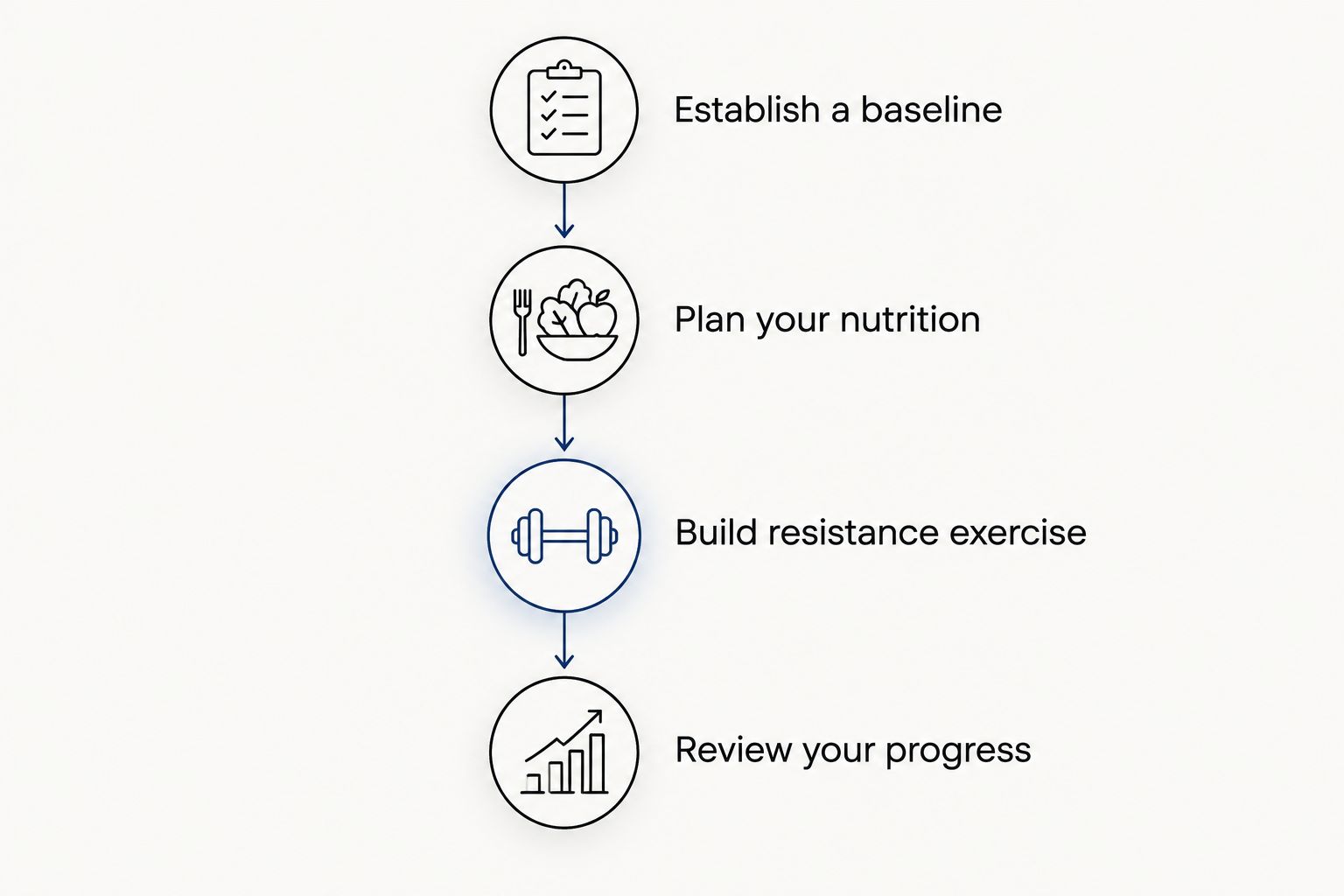
Use this sequence to build a plan with your prescribing clinician:
- Establish a baseline. Discuss your usual meals, current activity, recent weight changes and any difficulty standing, walking or lifting. Include injuries, kidney disease and other conditions that affect nutrition or exercise recommendations.
- Plan your nutrition. Identify protein-containing foods you tolerate and a practical way to maintain adequate overall intake when your appetite is lower. Ask whether a registered dietitian would help.
- Build resistance exercise. Choose movements appropriate to your ability, then increase the challenge gradually. Get guidance if you are unfamiliar with strength training or have balance, joint or mobility limitations.
- Review your progress. Bring changes in appetite, gastrointestinal symptoms, strength and daily function to follow-up visits. Your clinician determines whether the treatment plan needs adjustment.
These steps are educational, not a personalized prescription. A person recovering from an injury needs a different starting point from someone who already trains regularly.
Choose activity for its specific purpose
Resistance exercise and aerobic activity both matter, but they do different jobs. The comparison below describes general activity choices, not a ranking of treatment programs.
| Activity | Best for | Main benefit | Limitation or caution |
|---|---|---|---|
| Resistance exercise | Building or maintaining strength | Challenges muscles against resistance | Requires suitable technique and progression; injuries can limit exercise selection |
| Walking | Accessible aerobic movement | Supports cardiovascular activity and daily movement | Does not replace a progressive resistance program |
| Cycling or swimming | Aerobic exercise with less impact | Offers alternatives when impact is uncomfortable | Does not provide the same strength-training stimulus as resistance exercise |
Use resistance exercise for strength and aerobic activity for cardiovascular health. Choose activities you can perform safely and repeat consistently rather than trying to make one activity serve every purpose.
How much strength training should you do during GLP-1 weight loss?
At least 2 days per week of muscle-strengthening activity is the general adult guideline, not an individualized starting requirement. The U.S. Department of Health and Human Services’ Physical Activity Guidelines for Americans, second edition, recommends strengthening activities involving all major muscle groups on at least 2 days per week.
For a 2026 strength plan, ask how that guideline fits your current ability. Someone new to exercise, recovering from surgery or experiencing significant weakness needs an appropriate starting point rather than an abrupt jump into demanding workouts.
Resistance can come from weights, machines, resistance bands or body-weight movements. The useful feature is that muscles work against a challenge—not that you own a particular piece of equipment. Exercise selection should account for pain, balance and technique.
Keep a simple record of the movements you perform and whether they become easier or harder. Declining performance deserves attention, particularly when it occurs alongside poor intake, dizziness or persistent fatigue. Do not train through concerning symptoms to satisfy a weekly target.
Does walking replace strength training?
Walking does not replace muscle-strengthening activity. It contributes to aerobic activity and supports a less sedentary routine, but it does not challenge all major muscle groups in the same way as resistance exercise.
The same federal guidelines recommend 150 minutes per week of moderate-intensity aerobic activity, or 75 minutes per week of vigorous-intensity activity, for substantial health benefits in adults. These are general public-health targets; your clinician can help you adapt them to your health and fitness.
Walking remains useful even when you cannot yet meet those targets. Build from your current ability and keep strength work as a separate part of the plan when medically appropriate.
How should you eat to support muscle during GLP-1 weight loss?
Adequate protein matters, but adequate total nutrition matters too. A protein-focused diet that leaves you consistently underfed does not solve the broader problem of insufficient intake.
GLP-1 treatment can reduce appetite and make you feel full sooner. Nausea, vomiting or other gastrointestinal symptoms can make eating harder. Plan around what you tolerate, and tell your clinician when symptoms prevent normal eating or drinking.
For your 2026 food plan, focus on practical habits:
- Include a protein-containing food in meals you can tolerate, such as eggs, fish, poultry, dairy, beans, lentils or tofu.
- Keep room for other foods that provide energy, fiber and essential nutrients.
- Use smaller eating occasions if larger meals are uncomfortable, rather than repeatedly skipping food.
- Discuss ongoing poor intake with your clinician instead of treating it as proof that medication is working well.
- Ask for individualized nutrition advice if you have kidney disease, dietary restrictions or a history of disordered eating.
There is no single protein target appropriate for every reader. Body size, kidney function, nutritional status and activity affect the recommendation. A clinician or registered dietitian can translate those factors into a practical eating plan without relying on a generic online target.
Are protein supplements necessary?
Protein supplements are not automatically necessary during GLP-1 weight loss. Food can supply protein, and a supplement is a convenience option when it helps meet an identified nutritional need.
A supplement also has limits: it does not replace a varied diet, resistance exercise or medical evaluation of weakness. Review the ingredient list and discuss suitability with your clinician, especially if you have kidney disease, food allergies or difficulty tolerating supplements.
Why your muscle-health plan varies
A useful plan responds to your health rather than applying the same exercise and nutrition instructions to everyone. Discuss these factors before adopting an aggressive routine:
- Starting strength and mobility: Current ability determines which movements are safe and practical.
- Appetite and gastrointestinal symptoms: Reduced intake or persistent symptoms can interfere with adequate nutrition.
- Medical conditions: Kidney disease and other health problems affect nutrition advice and exercise planning.
- Injuries and balance: Joint pain, recent injury or unsteadiness changes exercise selection and supervision needs.
- Changes in function: New difficulty with usual activities warrants assessment even when weight is decreasing.
These factors explain why personalized follow-up matters. They do not establish a medication choice or predict an individual outcome. Prescribing decisions require an assessment of your medical history, treatment response and risks.
How do you know whether you are losing muscle?
A lower scale reading cannot tell you how much muscle you have lost. Body weight reflects fat, lean tissue and fluid, so interpreting a change requires more context.
Lean mass and skeletal muscle are not interchangeable terms. Lean mass includes nonfat tissues and body water; a reported decrease in lean mass is not automatically an equal decrease in skeletal muscle. Hydration and measurement methods also affect body-composition results.
For a 2026 follow-up plan, bring observations your clinician can interpret together:
- Whether getting out of a chair or climbing stairs has become harder.
- Whether familiar resistance exercises feel more difficult.
- Whether fatigue or dizziness limits normal activity.
- Whether you are regularly missing meals or struggling to drink enough.
- Whether body-composition measurements were taken under comparable conditions.
Your clinician can decide whether an examination, nutrition assessment or testing is appropriate. Do not diagnose muscle loss from a home scale alone, and do not assume that weakness is simply an expected part of weight loss.
When should you contact your prescribing clinician?
Contact your clinician when persistent nausea, vomiting, poor intake or new weakness interferes with everyday activity. These symptoms need assessment rather than an instruction to push harder with exercise or restrict food further.
Seek prompt medical care for severe or persistent abdominal pain, inability to keep fluids down, fainting or signs of significant dehydration. Use emergency services for severe symptoms; a routine telehealth appointment is not a substitute for emergency care.
Before treatment, review side effects to discuss before GLP-1 weight loss. Ask your prescriber which symptoms require routine contact, prompt assessment or emergency care. Do not change medication dosing on your own in response to appetite or exercise performance.
What should you ask at a muscle-focused consultation?
A useful consultation connects your weight goal with nutrition, physical function and a follow-up plan. Bring your medication list, relevant medical history and a description of your current eating and activity patterns.
Ask questions that lead to practical decisions:
- What should I track besides body weight?
- Is my current food intake adequate for my health needs?
- Do I need a dietitian or supervised exercise guidance?
- Which symptoms should trigger contact before my next appointment?
- How will we review strength, tolerability and treatment progress?
Bainshealth emphasizes personalized care, continuity with the same provider and direct provider access. Those features support discussion of changing appetite, symptoms and activity without promising a response time or guaranteed appointment.
Bainshealth is a self-pay practice and does not currently accept insurance. Ask for clear pricing and an explanation of what you would pay the practice directly; do not assume that medication, laboratory testing or other services are included. A consultation helps establish suitability, but it does not guarantee a prescription or a particular result.
Discuss your muscle-health plan
Review nutrition, activity and follow-up needs during a personalized weight loss consultation.
FAQ
Can you prevent all muscle loss during GLP-1 weight loss?
No treatment plan guarantees that you will prevent all muscle loss during GLP-1 weight loss. Resistance exercise, adequate nutrition and clinical follow-up support muscle health, but individual outcomes differ.
How often should I strength train while taking a GLP-1 medication?
At least 2 days per week is the general adult muscle-strengthening guideline from the U.S. Department of Health and Human Services. Your starting routine needs to reflect your health, injuries and current ability.
Is walking enough to protect muscle during weight loss?
Walking does not replace resistance exercise for muscle strengthening. Use walking for aerobic activity and discuss a separate strength-training plan appropriate to your ability.
How much protein should I eat during GLP-1 weight loss?
Your protein target should be individualized rather than taken from a universal online recommendation. A clinician or registered dietitian should consider your body size, kidney function, nutritional status and activity.
Does a body-composition scale show exactly how much muscle I have lost?
A home body-composition scale does not show exactly how much skeletal muscle you have lost. Its estimates require interpretation, and changes in hydration can affect the result.
What should I do if I feel weak during GLP-1 treatment?
New or worsening weakness should be discussed with your clinician, especially when it affects daily activities or accompanies poor intake. Seek prompt care for fainting, inability to keep fluids down or severe symptoms.
Does Bainshealth accept insurance for weight loss care in 2026?
Bainshealth operates as a self-pay practice and does not currently accept insurance. Patients pay the practice directly and should confirm the costs and scope of their care before treatment.
One last thing
Choose a functional goal alongside your weight goal. Being able to rise from a chair comfortably, carry groceries or maintain familiar exercise performance gives your follow-up conversation a concrete purpose beyond the scale.
Weight loss and muscle health are related, but they are not the same outcome. Bring changes in function to your provider even when the weight trend looks favorable.