

Best for personalized self-pay care: Bainshealth; best for remote follow-up: an established telehealth provider; best when you need a physical examination: in-person primary care. For a tirzepatide online prescription in 2026, choose a licensed clinician who evaluates eligibility, explains risks and provides follow-up—not a checkout process that promises medication before assessment.
- Bainshealth is a fit for patients seeking personalized, self-pay GLP-1 medical weight loss care.
- A tirzepatide online prescription requires clinical evaluation; an online appointment does not guarantee prescribing.
- Telehealth supports remote consultations; in-person care provides a physical examination when needed.
- Choose specialist assessment when your medical history or treatment needs require additional expertise.
Why this matters
The best way to start GLP-1 treatment depends on your medical history, the assessment you need and how you will receive ongoing care. The appointment format matters less than the clinical plan. A convenient first visit is not enough if you do not know who handles side effects or reassesses treatment.
Bainshealth provides personalized medical weight loss services and confirms prescribing both semaglutide and tirzepatide. The practice operates on a self-pay basis: patients pay the practice directly, and it does not currently accept insurance. A consultation determines whether treatment is appropriate; it is not a promise of a prescription.
For prospective patients in California and Oregon, confirm that the clinician can treat you in the state where you will physically attend the appointment. An online service's presence in search results does not establish that eligibility.
What makes the best GLP-1 treatment pathway?
Use these criteria before comparing appointment formats or choosing a provider in 2026:
- Clinical assessment: The clinician reviews your goals, health conditions, medications and previous weight-management treatment before recommending medication.
- Appropriate examination: The pathway allows an in-person assessment when symptoms or clinical findings require one.
- Provider continuity: You know who manages follow-up and whether you can continue with the same clinician.
- Direct access: You receive clear instructions for contacting the provider about treatment questions, without assuming immediate responses.
- Transparent self-pay terms: You understand which services are included and which expenses are separate before committing.
- Safety planning: The clinician explains side effects, warning signs and what happens if treatment is unsuitable or needs to stop.
Choose the care pathway that can complete your assessment and support follow-up, not simply the one that makes prescribing sound easiest.
GLP-1 treatment pathways at a glance
These options are care pathways, not a ranking of competing clinics. The right choice changes when you need an examination, specialist input or closer coordination with existing care.
| Option | Best for | Standout feature | Key limitation |
|---|---|---|---|
| Bainshealth personalized care | Patients seeking individualized self-pay treatment | Same-provider continuity and direct provider access | Patients pay the practice directly; prescribing remains individualized |
| Established-provider telehealth | Remote follow-up when an examination is unnecessary | Consultation without attending a clinic in person | Cannot complete a hands-on physical examination |
| In-person primary care | Patients who need an initial physical assessment | Examination and review of broader health concerns | Requires attendance at a clinical location |
| Obesity medicine or endocrinology assessment | Patients needing specialist evaluation | Focused assessment of complex weight or metabolic concerns | Does not replace coordination with your other clinicians |
1. Bainshealth: best for personalized self-pay GLP-1 care
Bainshealth offers personalized medical weight loss care and prescribes semaglutide and tirzepatide when clinically appropriate. The practice emphasizes attentive individual care, continuity with the same provider, direct provider access and transparent pricing. Those features matter when your questions extend beyond getting an initial prescription.
The self-pay model is central to the decision. Ask what the consultation, follow-up, medication and laboratory arrangements involve rather than assuming that one payment covers every part of treatment. Do not treat possible future insurance acceptance as current coverage.
Bainshealth pros:
- Personalized assessment rather than an assumption that every patient needs the same medication.
- Continuity with the same provider during ongoing care.
- Direct provider access for questions, without a promised response time.
- An emphasis on explaining treatment costs before you proceed.
Bainshealth limitations:
- The practice does not currently accept insurance.
- A consultation does not guarantee medication eligibility or a prescription.
- Appointment format, state eligibility and included services need confirmation before booking.
Best for: Patients who want individualized, self-pay GLP-1 care and an ongoing relationship with their provider.
Verdict: Choose this route if personalized continuity and direct payment fit your needs. Confirm the clinical and financial arrangements before starting.
2. Established-provider telehealth: best for remote follow-up
Telehealth lets you discuss symptoms, medication history, treatment goals and side effects remotely. It is a practical route when the clinician can make the required assessment without a hands-on examination and has access to the information needed for prescribing.
An established provider relationship gives the consultation context. Your clinician can review previous findings and decide whether remote care is sufficient or an examination is necessary. Video access alone does not make every patient suitable for online treatment.
Established-provider telehealth pros:
- Removes the need to travel for consultations completed remotely.
- Supports discussion of side effects and treatment progress.
- Allows review of existing records when those records are accessible.
- Fits ongoing care when the same clinician remains involved.
Established-provider telehealth limitations:
- Does not provide a hands-on examination.
- Requires the clinician to be authorized to treat you where you are located.
- Laboratory work or an in-person assessment can still be necessary.
Best for: Patients whose assessment and follow-up can be completed remotely with an established clinician.
For a tirzepatide online prescription in 2026, verify the provider's licensure, follow-up process and instructions for escalating symptoms. Verdict: Choose telehealth when the clinician confirms that remote assessment is sufficient; hold if an examination is needed.
3. In-person primary care: best when you need an examination
In-person primary care combines a medical history review with a physical examination. It is the direct route when symptoms need hands-on assessment or when weight treatment must be considered alongside other health concerns.
An existing primary care clinician can also place your weight-management goals within your broader care plan. That does not mean every primary care practice provides ongoing GLP-1 treatment. Ask whether the clinician manages this treatment or refers patients elsewhere.
In-person primary care pros:
- Provides a physical examination when clinically indicated.
- Creates an opportunity to assess symptoms that are difficult to evaluate remotely.
- Supports discussion of weight treatment alongside other medical conditions.
- Allows coordination with established primary care when you already have that relationship.
In-person primary care limitations:
- Requires travel and attendance at a clinical location.
- The practice's weight-management services need confirmation.
- A referral or separate treatment pathway can still be necessary.
Best for: Patients who need an examination, have unexplained symptoms or want an initial assessment within existing primary care.
Verdict: Choose in-person primary care when examination findings could change the treatment decision. Do not bypass that assessment simply because an online appointment is available.
4. Specialist assessment: best for complex clinical questions
An obesity medicine clinician or endocrinologist can assess weight-management questions that require specialist expertise. This route is appropriate when your treating clinician identifies a need for additional evaluation, particularly around metabolic disease, uncertain diagnoses or complicated treatment decisions.
Specialist assessment is not automatically necessary for everyone seeking GLP-1 treatment. The reason for referral should be specific. Ask what question the specialist will answer and who will manage treatment afterward.
Specialist assessment pros:
- Provides focused evaluation of weight or endocrine concerns.
- Supports decisions when previous treatment has been difficult to manage.
- Helps address diagnostic questions before medication selection.
Specialist assessment limitations:
- Still requires communication with clinicians managing your other conditions.
- Does not guarantee that tirzepatide is the appropriate treatment.
- Adds another care relationship unless responsibilities are clearly defined.
Best for: Patients whose clinical history or treatment needs warrant specialist input.
Verdict: Choose specialist assessment when there is a defined clinical question; skip an unnecessary referral when your existing clinician can safely manage care.
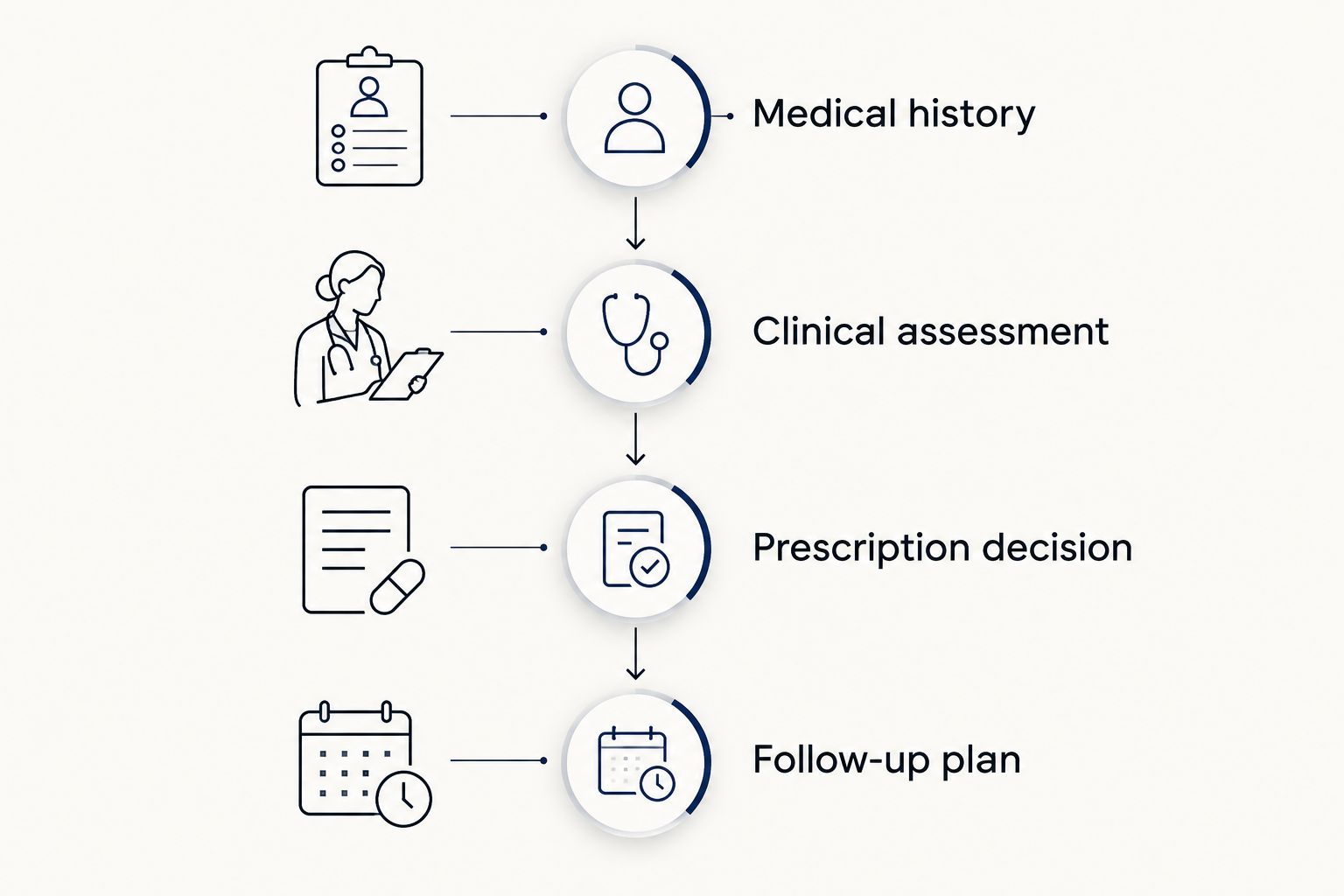
What should happen before a prescription?
Whether your 2026 consultation is online or in person, the decision should follow a clinical assessment. Completing a questionnaire is information gathering, not proof that medication is appropriate.
Medical history
Prepare your medication list, relevant diagnoses, previous weight-management treatments and treatment goals. Include supplements and any other weight-loss medication. Tell the clinician about pregnancy plans, breastfeeding, previous pancreatitis, gallbladder problems and significant digestive symptoms.
Clinical assessment
For adults, FDA-approved chronic weight-management indications for tirzepatide include a body mass index of 30 kg/m² or greater, or 27 kg/m² or greater with at least one weight-related condition. These thresholds describe labeled eligibility, not an automatic prescribing decision. Other indications and individual health considerations require separate assessment.
Body mass index is weight relative to height. It does not directly measure body composition, so discuss the broader clinical picture rather than treating a single calculation as the entire evaluation.
Prescription decision
The clinician determines whether medication fits your health history and goals. Tirzepatide acts on GIP and GLP-1 receptors; semaglutide acts on GLP-1 receptors. Both require individualized prescribing decisions, and neither should be selected solely because it appears in an advertisement.
Follow-up plan
Know who reviews your progress, how to report side effects and when your treatment will be reassessed. Ask how the clinician evaluates nutrition, hydration and tolerability alongside weight change. Do not change medication use without your prescriber's guidance.
Risks to discuss before starting treatment
GLP-1-based treatments can cause nausea, vomiting, diarrhea and constipation. Persistent symptoms deserve clinical review, particularly if you cannot maintain hydration. A treatment plan should explain how to contact the prescriber and which symptoms require urgent evaluation.
FDA prescribing information for tirzepatide includes warnings about pancreatitis, gallbladder disease and severe gastrointestinal adverse reactions. Low blood sugar risk increases when treatment is combined with certain diabetes medications, including insulin or sulfonylureas. Give the clinician your complete medication list.
Tirzepatide is contraindicated for people with a personal or family history of medullary thyroid carcinoma or multiple endocrine neoplasia syndrome type 2. Discuss pregnancy plans and oral contraception before treatment. Tell procedural and anesthesia teams about treatment because delayed stomach emptying matters for procedure planning.
Seek urgent medical evaluation for severe, persistent abdominal pain or other serious symptoms; do not wait for a routine telehealth follow-up. This article provides general education, not personalized prescribing advice.
Compare self-pay terms before committing
For a 2026 treatment decision, request a clear explanation of each expense and what happens if the clinician does not prescribe medication. A consultation charge, follow-up arrangement and medication expense are different parts of care. Ask about each separately.
Use these questions to compare providers:
- What does the initial assessment include?
- Which follow-up services are included, and which are separate?
- How are medication and laboratory expenses handled?
- What financial commitment applies if treatment is unsuitable?
- What are the terms for changing or ending ongoing care?
Bainshealth is a self-pay practice, not an insurance-billing option. Do not assume reimbursement, medication coverage or eligibility to use a particular health spending account. If you investigate insurance benefits elsewhere, keep that discussion separate from what the practice charges directly.
Discuss your treatment options
Ask about eligibility, follow-up and self-pay terms before starting GLP-1 treatment.
How these pathways are ranked
This guide ranks care pathways by clinical assessment, examination access, provider continuity, communication, payment clarity and safety planning. It does not claim that one appointment format produces better weight-loss outcomes. No outcome comparison is needed to decide whether you require an examination or want an established provider relationship.
Which GLP-1 treatment pathway should you choose?
Start with the clinician who can complete your assessment and remain responsible for follow-up. Choose remote care when the clinical assessment supports it. Choose in-person care when an examination is needed, and specialist care when a defined medical question requires additional expertise.
For personalized self-pay treatment, Bainshealth is a fit for patients who prioritize same-provider continuity and direct access. Before booking, confirm your location eligibility, appointment format and financial terms. That turns a search for medication into an informed care decision.
FAQ
Can I get a tirzepatide online prescription?
A licensed clinician can prescribe tirzepatide through telehealth when the evaluation supports treatment and applicable requirements are met. An online consultation does not guarantee a prescription, and an examination or additional testing can be necessary.
Is telehealth better than an in-person visit for GLP-1 treatment?
Telehealth is a practical choice when the necessary assessment can be completed remotely; in-person care is the better route when you need a physical examination. Choose based on clinical needs and follow-up arrangements, not appointment format alone.
Does the practice prescribe semaglutide and tirzepatide?
The practice confirms prescribing both semaglutide and tirzepatide. The clinician determines which treatment, if any, is appropriate after an individualized assessment.
Does the practice accept insurance for weight loss treatment?
The practice currently operates on a self-pay basis and does not accept insurance. Patients pay the practice directly; future plans to accept insurance do not change the current arrangement.
How much does online GLP-1 treatment cost?
Request the current consultation, follow-up, medication and laboratory terms from the provider. Do not assume that a stated program fee includes every treatment-related expense.
Who qualifies for tirzepatide for weight management?
FDA-approved adult chronic weight-management indications include a BMI of at least 30 kg/m², or at least 27 kg/m² with a weight-related condition. Meeting a threshold does not replace assessment of contraindications, risks and individual treatment needs.
Can I start treatment while living in California or Oregon?
Confirm that the clinician is authorized to treat patients in the state where you will physically attend the appointment. Do not assume that a website or remote booking option establishes eligibility in both states.
What should I ask before booking a consultation?
Ask who manages your care, whether an examination is needed, how follow-up works and what you pay directly. Also ask how to contact the provider about side effects and what happens if medication is unsuitable.
One last thing
Ask what the provider relationship includes beyond weight-management prescribing. Established patients at the practice may see their own provider for minor ailments or work-note requests up to twice a year, when clinically appropriate. That is a defined continuity benefit—not unlimited primary care, urgent care, a guaranteed work note or a promise of no-cost visits.
Before starting treatment in 2026, save the provider's contact instructions and symptom-escalation plan somewhere accessible. Knowing what to do between appointments is part of choosing care, not an administrative detail to postpone.