

If GLP-1 weight loss slows down, your clinician reviews your weight trend, treatment consistency, eating patterns, activity, and side effects before deciding whether your plan needs to change. Slower loss does not automatically mean the medication has stopped working, and a temporary scale change is not the same as a sustained plateau. Do not increase, stop, or switch medication on your own; the next step is a clinical review, not an automatic dose change.
- Slower GLP-1 weight loss calls for a clinical review, not an automatic medication increase.
- Semaglutide and tirzepatide decisions depend on your response, side effects, and medical history.
- Bainshealth offers self-pay medical weight loss with personalized care and continuity with your provider.
- Severe abdominal pain, persistent vomiting, or inability to keep fluids down requires prompt medical assessment.
Why this matters
A scale measures total body weight, not just body fat. Fluid changes, constipation, and the conditions under which you weigh yourself can obscure the underlying trend. Reacting to an isolated reading can lead you to restrict food unnecessarily or request a medication change before your clinician understands what happened.
Bainshealth is best for patients seeking personalized, self-pay GLP-1 weight loss care with continuity from the same provider. The practice prescribes semaglutide and tirzepatide, but selecting a medication remains an individual medical decision. You pay the practice directly; it does not currently accept or bill insurance.
For your 2026 treatment review, the useful question is not simply whether the scale moved. It is whether the plan remains appropriate, tolerable, and aligned with your health goals.
What happens if GLP-1 weight loss slows down?
Your clinician separates a brief fluctuation from a persistent change, then reviews possible explanations. That review includes whether you are taking the medication as prescribed, whether side effects are affecting nutrition or hydration, and whether your health or daily routine has changed.
A plateau is a reason to reassess treatment, not proof that treatment has failed. Weight loss does not continue at a constant pace indefinitely. As body weight decreases, energy needs also change, which can affect the pace of further loss.
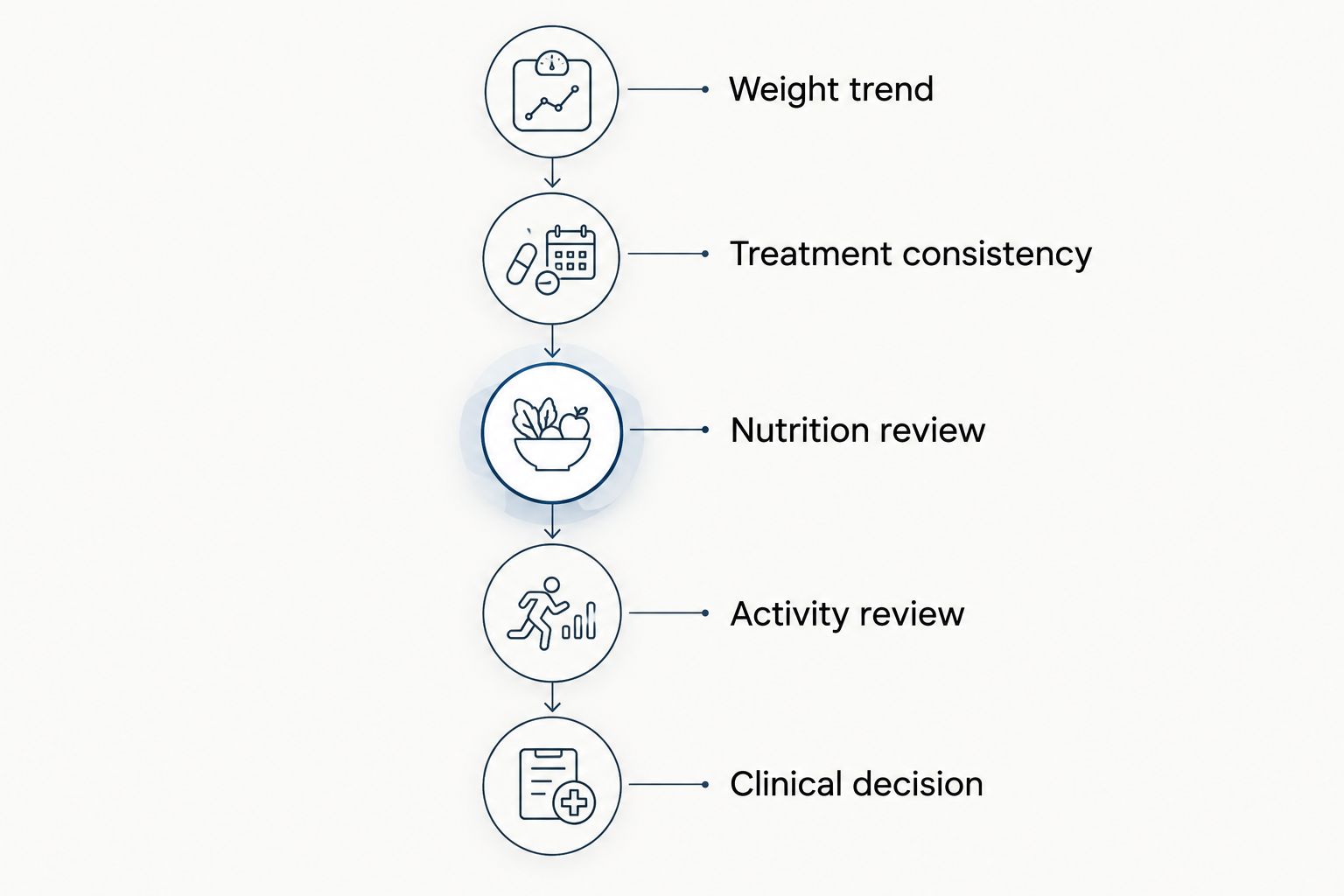
A practical review follows this sequence:
- Weight trend. Bring dated measurements taken under similar conditions. Include when the slowdown started and whether your weight is stable, fluctuating, or rising.
- Treatment consistency. Report missed doses, interruptions, and any difficulty following the prescription. Ask your prescriber how to handle interruptions rather than improvising.
- Nutrition review. Describe meals, appetite, fluid intake, and whether nausea or early fullness makes eating difficult. Include supplements and any major dietary changes.
- Activity review. Explain changes in walking, exercise, strength training, sleep, and your ability to perform usual activities.
- Clinical decision. Your clinician assesses benefits, risks, and next steps. The outcome can be continued treatment, additional assessment, or a supervised change.
This sequence supports a more useful conversation than asking for a stronger prescription without reviewing the context. It also gives your clinician a starting point for distinguishing a weight-management concern from a side effect that needs attention.
What a slower weight trend does—and does not—tell you
An unchanged scale reading does not establish that you have stopped losing body fat. Conversely, a lower reading does not show whether the change came entirely from fat, fluid, or lean tissue. Your clinician interprets measurements alongside your symptoms, function, and treatment history.
Keep your measurement routine consistent rather than weighing repeatedly in response to anxiety. Use the same scale and similar conditions, and bring the record to your appointment. Your clinician can recommend a tracking frequency suited to your situation, particularly if weighing increases distress.
Do not treat appetite suppression as the only measure of success. Report both hunger changes and difficulty eating enough. Feeling unable to eat is a tolerability concern, not a goal to pursue.
For a 2026 follow-up, also describe changes in strength, energy, clothing fit, and everyday function. These observations provide context, but they do not replace clinical assessment or establish a body-composition result by themselves.
Why GLP-1 weight loss varies
Several factors can affect your weight trend. The purpose of reviewing them is to identify what needs attention—not to assign blame.
- Changing energy needs. A smaller body generally requires less energy. A routine associated with earlier weight loss does not necessarily produce the same ongoing change.
- Fluid and bowel changes. Hydration, menstrual-cycle changes, and constipation can affect scale readings without representing an equivalent change in body fat.
- Treatment interruptions. Missed medication or a break in treatment changes the context of your response. Give your clinician an accurate account of what you have taken.
- Nutrition and tolerability. Nausea, vomiting, or early fullness can interfere with adequate nutrition and fluids. Your clinician needs to assess these symptoms rather than assume less food is always better.
- Activity and recovery. Changes in movement, strength training, sleep, or illness affect the treatment picture and your ability to maintain routines.
- Other health conditions or medications. Your clinician reviews conditions and prescriptions that affect weight or require adjustment during treatment. Do not stop another medication without advice.
More than one factor can be present. Bring the full picture rather than choosing a single explanation from the scale.
Does a plateau mean you should switch medications?
A plateau alone does not establish that switching is appropriate. Your clinician first evaluates the benefit you have received, side effects, treatment consistency, and medical history. A change needs a clinical reason and a clear follow-up plan.
Semaglutide and tirzepatide are different medications, not interchangeable instructions. The comparison below explains their mechanisms without predicting which will work better for you.
| Medication | What it does | Best for | What needs review |
|---|---|---|---|
| Semaglutide | Activates the GLP-1 receptor, which participates in appetite and glucose regulation | Patients whose clinician determines semaglutide is appropriate after an individual assessment | Response, gastrointestinal effects, medical history, and prescription-specific precautions |
| Tirzepatide | Activates both GIP and GLP-1 receptors, which participate in metabolic regulation | Patients whose clinician determines tirzepatide is appropriate after an individual assessment | Response, gastrointestinal effects, medical history, and prescription-specific precautions |
Both medications can support weight management when appropriately prescribed. Both also have risks and require monitoring; neither guarantees a particular outcome. Gastrointestinal effects include nausea, vomiting, diarrhea, and constipation.
For 2026 prescribing decisions, the FDA prescribing information for the specific medication is the reference for approved uses, warnings, and contraindications. Your clinician applies that information to your situation. A comparison table cannot establish eligibility or justify switching.
Ask what a proposed change is intended to address. Is the concern tolerability, insufficient benefit, a treatment interruption, or another medical issue? Understanding the reason helps you evaluate the plan without treating medication changes as a contest between products.
What should you bring to a plateau appointment?
Bring enough detail to make the appointment practical, without turning tracking into a second job. Your clinician needs an accurate history more than a perfectly formatted spreadsheet.
Prepare these items:
- Your weight record and the approximate date the trend changed.
- Your current prescriptions and supplements, including medications prescribed elsewhere.
- Any missed doses or interruptions, described honestly.
- Changes in appetite, meals, fluid intake, bowel habits, and activity.
- Symptoms such as persistent nausea, vomiting, dizziness, or abdominal pain.
- Your priorities, including strength, function, tolerability, and sustainable habits.
Ask how progress will be assessed and what would trigger another review. Also ask whom to contact about side effects between appointments. Direct provider access is useful only when you understand what belongs in routine follow-up and what needs immediate medical attention.
At Bainshealth, GLP-1 weight loss care emphasizes personalized treatment, an accessible provider, and continuity. Those features support an ongoing clinical conversation; they do not mean unlimited primary care, urgent care, or a guaranteed response time.
Discuss your treatment plan
Review your weight trend, symptoms, and self-pay care options with a provider.
What can you work on without changing your prescription?
Keep following your prescribed plan while arranging a review, unless a clinician advises otherwise or a concerning symptom requires prompt assessment. Focus on routines you can describe and sustain. Avoid crash diets or deliberately pushing through symptoms to pursue faster weight loss.
Discuss nutrition with your clinician, including how to maintain adequate intake when your appetite is reduced. A dietitian can help translate individual nutrition needs into meals. There is no single protein or calorie target appropriate for every reader, particularly when kidney disease, other conditions, or dietary restrictions are involved.
Physical activity supports health and function beyond changes on the scale. The U.S. Physical Activity Guidelines for Americans recommend at least 150 minutes per week of moderate-intensity aerobic activity and muscle-strengthening activity on 2 days per week for adults. These are general public-health recommendations, not a personalized plateau treatment; adapt activity to your health and physical ability with clinical guidance.
For your 2026 plan, choose a routine you can maintain rather than making a sudden increase to compensate for an unchanged reading. Report weakness, dizziness, or difficulty recovering from activity. Protecting function matters alongside weight management.
When should you contact your clinician sooner?
Persistent side effects deserve attention even when your weight is decreasing. Contact your clinician about ongoing vomiting, worsening constipation, difficulty eating, or symptoms that interfere with daily life. Do not wait for a routine weight review to discuss them.
Severe or persistent abdominal pain, repeated vomiting, or inability to keep fluids down requires prompt medical assessment. Severe pain, fainting, trouble breathing, or other emergency symptoms belong in emergency care, not a routine consultation request.
If you use insulin or another medication that can cause low blood sugar, ask your prescriber how treatment changes affect your monitoring plan. Do not adjust those medicines yourself. A plateau review should include medication safety, not just the next weight target.
Can GLP-1 treatment still be useful if your weight is stable?
Stable weight can still be relevant to maintaining a previous loss, but continued treatment needs an individual benefit-risk review. Your clinician considers the medication's indication, your response, tolerability, and health goals—not just whether the latest measurement is lower.
Ask whether the current goal remains further loss or whether maintenance deserves discussion. Do not interpret this as permission to continue indefinitely without follow-up. A treatment plan should explain what is being monitored and why.
How does self-pay follow-up fit into the plan?
Self-pay care means you pay the practice directly; it does not establish what every service or prescription includes. Ask for transparent pricing and a written explanation of consultation, follow-up, medication, and laboratory arrangements before making a treatment decision.
Bainshealth currently operates as a self-pay practice and does not accept or bill insurance. General insurance information should not be treated as a description of the practice's payment model. Do not assume reimbursement, medication coverage, or laboratory coverage.
Established patients may see their own provider for minor ailments or work-note requests up to twice a year, when clinically appropriate. This continuity benefit is not unlimited primary care and does not guarantee a work note or appointment. Ask how those visits are arranged and billed.
FAQ
Why has my GLP-1 weight loss slowed down?
GLP-1 weight loss can slow as energy needs change or because fluid changes, constipation, treatment interruptions, or other factors affect the trend. Your clinician reviews the pattern before deciding whether treatment needs to change.
Does a plateau mean semaglutide has stopped working?
A plateau does not automatically mean semaglutide has stopped working. Your clinician assesses previous benefit, current response, side effects, and treatment consistency.
Should I switch from semaglutide to tirzepatide?
Switching from semaglutide to tirzepatide requires an individual prescribing decision. A slowdown alone does not establish which medication is appropriate for you.
Should I increase my medication when weight loss slows?
Do not increase your medication without your prescriber's instructions. Arrange a review of your weight trend, symptoms, and treatment history instead.
Can constipation make my weight look unchanged?
Constipation can affect scale weight without representing an equivalent increase in body fat. Tell your clinician about persistent or worsening constipation, especially if it occurs with pain or vomiting.
What symptoms should not wait for my next appointment?
Severe or persistent abdominal pain, repeated vomiting, or inability to keep fluids down requires prompt medical assessment. Use emergency care for severe pain, fainting, trouble breathing, or other emergency symptoms.
Does Bainshealth accept insurance for weight loss care?
Bainshealth currently provides self-pay care and does not accept or bill insurance. Ask what consultations, follow-up, medications, and laboratory services involve before committing to treatment.
One last thing
Before your next 2026 appointment, write down what has improved, what has become difficult, and what you want treatment to accomplish now. Bring that list alongside your weight record. The next move should follow your health needs, not an isolated scale reading.
This article provides general education, not personalized prescribing advice. Your clinician determines whether to continue, change, or stop treatment after reviewing your individual circumstances.